
AI Agents for Trend Analysis: What They Do for Marketing
AI agents for trend analysis watch the signals a marketing team can't check every day: which search queries are rising, how often AI answers cite you, what competitors changed, which ad patterns are working and which topics are surfacing in the sources you follow. The useful ones compare fixed windows, refuse to call a change real until it clears the noise, and hand a person the decision. Here's what each kind of trend looks like, and how DRIS and Nagent's other agents handle it.
What does trend analysis mean for a marketing team?
For most marketing teams, trend analysis isn't a forecasting model. It's a weekly answer to three questions:
What changed? In search demand, in AI answers, in competitors' moves, in creative, in the topics buyers care about.
Is it real? Or is it the normal week-to-week wobble in the data.
What should we do about it? Write something, fix something, test something, or nothing.
People are good at the third question and bad at the first two at scale. Nobody can read every Search Console query, ask every answer engine the same fifty questions each week, and scan competitors' pages and ads as well. That's the part agents can carry.
Which trends can AI agents track for marketing?
Trend: Search trends, What an agent watches: Rankings, clicks and impressions per query, against their own recent history, What it's good for: Spotting pages that are slipping and queries that are rising
Trend: AI answer trends, What an agent watches: How often ChatGPT, Claude, Gemini and others cite you, and your share against competitors, What it's good for: Seeing whether AEO work is landing
Trend: Competitor moves, What an agent watches: Competitors gaining citation share, newly cited, or changing tracked pages, What it's good for: Knowing when a rival is taking ground
Trend: Ad creative trends, What an agent watches: Competitor and category ads, broken down into what makes them work, and your own ad results, What it's good for: Choosing the next angle to test
Trend: Content topic trends, What an agent watches: New items from sites, accounts and news searches you follow, scored against your buyers, What it's good for: Writing about what's surfacing while it's still relevant
How do AI agents tell a real trend from noise?
This is the part that matters most, and where weak tools fail. A chart that wiggles every week trains a team to ignore it, or worse, to react to every wiggle. Good trend agents follow a few rules:
Compare against the same thing. A query's position against its own last seven days, this week's citation share against last week's, the same prompts asked the same way.
Require enough data. A change measured on a handful of answers isn't a trend. Set a minimum sample before reporting a movement.
Use ranges, not points. If the plausible ranges for two periods overlap, say "no clear change" rather than drawing an arrow.
Check whether everyone moved. If a whole category moved on the same day, it's probably a search engine change, not your page.
Wait for persistence. A rise that lasts one week is a blip. A rise sustained for two or more weeks is worth a look.
Don't confuse timing with cause. A change published the day before a jump may or may not have caused it. Mark it, don't claim it.
How do agents spot search and AI answer trends?
For search, an agent reads Search Console daily and compares each query with its own recent history: did its position move outside its normal band, did a different page start ranking for it, did impressions climb for weeks in a row. That turns thousands of rows into a short list worth reading.
For AI answers, there is no Search Console. An agent has to ask the engines a fixed set of buyer questions on a regular schedule, record which sources each answer cites, and track your share over time against the competitors you name. Because answers vary from run to run, the trend line is only meaningful if the prompt set stays fixed and changes are judged against the noise.
Can AI agents spot ad creative and content topic trends?
Yes, with a person in the loop.
Ad creative. An agent can collect competitor and category ads worth studying, break each down into its beats and what makes it work, and look for patterns across many ads, stated as a mechanism rather than a screenshot. On your own ads, it can read ad-level results and separate a weak angle from a weak execution of a good one. That's trend analysis for creative: which angles are rising in your category, and which of yours are tiring.
Content topics. An agent can watch the sites, accounts and news searches you choose, score each new item against your buyers and themes, and turn the strongest into draft topics. The value is speed: you hear about a topic while it's still being discussed, not a month later.
What can't AI trend agents do yet?
Be wary of any tool that claims to see everything. Common gaps:
Whole-network social listening. Tracking every mention of a brand across social networks is a different product from watching named accounts.
Causes. Agents are good at what moved and when. Why it moved still needs judgment.
Private data. An agent only sees what it's connected to or can read publicly.
How does Nagent handle trend analysis?
Nagent is multiplayer AI for growth: people and AI agents in one shared context, delivering the number. Trend analysis sits with the agents whose work it feeds.
DRIS: search and AI answer trends. DRIS leads organic visibility on the Marketing team and reports to MIRA, the AI Marketing Chief of Staff. In Search Console, his Rank movers list shows the queries whose position moved past their band against their own last seven days and the queries whose ranking page changed, and marks a move made on a day the whole category moved, which reads as weather rather than a page problem. Explain (Beta) asks AI to describe what moved, without changing the figures.
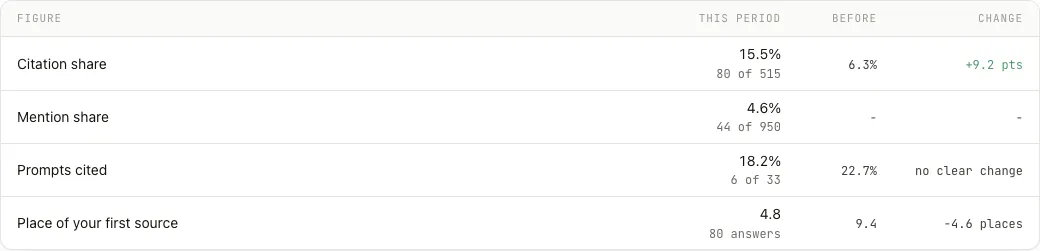
DRIS Analytics (Beta): AI answer trends. Analytics shows your citation share and mention share in AI answers, for you and each competitor on your list, and yours by engine, question, persona and intent. Each figure is set against the same length of time before it. A change is shown only when both periods hold at least eight answers and their 95% ranges no longer overlap; otherwise it reads no clear change. Dotted marks show the days changes were published, to read beside a movement, not as its cause.
Competitor moves. DRIS compares each competitor's last seven days with the seven before and flags a gain in citation share, a competitor newly cited, a tracked competitor page that changed materially, or a competitor now cited on more answer engines.
HOOK: ad creative trends (Beta). HOOK, the AI Ad Creative Strategy Lead, works through eight sub-agents. SCOUT finds the competitor and category ads worth studying for the swipe library, MINE mines it for what is working and why, and PULSE reads your ad-level performance from a connected Meta account or an uploaded export, separating a weak angle from a weak execution. HOOK makes read calls only on an ad account.
CREA: content topic trends (Beta). CREA, the AI Content Chief of Staff, watches the Sources you add: a site's feed or page, a LinkedIn, X, YouTube or Reddit account, or a news search for a market you choose. She scores each new item out of 100 against your buyers and themes, and an item above 80 is queued as a topic and drafted, up to five a day, into Review. Nothing is published without you.
What Nagent doesn't do: it has no Google Trends feed and no whole-network social listening. Where you need a trend workflow that isn't built, you can build an agent from one sentence in Agent Workbench (creating an agent) and connect hundreds of tools via Composio, plus your own API.
Frequently Asked Questions
What are AI agents for trend analysis?
They are AI agents that watch marketing signals on a schedule (search rankings, AI answer citations, competitor pages, ads and new content in your sources) and report what changed, judged against the normal noise, so a person can decide what to do.
Can AI agents predict marketing trends?
Not reliably. They are much better at detecting a change early and checking whether it is real than at forecasting one. Treat any prediction as a hypothesis to test.
How do AI agents avoid false trends?
By comparing fixed windows, requiring a minimum sample, using ranges rather than single points, checking whether a whole category moved, and waiting for a signal to persist before reporting it.
Can AI agents track AI search trends?
Yes. An agent asks answer engines like ChatGPT, Gemini and Perplexity a fixed set of buyer questions over time and tracks how often each answer cites you and your competitors.
Read the trend, then decide
Trend analysis pays when it is regular, judged against noise and tied to a decision. AI agents can carry the watching across search, AI answers, competitors, creative and content sources, and leave the judgment to your team. DRIS does that for search and AI answers, beside the rest of Nagent's growth team.
Book a demo to see DRIS track the trends in your own search and AI answer data.