
Best AI Tools for SEO Blogs That Sound Like Your Company

The best AI tools for SEO blogs that sound like your company are the ones grounded in your own content, not generic prompts. Tools that read your brand material before every draft, enforce tone parameters as structured inputs, and hold a person in the approval loop produce posts that sound like you. Speed is a side effect of good configuration. Brand voice is the primary test.
Why do most AI SEO blogs sound generic?

Most AI SEO blogs sound generic because the tool was never told who it is writing for or what the brand actually sounds like.
A topic and a keyword are not a brief. Hand an AI a headline and expect brand-aligned output, and you get something competent and completely interchangeable with your competitors. The output sounds like "content" rather than your company. That costs your editor two hours of rewrites, and it costs your readers the one thing that builds trust: a recognizable voice.
The root cause is not the model. It is the configuration. (1)
Teams that ship publish-ready posts define tone parameters, audience inputs, and review gates before the first word is generated. Teams that treat AI output as "raw material to fix" have skipped that step. (1)
What actually controls brand voice in an AI writing tool?

Brand voice in an AI writing tool is controlled by structured inputs, not by the prompt alone.
Most tools let you paste a style guide into a prompt box. That is prompt engineering, and it is the last mile, not the foundation. The foundation is a data and system design problem: where does the tool read from, what format does it expect, and what happens when the draft drifts from your voice? (3)
Three inputs do the real work:
Tone parameters. Register, sentence length, POV on industry topics, words you never use. These need to be labeled fields, not a paragraph of context.
Audience profile. Job title, seniority, primary pain, assumed knowledge level. A "SaaS content lead at a 30-person company" reads differently from "VP Marketing at a Series-C." The agent needs that distinction in writing. (1)
Source material. Your existing posts, your product pages, your brand guidelines. The tool should read these on every draft, not once during onboarding.
Structured inputs produce structured reasoning. Vague context produces vague content.
How do you evaluate the best AI tools for SEO blog brand voice?
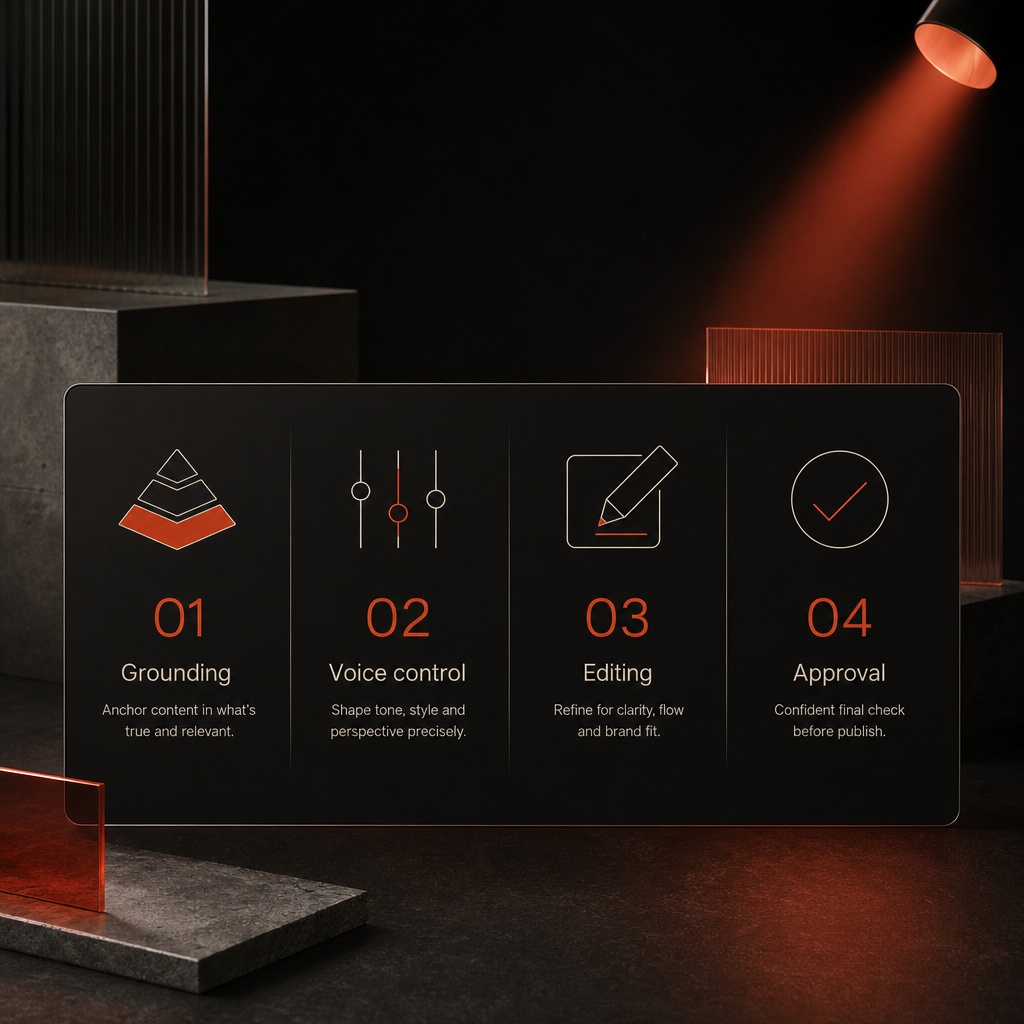
Evaluate AI tools for SEO blog brand voice on four criteria: grounding, voice control, editing, and approval. Rank them in that order.
Here is the checklist built for a content or SEO lead at a 20 to 200 person company. Enterprise feature lists are not the goal. Consistent, approvable output is.
1. Grounding: does the tool read your material?
The tool must pull from your own content on every generation run, not from a one-time upload. Ask the vendor: where does the agent read from before it drafts? If the answer is "the prompt," the brand voice is only as good as whoever wrote the prompt that day.
Look for: a knowledge base or content hub the agent actively reads, not a style guide field you fill in once.
2. Voice control: are tone parameters structured or freeform?
Freeform instructions degrade over a long document. Structured fields, sentence length, register, banned phrases, POV stance, hold across a 1,500-word post.
Look for: labeled tone fields, not a single "write in our brand voice" text box.
3. Editing: what stays human?
Some tasks are safely delegatable once configuration is solid. Others are not. Statistics need a human trace to a source before publish. Internal links need a human to verify they exist and are contextually relevant. CTAs need to match the conversion goal of that specific post, not a generic awareness-stage default. (1)
Look for: a tool that flags what it cannot verify rather than inventing plausible-sounding details.
4. Approval: does a person sign off before anything goes live?
This is the control point that separates a configured AI team member from an autonomous content machine. The approval gate is not a bottleneck. It is what keeps your brand voice from drifting at scale.
Look for: a workflow where proposals and drafts wait for human approval before publishing, not a "publish automatically" toggle.
Where does CREA fit in this evaluation?
CREA is Nagent's AI content team lead, and it fits at the intersection of grounding and voice control.
CREA reads from the Nagent Knowledge Hub, where your tone rules, brand guidelines, and audience profiles live as structured inputs rather than freeform prompts. Every draft pulls from that hub before a word is generated. (1)
On the editing side, CREA produces structurally sound drafts. A human editor handles the tasks that require judgment: verifying statistics, confirming internal links are real and relevant, and setting the CTA to match the specific conversion goal of that post. (1)
On approval, nothing goes live without a person signing off. Every proposal waits in a queue with its source and status visible. That queue is the practical difference between AI-assisted content and AI-controlled content. (3)
For a growth-stage team publishing consistently without a large editorial staff, that configuration matters more than raw generation speed.
What does a realistic workflow look like for a small content team?
A realistic AI-assisted blog workflow for a small team runs in roughly 30 minutes of human time per post, once configuration is complete. (1)
Initial setup takes most content teams 2 to 3 hours: defining tone parameters, building audience profiles, and establishing the review gates. That investment pays back within the first week of publishing. (1)
The workflow itself has three stages:
Brief. A human sets the topic, primary keyword, audience profile, and CTA goal as structured inputs. This takes 5 to 10 minutes and is not optional. It is the configuration step that makes the output publish-ready.
Draft. The agent generates against the brief, reading from the knowledge hub. The output includes a title, meta description, slug, and body. A human reviews for factual accuracy, link validity, and CTA alignment.
Approve. The draft sits in a queue until a person approves it. Nothing goes live on a timer.
The 60% time reduction comes from eliminating the rewrite loop, not from skipping review. (1)
What should a growth-stage team avoid when choosing an AI blog tool?
Growth-stage teams should avoid tools that optimize for volume over voice control.
The common failure mode is this: a team selects a tool based on output speed, publishes at high volume, and six months later the blog reads like it was written by a different company every week. The voice has drifted because no structured configuration was ever in place. (3)
Three things to avoid:
One-time style guide uploads. If the tool reads your brand guidelines once during setup and never again, voice drift is guaranteed as your brand evolves.
No approval gate. Autonomous publishing removes the human judgment that catches factual errors, off-brand CTAs, and invented internal links.
Freeform prompt fields as the only voice control. These degrade across a long document and across team members who write prompts differently.
The best AI tools for SEO blogs that sound like your company are not the fastest ones. They are the ones that hold configuration and human approval as non-negotiable constraints.
Related reading
Frequently Asked Questions
What makes an AI tool sound like your company rather than generic content?
The tool reads your own brand material, not a generic training set, on every draft. Structured tone parameters, audience profiles, and a knowledge base of your existing content are what separate a brand-aligned post from a generic one. Configuration before generation is the deciding factor, not the underlying model.
How long does it take to configure an AI blog tool for brand voice?
Initial configuration takes most content teams 2 to 3 hours, covering tone parameters, audience profiles, and review gates. (1) After that, each post runs in roughly 30 minutes of human time. The setup investment returns within the first week of consistent publishing.
Do AI-written SEO blogs rank on Google?
AI-written posts rank when they meet Google's E-E-A-T standards: factual accuracy, original insight, and clear authorship. A well-configured agent produces structurally sound drafts. A human editor adds the experience signals and source verification that satisfy those standards.
Should a human always approve AI blog content before it goes live?
Yes. The approval gate is what keeps brand voice consistent and factual claims accurate. Statistics need a human trace to a source, internal links need verification, and CTAs need to match the specific conversion goal of each post. (1) Removing that gate trades short-term speed for long-term brand damage.
What is the difference between prompt-based voice control and structured voice control?
Prompt-based voice control is a freeform instruction that degrades over a long document and varies by whoever writes the prompt. Structured voice control uses labeled fields, sentence length, register, banned phrases, POV stance, that the agent reads as data. (3) Structured inputs produce consistent output; freeform prompts produce inconsistent drafts that need heavy editing.
What should you do next?
If your blog sounds different every week, the configuration is the problem, not the tool. Book a session with the Nagent team to see how CREA reads from your own knowledge base and holds every draft in an approval queue before it goes anywhere near your site: book a demo.