
Top 10 GEO and AEO Tools to Get Your Brand Cited by ChatGPT (2026)
A GEO or AEO tool asks the answer engines the questions your buyers ask, records whether your brand is named and which pages are cited, and tells you what to change so you appear more often. The best ones in 2026 differ on one point: whether they stop at a dashboard, or turn each gap into a fix a person can approve.
Disclosure: Nagent makes DRIS, first on this list. The other nine are described from their own published claims and prices.
Two names, one job. Generative engine optimization (GEO) and answer engine optimization (AEO) both mean earning a place in the answer an assistant gives, rather than a position in a list of ten blue links. We use the terms interchangeably here, because the tools do. The hard part is not the measurement. The hard part is knowing which of two hundred findings moves the number you are measured on, and getting it live without an agent editing your site unsupervised.
How did we pick these tools?
Engine coverage: which assistants it asks, whether the prompts are recorded, and whether the prompt set is stable enough for a trend to mean something.
From finding to fix: does it stop at a report, or produce a ranked proposal with a reason, and can a person approve it without leaving the tool?
Control: what changes on your site without a person, how spend is capped, and whether the tool can roll a change back.
Classic search alongside: Search Console, site audit and ranked keywords in the same place, because the engines cite pages that already rank.
Value: what the entry price buys, and whether it is public.
Prices are the vendor's published figure where there is one, checked October 2026, and marked approximate otherwise.
What are the 10 best GEO and AEO tools in 2026?
1. Nagent DRIS
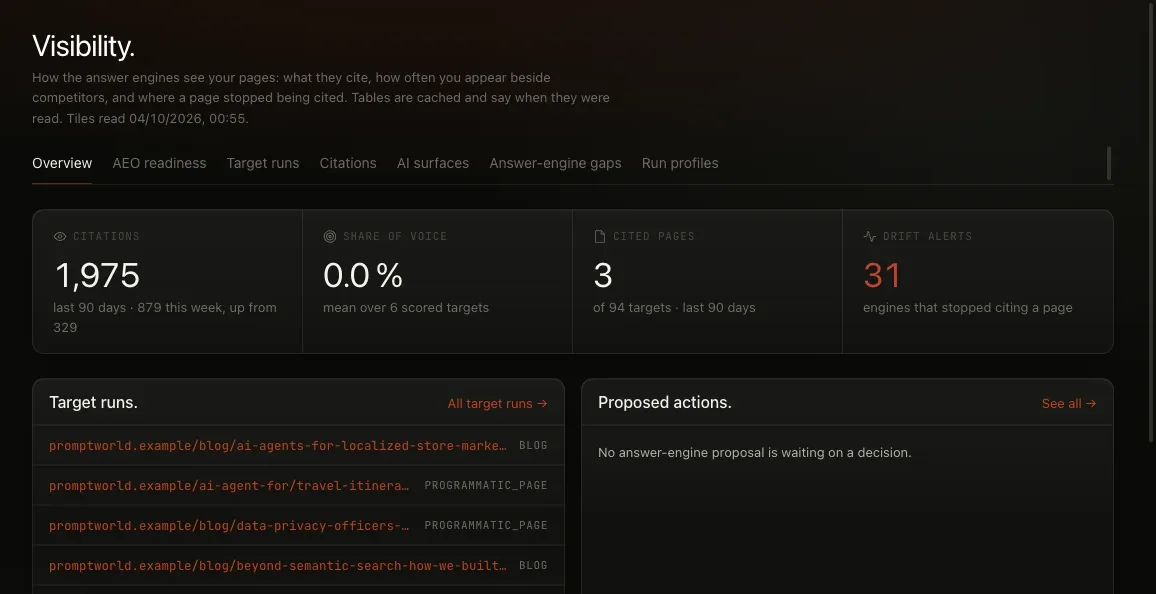
DRIS is Nagent's AI visibility lead. He measures how a company shows up in classic search and in the answer engines people now ask instead of searching, audits its pages, finds the gaps and proposes fixes ranked against one objective the team declares. He never edits a live page on his own. DRIS leads organic visibility on Nagent's Marketing team and reports to MIRA, the Marketing chief of staff.
Try it: Hire DRIS · See plans · Talk to the team
The Visibility overview: citation, share of voice, cited pages and drift, with the target runs behind each figure. Shown from a Nagent demo workspace.
How DRIS gets a brand cited
Connect and baseline. Search Console and Analytics connect first. DRIS runs a baseline sweep and a site audit, and the dashboard unlocks when they finish.
Declare an objective. One number, a target and a date: organic clicks, organic impressions, mean page score or AI answer presence. Every target is measured against the baseline.
Ask the engines. DRIS asks ChatGPT, Claude, Gemini, Perplexity and Grok the questions buyers ask, on run profiles. The default profile reads ChatGPT, Gemini and Perplexity weekly and Claude monthly. The exact prompt that produced each result is recorded beside the citation, and the prompt set is fixed per account so a trend means something.
Measure six ways. Each target is scored on coverage, share of voice, entity strength, recommendation position, sentiment, and whether the page is legible to an agent at all. Every figure carries the run count, the window and the engine it was measured on.
Rank the proposals. Findings become proposals ranked by contribution to the objective, severity, effort and age. Each carries a recommendation, a "Why" block and its confidence.
A person approves. Approving in the Queue never publishes; it clears the step to run. Metadata fixes go live through the site connection once approved on the SEO proposals page, with Withdraw to take one off. Index and canonical changes need a separate senior approval. Content gaps go to the content team as tasks.
Report what moved. Today grades the objective monthly; Reports carries weekly, monthly and day-75 reports.
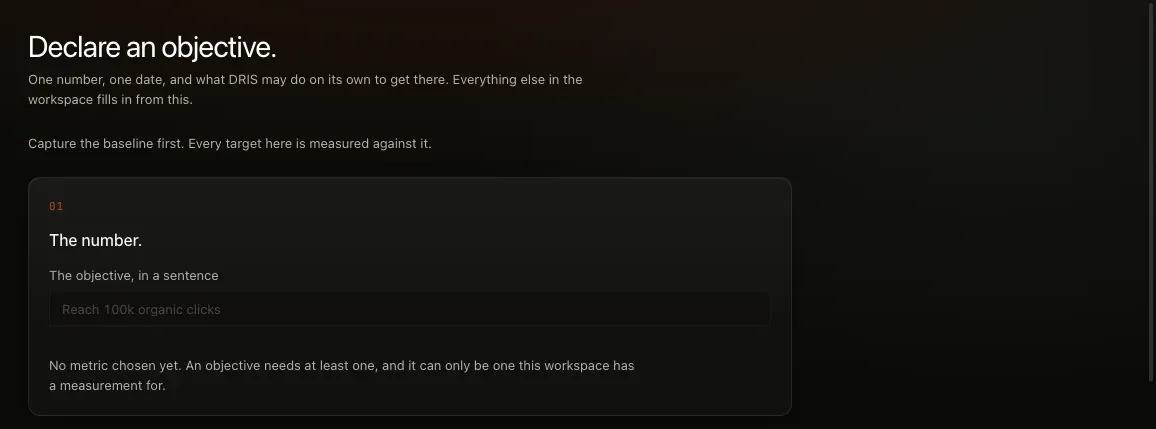
Declaring the objective. One number, a target and a date, and every proposal after this is ranked by how much it contributes.
Why DRIS stands out
An objective, not a backlog. DRIS will find more problems than anyone can fix, so the declared number is the filter. The fix that moves it rises; the rest waits.
The Leaders quadrant. Every target is plotted on brand coverage against recommendation position. The top right is where an answer both mentions the brand and recommends it well, and driving targets there is the goal the workflow is organized around.
Every proposal carries its reasoning. A model can explain a proposal, but it never triggers a change, alters a score or skips an approval. If the reasoning fails, the pipeline completes without it.
Destructive changes never earn autonomy. Index rules and canonicals always wait for a senior person. Everything else is earned on the record, one level at a time: 30 days at a level with at least 25 decided approvals and few dismissed earn a nomination that an admin approves or declines.
Spend has a ceiling. Every paid provider call passes a budget check first. The daily cap for answer-engine reads runs from $1 to $1,000, and paid runs started by hand show an estimate before they spend.
Classic search in the same place. Site audit, ranked keywords, Search Console, traffic and competitor tracking sit beside the answer-engine sampling.
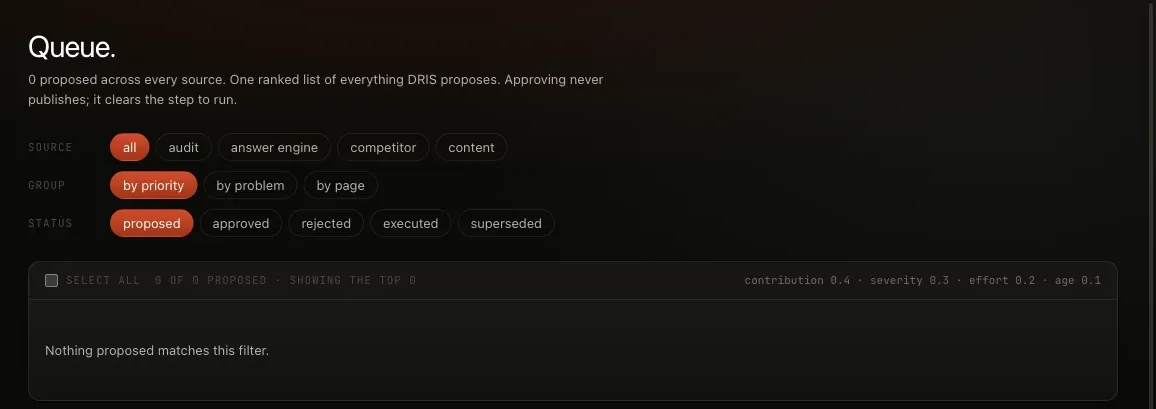
The Queue. One ranked list of everything DRIS proposes, with the weights that rank it visible on the right.
Limits to know
DRIS is in Beta. The site connection that makes approved metadata fixes live is itself Beta, and a developer wires it in once.
Answer-engine and content proposals stay in the Backlog today; the Queue holds search fixes.
Direct publishing into a customer's CMS is not built. Authority, the Handover plan, Technical SEO, browser intelligence and sending reports into the workspace are marked Coming soon.
DRIS comes with the Visibility module, which is part of a plan; the pricing page says which.
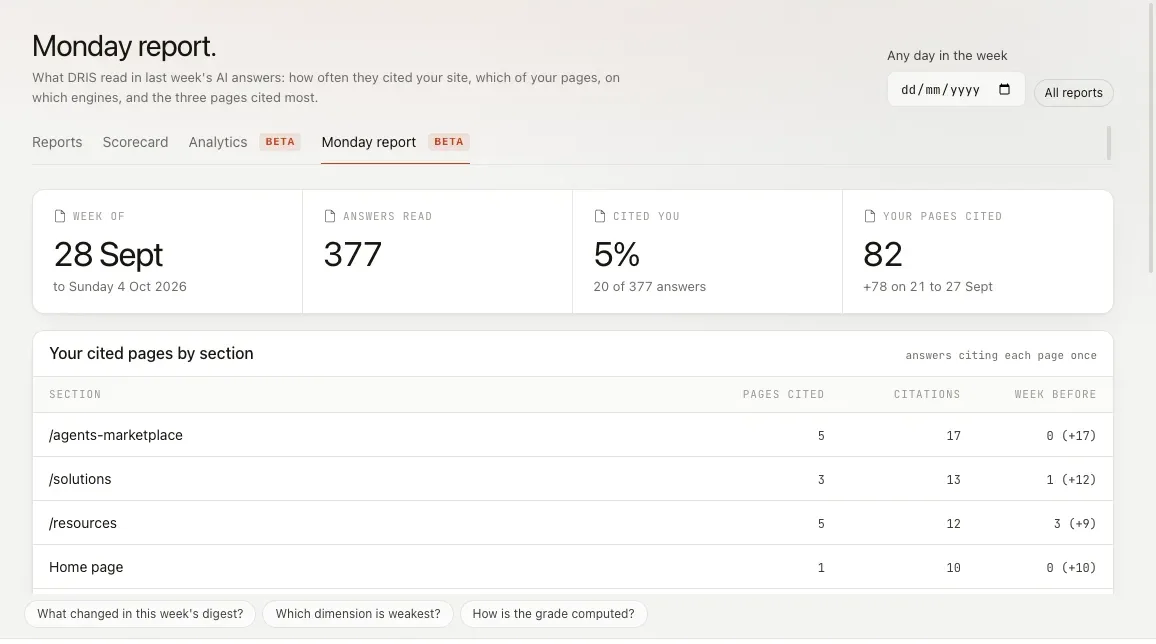
The Monday report. Answers read, the share that cited you, and which pages were cited, beside the week before.
Pricing
DRIS works on the Marketing team. Nagent plans: Solo $29.99/mo ($19.99/mo billed annually), Team $299/mo ($199/mo annually), Business $1,499/mo ($999/mo annually), and Enterprise by quote. See pricing for which plans include the Marketing team.
Best for: heads of marketing who own an organic number and want answer-engine presence and classic SEO worked from one ranked queue, with a person approving every change to the site.
2. Profound
An AI visibility and answer-engine optimization platform with agentic marketing workflows. Profound's claim is that teams can understand and improve how their brand shows up across AI answer engines, and act on it through context-grounded workflows.
Standout: measurement and an AI Marketer layer in one product.
Watch for: the free trial runs 10 prompts once on ChatGPT, and everything beyond that is enterprise packaging by quote.
Best for: larger marketing teams that want tracking and workflow automation from one vendor and expect a sales conversation.
3. Peec AI
An AI-search analytics and action platform with monitoring, custom skills and recommended marketing actions. Peec positions analytics as the basis for improving visibility across AI search experiences, and its current material includes brand fact-checking and agent actions.
Standout: source diagnosis. It shows which pages the engines cite and the intent behind the prompt, not just whether you appeared.
Watch for: prompt, model and billing-period limits apply per tier, so check the allowance against your prompt set.
Best for: teams that want to understand why a competitor is cited before deciding what to write. Published entry price from $95 a month.
4. Writesonic
An AI visibility, content and action platform for both traditional and answer-engine discovery. Writesonic's claim is that teams can move from AI-search visibility gaps to prioritized content, citation and technical actions, through tracking, articles and an Action Center.
Standout: the cheapest published entry point here that pairs tracking with article production.
Watch for: prompt, answer, article and action allowances differ by plan, and the entry plan does not include unlimited agent execution.
Best for: small content teams that want to see a gap and write the article in the same tool. Published entry price $79 a month on annual billing.
5. AthenaHQ
An agent-oriented platform for improving brand presence in AI search. AthenaHQ positions its agents as a way to win discovery across AI answers, with monitoring, content recommendations and on-page and off-page actions.
Standout: content optimization agents that recommend on-page and off-page actions, not just a scoreboard.
Watch for: pricing is credit-based, one credit per AI response, so a large prompt set across many engines spends quickly. Extra credits and API access can add cost.
Best for: teams that want recommended actions with their monitoring and can size a credit budget. Published entry price $295 a month.
6. Scrunch AI
An AI search visibility and customer-experience platform for how brands appear to answer engines. Scrunch's claim is that brands can manage how AI agents understand and represent them, through prompt and citation monitoring, personas, page audits and an Agent Experience Platform for AI visitors.
Standout: the agent-experience angle. It treats the AI crawler as a visitor to design for, alongside the monitoring.
Watch for: the published core plan covers 125 unique prompts, five audits, one brand workspace and five users, and older indexed tier tables differ from the current page.
Best for: brands that want to shape what an agent reads on their site, not only track what it says. Published entry price $250 a month.
7. AirOps
A content operations platform built around workflows for organic and AI discovery. AirOps's claim is that teams can run strategies that win across traditional and AI search, with editorial review and quality controls applied at scale.
Standout: the workflow builder. Research-to-publication pipelines you design yourself, with review steps inside.
Watch for: the published pricing page mixes new package labels with older references, so the binding tier needs confirmation before you buy. Base price not verified; Solo lists 35,000 content tasks and Pro 100,000.
Best for: content operations teams with someone to own the workflows, producing at volume for both kinds of search.
The AI visibility add-on to the established SEO suite. Semrush positions it as a way to track brand mentions and citations in AI answers alongside the keyword, backlink and site audit data teams already use.
Standout: it lives next to the classic SEO data most teams already pay for.
Watch for: it is a toolkit inside a suite, so expect reporting more than ranked fixes.
Best for: teams already on Semrush who want AI answer tracking without a new tool. Approximately $99 a month for the toolkit, on top of a plan; prices are approximate.
Ahrefs's brand and AI visibility module. It positions Brand Radar as a way to see how often a brand is mentioned across AI assistants and the web, drawing on Ahrefs's own crawl and index.
Standout: the breadth of Ahrefs's index behind the mentions, in a familiar interface.
Watch for: it reports presence more than it prescribes fixes.
Best for: SEO teams on Ahrefs who want a mentions and share-of-voice view in the tool they already open daily. Included with Ahrefs plans from approximately $129 a month; prices are approximate.
10. Otterly.ai
A lighter AI search monitoring tool that tracks brand mentions, citations and link visibility in ChatGPT, Perplexity and Google's AI answers for a set of prompts you define.
Standout: fast to set up and the lowest entry price on this list.
Watch for: it is monitoring, not a fix pipeline. What to change stays with your team.
Best for: founders and small marketing teams who want to know whether they appear at all before committing to a heavier platform. Approximately $29 a month at entry; prices are approximate.
How do they compare at a glance?
Tool: Nagent DRIS, What it is: AI visibility lead on an AI Marketing team, Engines covered: ChatGPT, Claude, Gemini, Perplexity, Grok, From finding to fix: Ranked proposals with a "Why"; a person approves; metadata fixes go live via site connection, Entry price: Nagent plans from $29.99/mo (check which include Marketing)
Tool: Profound, What it is: AI visibility plus agentic workflows, Engines covered: Major answer engines, From finding to fix: AI Marketer workflows, Entry price: Free trial; Enterprise custom
Tool: Peec AI, What it is: AI-search analytics and actions, Engines covered: Major answer engines, From finding to fix: Recommended marketing actions, Entry price: From $95/mo
Tool: Writesonic, What it is: Visibility, content and action platform, Engines covered: Major answer engines, From finding to fix: Articles and an Action Center, Entry price: $79/mo, annual billing
Tool: AthenaHQ, What it is: Agent-oriented AI search platform, Engines covered: Major answer engines, From finding to fix: Content agents, on-page and off-page actions, Entry price: $295/mo
Tool: Scrunch AI, What it is: AI visibility and agent experience, Engines covered: Major answer engines, From finding to fix: Audits and agent-facing site experiences, Entry price: $250/mo
Tool: AirOps, What it is: Content operations workflows, Engines covered: Via workflows, From finding to fix: Research-to-publication pipelines, Entry price: Base price not verified
Tool: Semrush AI Visibility Toolkit, What it is: Add-on to an SEO suite, Engines covered: AI answers alongside classic SEO, From finding to fix: Reporting, Entry price: ~$99/mo add-on
Tool: Ahrefs Brand Radar, What it is: Module in an SEO suite, Engines covered: AI assistants and the web, From finding to fix: Reporting, Entry price: With plans from ~$129/mo
Tool: Otterly.ai, What it is: AI search monitoring, Engines covered: ChatGPT, Perplexity, Google AI, From finding to fix: Monitoring only, Entry price: ~$29/mo
Prices change often; check each vendor's pricing page before buying. Entries 2 to 7 paraphrase the vendor's own published claims as recorded in Nagent's comparison research.
How do you choose the right one?
Start from what happens after the finding. If you want a ranked queue tied to one number, with a person approving each change, you want DRIS. If you want measurement with workflows you build yourself, Profound or AirOps fit, with the budget and the operator to match. If you want a report in a suite you already pay for, Semrush or Ahrefs is the least disruptive step. If you are not yet sure you have a problem, Otterly or Peec will tell you cheaply.
Then check three things on a trial:
Ask for the prompt behind one citation. A good tool shows the exact question it asked, the engine, the date and the answer. A weak one shows a percentage with nothing behind it.
Find what changes without you. Know whether the tool can edit a page, a tag or an index rule on its own, and who can undo it. The safest answer is that nothing goes live without a named person.
Count the findings against your capacity. Two hundred recommendations are a backlog, not a plan. Ask how the tool decides which five matter this week, and whether that is tied to a number you report on.
Frequently Asked Questions
What is the difference between GEO and AEO?
Nothing that matters to the work. Generative engine optimization and answer engine optimization both describe earning a place in the answer an assistant gives, by making sure the engines find, trust and cite your pages. Vendors pick one name; the tools do the same job.
How do I get my brand cited by ChatGPT?
Be the page the engine finds when it looks for the answer to a buyer's question, and say the thing plainly enough that an agent can read it. The tools above measure which questions you are missing from and which pages the engines cite instead. DRIS turns that into proposals ranked against one objective; most others hand you the list.
Do these tools change my website?
Most only report. Some, including DRIS, can make approved metadata fixes live through a site connection, with a person approving each one first. Check what a tool can do on its own before connecting it; destructive changes such as index rules and canonicals should always wait for a senior person.
How much do GEO and AEO tools cost?
From approximately $29 a month for monitoring, through $79 to $295 a month for platforms that pair tracking with actions, to enterprise quotes for Profound. Nagent plans start at $29.99 a month; see the pricing page for which plans include the Marketing team.
Is classic SEO still relevant?
Yes. The engines cite pages that already rank and load cleanly. A tool that tracks AI answers without Search Console and a site audit is measuring the output and ignoring the input.
What should you do next?
Ready to find out whether you are in the answer? DRIS asks the engines what your buyers ask, ranks the gaps against the number you own, and waits for your approval before anything goes live. Hire DRIS → · Best AI visibility tools in 2026, compared · The Answer Layer
See an AI team at work
Book a 15-minute demo and watch a Nagent team plan, do and hand back real work in its room.