
AI Sales Agents vs. CRM Automation for Fashion

AI Sales Agents vs. CRM Automation for Fashion
CRM automation moves emails. AI sales agents move pipeline. For fashion brands running drop launches, trade show circuits, and seasonal clearance windows, that distinction is the difference between a sequence that fires on schedule and an agent that reads a buyer's behavior at 11 PM, adjusts the message, and acts before your competitor's rep wakes up. The ai sales agent vs crm automation fashion debate isn't about which tool is better, it's about which problem you're actually trying to solve.
What does CRM automation actually do for fashion sales teams?
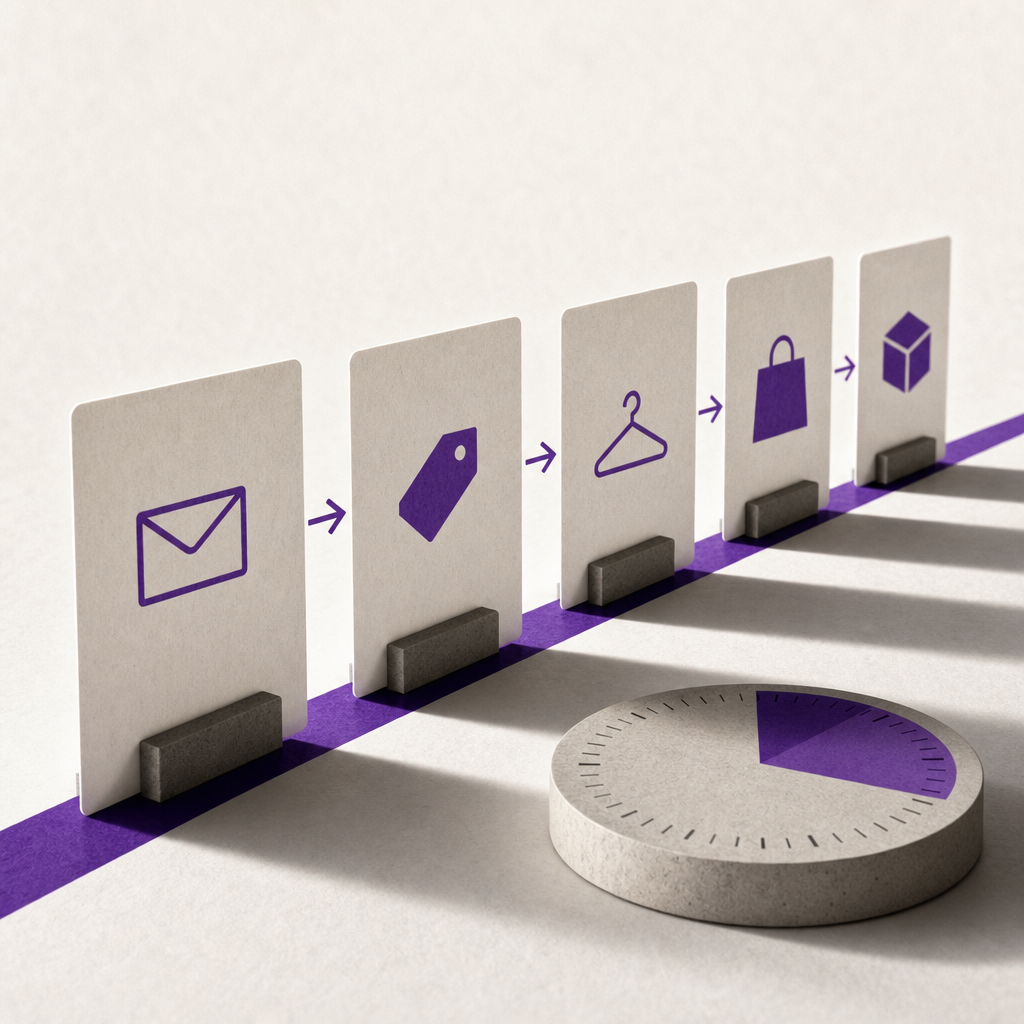
CRM automation executes pre-defined sequences on a fixed schedule.
When a wholesale buyer opens your lookbook email, your CRM logs the event and fires the next step in the cadence, maybe a follow-up in 48 hours, maybe a meeting invite. That's genuinely useful. For stable, predictable outreach, onboarding a new retail account, nurturing a warm lead through a 90-day buying cycle, automation sequences work well.
The problem is the word pre-defined.
Fashion sales cycles are not pre-defined. They're punctuated by:
Drop windows that compress buyer attention into 72-hour windows
Trade show surges where 40 buyers go live simultaneously
End-of-season clearances where urgency changes by the hour
CRM automation was designed for predictable pipelines. Fashion pipelines are anything but.
Where does CRM automation hit a ceiling for fashion brands?

CRM automation hits its ceiling the moment context matters more than schedule.
Consider a typical drop window scenario. Your CRM fires a follow-up email to 200 wholesale buyers at 9 AM Tuesday, because that's when the sequence says to. But 30 of those buyers clicked the product page three times yesterday evening. Twelve of them visited your stockist locator. Two of them forwarded the lookbook to a colleague.
Your CRM doesn't know any of that. It sends the same email to all 200.
An AI sales agent reads those signals in real time. It prioritizes the 30 high-intent buyers. It changes the message, not the template, the actual angle, based on which SKUs they browsed. It flags the two who forwarded the lookbook as expansion opportunities and routes them to your senior account manager before the sequence even fires.
That's not automation. That's judgment.
"The shift from instruction-based to intent-based operations is the defining change in enterprise sales. Systems that wait for triggers are being replaced by agents that interpret context." [^1]
How do AI sales agents handle drop windows differently?
AI sales agents compress drop-window response time from hours to minutes by acting on live behavioral signals, not scheduled triggers.
During a drop, buyer intent spikes and then decays fast. A buyer who browses your new collection at 10 PM on launch night is in a different mental state than the same buyer receiving your 9 AM Tuesday follow-up. The window is narrow.
On Nagent, this is work for the Sales team. SERA, the AI chief of staff for Sales, routes each piece of sales work to its owner and reports where every buyer stands from the CRM. NORA researches the account and drafts the outreach, and a person approves what goes out.
Practically, that means:
A buyer spikes on three colorways from the new drop at 11 PM
The signal is logged against the buyer's CRM record
A personalised follow-up referencing those specific SKUs is drafted for the rep
SERA routes the lead to the right rep with that context already loaded
The rep approves the message, and it lands before the buyer's attention moves on
No sequence rewrite. No manual segmentation. The context shift is handled for the rep, and the rep keeps the decision.
What happens during trade show follow-up surges?
Trade show follow-up is where CRM automation creates the most visible damage to fashion pipelines.
After a trade show, your team returns with 60, 80, sometimes 200 new contacts. Everyone needs a follow-up. Everyone needs it this week, because the buying window closes fast once buyers return to their own workloads.
CRM automation's answer: load them into a sequence. Everyone gets the same five-step cadence. The buyer who spent 40 minutes at your booth and asked specific questions about your wholesale MOQs gets the same email as the buyer who grabbed a lookbook and moved on.
This is where the ai sales agent vs crm automation fashion gap becomes revenue-visible.
An AI sales agent ingests the context from your trade show CRM notes, LinkedIn activity, and post-show email behavior simultaneously. It segments not by list membership but by demonstrated intent. It writes follow-ups that reference the actual conversation, not a generic "great meeting you" template.
The pattern holds across complex B2B sales: follow-up that reflects the actual conversation earns replies that a static sequence does not.
On Nagent this compounds over time. Every trade show follow-up cycle is recorded: which messages converted and which cadences worked for which buyer profiles. At the next trade show that record is already in the team room and the CRM, and AI teammates that proved themselves have earned more room to act.
How does end-of-season clearance change the calculus?
End-of-season clearance demands a fundamentally different sales motion, and CRM automation can't switch modes.
During clearance, the goal shifts from relationship-building to velocity. You need buyers to commit fast, on specific SKUs, at specific price points, before the window closes. The message that worked in September, brand story, editorial imagery, wholesale partnership value, is the wrong message in February.
CRM automation doesn't know what month it is in terms of sales context. It knows what step in the sequence it's on.
An AI sales agent reads the commercial context. It knows you're in clearance mode because your team flagged it, your inventory system shows the SKU positions, and your prior-season data shows which buyer segments respond to urgency-driven outreach.
On Nagent, the shared record makes this possible. The CRM, the team room and the Knowledge Hub hold which buyers took clearance deals last season, at what discount threshold and on which product categories. That context is in front of the rep before the conversation starts, so every clearance call begins with intelligence, not a blank slate.
When should fashion brands still use CRM automation?
CRM automation remains the right tool for stable, low-context sales workflows.
Not every sales motion in fashion is context-sensitive. New account onboarding sequences, re-engagement campaigns for lapsed wholesale accounts, and post-purchase follow-ups for DTC buyers, these are predictable, repeatable, and well-served by automation.
The practical framework:
| Scenario | CRM Automation | AI Sales Agent |
|---|---|---|
| New account onboarding | ✓ Reliable | Overkill |
| Drop window follow-up | ✗ Too slow | ✓ Real-time |
| Trade show surge | ✗ No context | ✓ Intent-aware |
| End-of-season clearance | ✗ Wrong mode | ✓ Velocity-optimized |
| Lapsed account re-engagement | ✓ Works well | Optional uplift |
| Wholesale MOQ negotiation | ✗ Can't adjust | ✓ Adaptive |
The honest answer: most fashion sales teams need both. CRM automation handles the predictable base. AI sales agents handle the moments that actually move pipeline.
How do you deploy an AI sales agent without rebuilding your stack?
You keep your stack: AI teammates work alongside the CRM you already run.
On Nagent, SERA works with your existing CRM, whether Salesforce, HubSpot or Zoho. She reads your contact and pipeline data, hands each piece of work to the teammate who owns it, and reports where every deal stands from the CRM, not from memory.
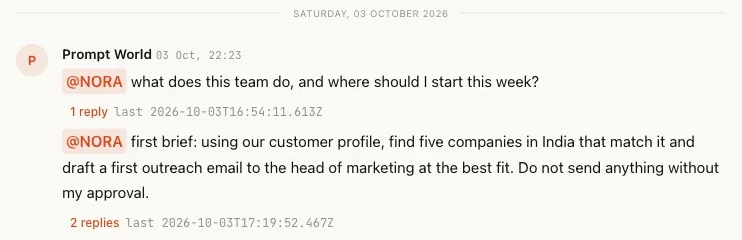
A first brief in a Sales team room, with nothing sent without approval.
AI teammates start supervised. You add the brand context, connect your CRM and set what needs a person's approval, and they earn more autonomy level by level on their track record.
Where the plan includes it, a Nagent forward deployed marketer joins the team and owns the number with you.
Related reading
Frequently Asked Questions
What is the core difference between an AI sales agent and CRM automation?
CRM automation executes pre-built sequences on a fixed schedule. An AI sales agent reads live behavioral signals, interprets context, and adjusts its actions in real time, without waiting for a human to update the sequence. For fashion brands, this difference is most visible during high-velocity windows like drops, trade shows, and clearance periods.
Can AI sales agents work alongside existing CRM tools?
Yes. On Nagent, SERA works with Salesforce, HubSpot and Zoho CRM. She reads your existing contact and pipeline data and reports from the CRM itself, and the work she routes adds context back to the record. You don't replace your CRM; you give it a team that keeps it true.
How quickly can a fashion brand deploy an AI sales agent?
Start with one motion, such as trade show follow-up. On Nagent you brief SERA in the Sales team room, connect your CRM and set what needs approval. AI teammates start supervised and earn autonomy as their track record builds. Where the plan includes it, a Nagent forward deployed marketer joins the team and owns the number with you.
What makes AI sales agents better for drop windows specifically?
Drop windows compress buyer intent into 24-72 hour periods. CRM automation fires on schedule, typically missing the peak intent window. AI sales agents read real-time engagement signals (page visits, click patterns, forwarded emails) and act within minutes of the behavior occurring, reaching high-intent buyers while the window is still open.
Is there a risk of AI sales agents over-contacting buyers?
Well-configured agents include frequency caps and escalation thresholds, so they don't fire on every signal. On Nagent, a person approves what goes out, and the record of which cadences converted and which produced unsubscribes tells the team how to tune contact frequency, so outreach gets more precise each cycle rather than more aggressive.
What's next
See how SERA and the Sales team would handle your pipeline, with a person approving every send. Book a demo, bring your drop calendar, and we'll map the gaps live.
Sources
The Agentic FMCG Playbook _(pdf)_