
AI Lead Qualification for Fashion Wholesale

AI Lead Qualification for Fashion Wholesale
AI agents now qualify wholesale leads in fashion faster than a human rep can, by scoring retailer readiness from open-to-buy signals, past order history and social shelf presence at the same time. The result: your sales team stops cold-calling dead accounts and starts conversations with buyers who are already in-market.
Why Is Wholesale Lead Qualification Still Manual in Fashion?

Most fashion wholesale teams still run on spreadsheets, gut instinct, and cold calls.
A brand rep dials a buyer at a regional department store. The buyer moved to a new chain six months ago. The rep doesn't know. The call goes nowhere.
This isn't a skills problem. It's a data problem, and a routing problem.
Wholesale outreach in fashion sits at the intersection of three messy data streams:
Retailer open-to-buy (OTB) budgets: rarely public, often guessed
Past order cadence: locked in a CRM that no one updates in real time
Social shelf presence: which brands a retailer is actively featuring on Instagram, TikTok, and their own e-commerce
No human rep can synthesise all three signals at scale. An AI agent can, in seconds, per account, across thousands of retailers simultaneously.
What Does AI Lead Qualification Actually Look Like in Fashion Wholesale?
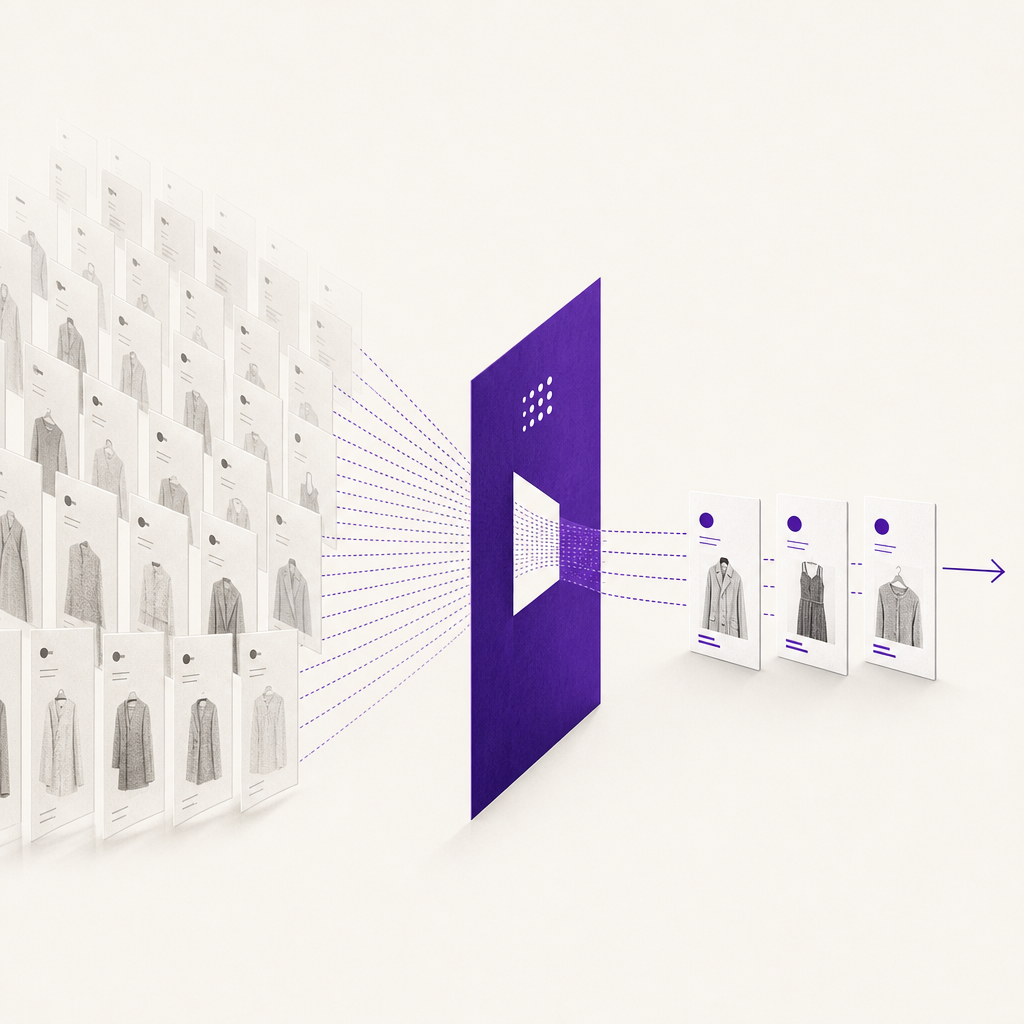
AI lead qualification in fashion wholesale means an agent continuously scores every retailer in your target list against live signals, then routes only the warm accounts to your reps.
Here's what that workflow looks like in practice:
Step 1: Signal ingestion
The agent pulls from three data layers:
Past order data: average order value, reorder frequency, seasonal peaks, category mix
Open-to-buy proxies: new brand listings on the retailer's site, shelf gaps in your category, trade show attendance signals
Social shelf presence: which competitor brands the retailer is actively promoting, how often, and with what engagement
Step 2: Lead scoring
Each retailer gets a composite score. High score = active buying cycle, category fit, and no recent competitive lock-in. Low score = dormant account, saturated category, or recent competitor exclusivity.
Step 3: Routing + nurture
High-score accounts go straight to a rep with a briefing note: the buyer's name, last order date, top-selling categories, and a recommended opening message.
Mid-score accounts enter a nurture sequence, personalised by category, season and retailer tier, until a buying signal tips them into the high-score bucket. Each message is approved before it goes out.
Low-score accounts get deprioritised. Your reps never see them.
On Nagent, this is the Sales team's workflow. SERA, the AI chief of staff for Sales, routes each account to its owner and reports where it stands from the CRM, and NORA, the AI outbound research lead, researches each fit into a sourced brief and drafts the first e-mail for approval.
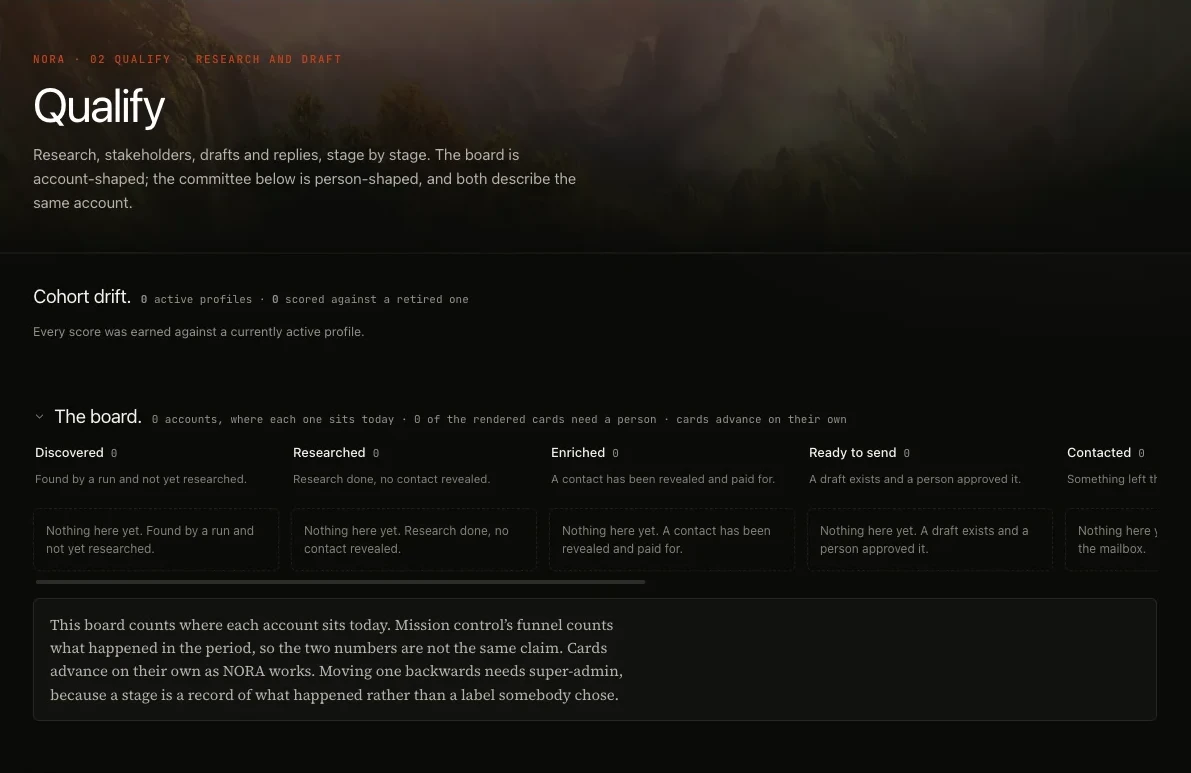
NORA's Qualify board, from discovered to contacted.
How Do Open-to-Buy Signals Actually Work as a Qualification Input?

Open-to-buy (OTB) is the single most reliable signal that a buyer is ready to spend, and it's the most underused input in fashion wholesale outreach.
OTB isn't always published. But it leaks through observable behaviour:
A retailer lists three new brands in your category within 60 days → they're actively buying
A retailer's own-brand SKU count drops → they're making room for wholesale
A buyer attends a trade show in your segment → they're in active discovery mode
An AI agent monitors these proxies continuously. A human rep checks them once a quarter, if at all.
The principle is simple: agents that read the market as it moves beat reps reading stale CRM data.
What Role Does Social Shelf Presence Play in Wholesale Lead Scoring?
A retailer's social feed is a live inventory signal, and most fashion brands aren't reading it.
When a boutique posts three consecutive Instagram Stories featuring a direct competitor's new collection, that's not just content. It's a buying decision made visible. The buyer chose that brand. They spent their OTB budget there.
An AI agent tracking social shelf presence can flag:
Competitor saturation: a retailer already featuring 4 brands in your exact niche
Category gaps: a retailer strong in denim but absent in outerwear, which is your core
Engagement velocity: which brands are getting traction on that retailer's feed vs. which are being quietly dropped
This turns social listening from a brand-awareness exercise into a wholesale qualification signal.
When you combine social shelf data with past order history and OTB proxies, your lead score stops being a guess. It becomes a prediction.
How Can Fashion Brands Personalise Outreach at Wholesale Scale?
Personalised outreach at scale sounds like a contradiction. It isn't, when an agent handles the research and the first draft.
Once a lead is scored and routed, the agent generates a rep briefing that includes:
The buyer's name, title, and last known order details
The retailer's top-performing categories and seasonal buying patterns
A recommended opening message tailored to the buyer's category gaps
Suggested product lines from your range that match their shelf profile
Your rep doesn't start from zero. They start from a briefing that would have taken three hours to compile manually, and they get it in 30 seconds.
For the nurture track, CREA's Content team writes personalised e-mail sequences by retailer tier, category and buying season from your own Knowledge Hub and brand, so mid-score accounts receive relevant touchpoints without a rep writing each one. A person approves what goes out.
This is the shift from cold outreach to informed outreach. And it's the difference between a buyer who takes the meeting and one who marks your email as spam.
How Does Agentic AI Handle the Visual Side of Wholesale Pitches?
Wholesale buyers don't just evaluate price sheets. They evaluate whether your product looks right for their store.
That used to mean expensive lookbooks, physical samples, and location shoots. For many mid-size fashion brands, a full seasonal photoshoot runs to tens of thousands of dollars, before a single buyer has said yes.
On Nagent, RUPA changes that calculation for product imagery.
She renders product shots and ad stills to a preset with the brand guidelines attached, with presets and references that set:
Model type, styling, and demographic
Location and environment (urban boutique, coastal lifestyle, editorial studio)
Lighting, weather, and seasonal context
A wholesale team can produce retailer-specific visual pitches, showing the product in the aesthetic context of that buyer's store, without a single physical shoot. A surf retailer in Byron Bay gets beach-context imagery. A premium department store buyer gets editorial studio shots.
This is not a minor efficiency gain. It collapses the time between "lead scored warm" and "pitch sent" from weeks to hours.
What Does a Full Agentic Wholesale Stack Look Like?
The most effective deployments don't run a single agent. They run a coordinated system.
Here's how that maps onto Nagent's AI teammates for a fashion wholesale team:
| Stage | Agent / Component | Output |
|---|---|---|
| Research and scoring | NORA | Sourced briefs and retailer scores |
| Outreach copy | CREA's Content team | Personalised email sequences |
| Visual assets | RUPA | Retailer-specific product imagery |
| Campaign timing | MIRA | Seasonal plan and routing |
| Sales routing | SERA | Routes work and reports pipeline from the CRM |
On Nagent you brief SERA in the Sales team room: "qualify and nurture our top 500 wholesale targets before the Spring buying window". She plans the work and hands each piece to the teammate who owns it. Every step is proposed, approved, run and audited.
Everyone works from one shared context: the team room, the CRM record and the Knowledge Hub. A buyer who engaged with your outreach six months ago isn't treated as a cold contact; the next touchpoint picks up where the last one left off.
Every reply, booked meeting and order placed is recorded, so the team can see which signals predict orders and tune the scoring, and AI teammates earn more autonomy level by level on that track record.
Related Reading
Frequently Asked Questions
What is AI lead qualification in fashion wholesale?
AI lead qualification in fashion wholesale means using autonomous agents to score, rank, and route retailer prospects based on live data signals, including open-to-buy proxies, past order history, and social shelf presence. Instead of reps manually researching accounts, the agent surfaces only the buyers most likely to convert, with a briefing ready to go.
Which signals does an AI agent use to qualify wholesale buyers?
The three most reliable signals are: retailer open-to-buy proxies (new brand listings, SKU gaps, trade show attendance), past order data (frequency, value, category mix), and social shelf presence (which brands a retailer is actively featuring and with what engagement). Combining all three produces a qualification score far more accurate than any single data point.
How do you start an agentic wholesale qualification workflow?
On Nagent, brief SERA with your target list and qualification criteria and connect your CRM. Researched, scored accounts reach your reps from the first run, a person approves every outreach message, and the scoring improves as campaign outcomes are recorded.
Can AI agents handle the visual assets needed for wholesale pitches?
Yes. On Nagent, RUPA renders product imagery to a preset with your brand guidelines attached, so a wholesale team can produce retailer-specific pitch visuals without a physical shoot, which shortens the time between a warm lead signal and a complete pitch in the buyer's inbox.
Is agentic AI only viable for large fashion brands?
No. Nagent is built for growth-stage brands with lean teams, and there is nothing to build: AI teammates work in a team room beside your reps. A wholesale team of three can run qualification and outreach that would otherwise need a much larger sales floor, because the AI teammates scale the research and drafting, not the headcount.
What's Next
Your next wholesale buying window won't wait for your reps to finish their spreadsheets. Book a demo to see how SERA and NORA qualify, route and draft for your buyer list, with a person approving every send.
Sources
The Agentic FMCG Playbook _(pdf)_