
How Do I Set AEO Goals With My CFO and Leadership?
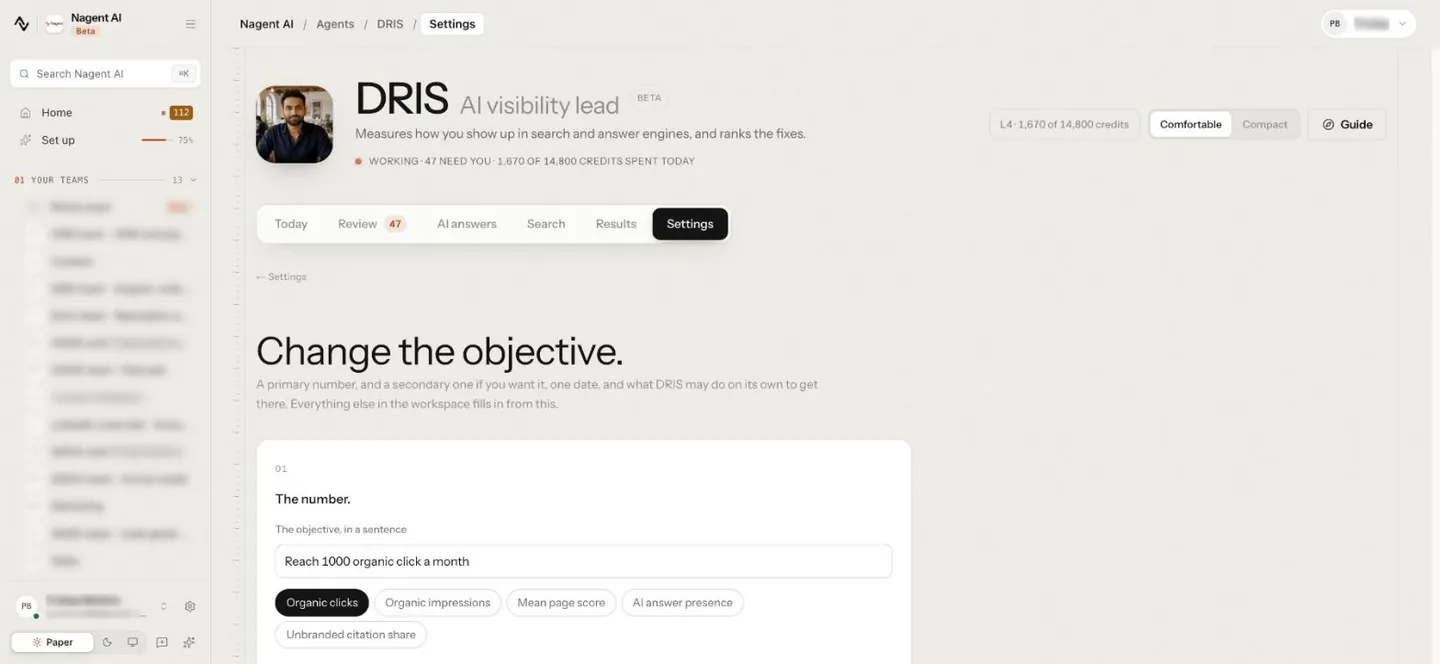
To set AEO goals with your CFO and leadership, agree one objective before any work starts. Capture a baseline first, then pick one number to move (AI answer presence or organic clicks), a target, a date and a spend cap. Size the target from the baseline and the noise in your data, not from a vendor's promise, and agree how often you will review it. This guide covers each decision, and how DRIS records the objective so nobody can move the goalposts later.
Why do AEO goals need a CFO's sign-off at all?
Answer engine optimization (AEO) is the work of getting ChatGPT, Claude, Gemini, Perplexity and Google's AI answers to cite your brand when buyers ask about your category. It costs people time, content, developer hours and measurement, and its return arrives slowly. Finance wants spend like that framed before it starts.
A goal agreed up front means you report against a number everyone signed instead of defending a chart. The CFO also gets a defined amount at risk and a date when the result is judged.
What should you agree before the first meeting?
Walk in with a short draft, not a blank page. Leadership reacts better to a concrete proposal they can adjust than to an open question. The draft needs six things:
One objective, in a sentence.
A baseline, measured before anything changes.
One primary metric, with a target.
A date when the verdict is called.
A spend cap for the program.
A review rhythm and what happens at each review.
Why should there be only one objective?
Because a program with five goals can always claim one went up, and finance reads a list of goals as hedging.
Pick the one outcome the business cares about most this period and name it plainly, for example "be cited when buyers ask assistants how to choose a product in our category". You can still track other numbers beside it. Agree in writing which one is primary: the one the program is steered by and graded on. Everything else is secondary, watched but not used to call success.
Why must the baseline come first?
Every later claim of progress is measured from the baseline, so it has to exist before the first fix ships. If you start work and measure later, you have no way to separate what the program did from where you already were.
Three rules make a baseline hold up with finance:
Measure it once, and freeze it. A baseline that gets re-taken mid-program resets every claim. Leadership should hear that it will not be replaced.
Connect your data first. Search Console for clicks and impressions, a site audit for page quality, and a fixed set of prompts for the answer engines. A baseline taken before the data sources are connected undercounts where you stand.
Fix the prompt set. AI answer presence depends on which questions you ask. If the questions change, the number changes with the measurement, not with your work.
Which metric should the goal use: AI answer presence or organic clicks?
Each metric answers a different question for leadership:
Metric: AI answer presence, What it tells finance: How often the answer engines cite you on the questions your buyers ask, When to choose it: When buyers increasingly ask assistants instead of searching, and being named is the goal
Metric: Organic clicks, What it tells finance: Visits from search, which finance can tie to sessions and conversions, When to choose it: When the business case rests on traffic and pipeline you can trace
Metric: Organic impressions, What it tells finance: How often you appear in search results at all, When to choose it: When you are early and need a leading indicator
Metric: Mean page score, What it tells finance: The average score of your pages in the site audit, When to choose it: When the first job is fixing pages that machines can't read well
For a CFO, organic clicks are the easiest to connect to money, because sessions and conversions are already in your analytics. AI answer presence is the purer AEO measure, but its commercial value is indirect: a buyer reads an answer, remembers your name and arrives later. A common compromise is AI answer presence as the primary metric, with organic clicks tracked as secondary so finance can see the traffic side move too.
Whichever you choose, use shares and rates, not raw counts. A bigger prompt set collects more citations without you being any more visible.
How do you size a realistic AEO target?
Leadership will ask "why that number?" Have an answer built from your own data:
Start from the baseline, not the ambition. A target is a distance from where you stand, and the distance has to fit the time you have.
Look at the gap to competitors. If named competitors are cited on questions where you are not, closing part of that gap is a defensible target. Closing all of it in one quarter usually isn't.
Allow for noise. AI answers vary from run to run. A target smaller than the normal swing in your data can be "hit" by chance, and missed the same way. Set it clearly above the noise.
Count the fixes you can actually ship. A target that needs fifty page rewrites from a team that can review ten a month is a plan to miss.
Present one target, then show the arithmetic: baseline, target, months available, the monthly rate that implies. A CFO who can check the arithmetic is far more likely to sign it.
Why put a date and a spend cap on the goal?
A goal without a date can't be missed, which means it can't be judged either. Pick a date far enough out to hold several months of shipped and measured fixes, and agree that the verdict is called on it, not extended quietly.
The spend cap answers the CFO's first question: how much is at risk? Set a lifetime cap for the objective, covering what the program may spend on measurement and AI work, and keep people and production costs in your own budget line beside it. If the cap is reached before the date, that's a decision point for leadership, not an overrun discovered later.
How often should leadership review AEO goals?
Monthly works for most teams. Each review answers one question: are we ahead, on target or behind the rate the target needs? Keep the format fixed:
The primary metric against baseline and target, with the monthly rate still needed.
Spend to date against the cap.
What shipped since the last review, and what is queued next.
Anything outside the program that could explain a movement, such as a search algorithm update or a product launch.
A quarterly review is where the objective itself can change: a new target, a new date, or a different primary metric. Changing it monthly turns the goal into a moving target and undoes the point of agreeing it.
How does DRIS record an AEO objective?
DRIS leads organic visibility on Nagent's Marketing team and reports to MIRA, the AI Marketing Chief of Staff. He asks ChatGPT, Claude, Gemini, Perplexity and Grok the questions your buyers ask, reads Search Console and Google Analytics, and nothing in DRIS starts until there is an objective. Declaring one follows the same steps as the meeting above:
The baseline. DRIS records where you stand today. This happens once and cannot be replaced, so connect Search Console and let the site audit run first.
The number. You pick what to move: Organic clicks, Organic impressions, Mean page score or AI answer presence, and set a Target. Only a metric the workspace can measure is offered. If you choose more than one, the first is the primary that DRIS steers and grades against; the others are tracked beside it.
The date. When the verdict is called, which property it tracks, and an optional Lifetime spend cap.
The review. Today grades the objective every month as ahead, on target or behind, with the arithmetic behind the verdict. A date that has passed, or is less than seven days away, gets no monthly rate, and the verdict says why.
The objective also decides what DRIS works on first: search fixes or answer-engine fixes rise to the top of his queue depending on the number you chose. Every fix is a proposal with its reason, and publishing to a live page needs a person. The DRIS guide covers declaring an objective, and setting up DRIS covers connecting the data so the baseline is complete.
Frequently Asked Questions
How do I set AEO goals with my CFO and leadership?
Bring a one-page draft: one objective, a baseline measured before any work, one primary metric with a target, a date, a lifetime spend cap and a monthly review. Show the arithmetic from baseline to target, and agree that the baseline won't be replaced and the date won't move quietly.
What is a good AEO goal?
One that names a single primary metric, such as AI answer presence on a fixed set of buyer questions, with a target sized from your own baseline, competitor gap and data noise, and a date several months out. Secondary metrics like organic clicks can be tracked beside it.
Should AEO goals use AI answer presence or organic clicks?
AI answer presence measures AEO most directly; organic clicks connect most easily to revenue. Many teams make presence primary and track clicks as secondary, so finance sees both the visibility and the traffic.
How long before AEO goals show results?
Expect the first weeks to show little, because search data lags and engines take time to read changed pages. Judge progress monthly against the rate the target needs, and call the verdict on the agreed date.
Agree the goal before the work
AEO goals win budget when they are agreed before the work, measured from a frozen baseline and judged on a date everyone signed. One objective, one primary metric, a cap and a monthly verdict give your CFO what they need to say yes. DRIS records that objective, captures the baseline once and grades it every month, so the conversation stays about the number.
Book a demo to see DRIS set and track an AEO objective for your own site.