
Is There a Marketplace for AI Agents? An Enterprise Guide
Yes, there is a marketplace for AI agents. There are several: Salesforce AgentExchange, the AI Agents and Tools category in AWS Marketplace, Google Cloud Marketplace, Microsoft's Agent Store, HubSpot's Agent Marketplace and OpenAI's GPT Store. Each helps an enterprise find an agent for a job inside one vendor's platform. A growth team needs more: agents that share context with its people, hand work to each other and wait for a person before anything goes out.
Below: each marketplace in one line, where single-task agents fall short, how an enterprise should judge a marketplace or platform, and how Nagent meets the same need as the multiplayer growth org.
What AI agent marketplaces exist today?
These are the marketplaces and stores run by large platform companies, each checked against its own official page in October 2026. They are listed in no particular order, and this is not a ranking.
Salesforce AgentExchange. Salesforce's marketplace for "apps, agents, and Slack solutions", where partner-built agents, subagents and MCP servers plug in within Agentforce Builder.
AWS Marketplace: AI Agents and Tools. A category of ready-to-use agents, agent tools such as MCP servers and knowledge bases, and partner services, bought with your AWS account, with select agents and tools able to run on Amazon Bedrock AgentCore.
Google Cloud Marketplace. Partner-built agents validated for Gemini Enterprise, found through the AI Agent Finder, bought by an administrator and then registered in Gemini Enterprise. For developers, Agent Garden is Google's library of prebuilt agents and templates.
Microsoft Agent Store. A curated marketplace inside Microsoft 365 Copilot with agents built by Microsoft, partners and customers, which administrators govern from the Microsoft 365 admin center.
HubSpot Agent Marketplace. Where HubSpot's own pre-built agents are installed and then customised in its agent builder. HubSpot's help centre says it lists only HubSpot's pre-built agents.
OpenAI GPT Store. The "Explore GPTs" directory in ChatGPT, where people browse custom GPTs that others have built and published, and use them inside ChatGPT.
The pattern: every store is attached to a platform, and its agents work best, sometimes only, inside that vendor's suite or cloud. That is a strength when your work lives in one place, and worth understanding before you buy.
What does a marketplace give you, and what does it leave to you?
A marketplace solves discovery and procurement. You can see what exists, try it, and in the cloud stores buy it on the account you already pay. The better ones add vetting and admin controls: Microsoft administrators can install, block and remove agents for some or all users, and Google administrators control which agents are deployed in Gemini Enterprise.
What a marketplace cannot do is decide how the agents you bought work together. That part stays with you.
Why do single-task agents fall short for a growth team?
Growth work is rarely one job. A launch touches research, positioning, content, paid ads, outbound and the CRM, and each step depends on what the last one learned. Agents bought one at a time tend to break that chain in three places.
They don't share context. Each agent starts from its own instructions and the data its vendor can reach. Your brand voice, your ideal customer, last week's decision to drop a segment: someone has to give every agent that, again, in every tool.
They don't hand work to each other. A research agent's findings reach the outbound agent only when a person copies them across. The team becomes the integration layer, moving work between tabs.
They leave the wiring and the governance to you. Who approves what an agent publishes, sends or spends? Where is the audit trail? What stops an agent from spending the month's budget in an afternoon? With agents from three stores, you answer those questions three times, in three admin consoles.
The marketplaces are getting better at governance inside their own walls. The gap a growth team feels is between the walls, and inside the team: the people and the agents still work in different places.
How is Nagent different from an AI agent marketplace?
Nagent is not a marketplace. Nagent is multiplayer AI for growth: people and AI agents in one shared context, delivering the number. We call it the multiplayer growth org.
We ran our own agent marketplace until 9 October 2026, then retired it in favour of ready-made AI teammates. The reason is the list above. Picking agents was never the hard part for a growth team. Making them work as a team, with people, was. So instead of a store, Nagent gives you four ways in.
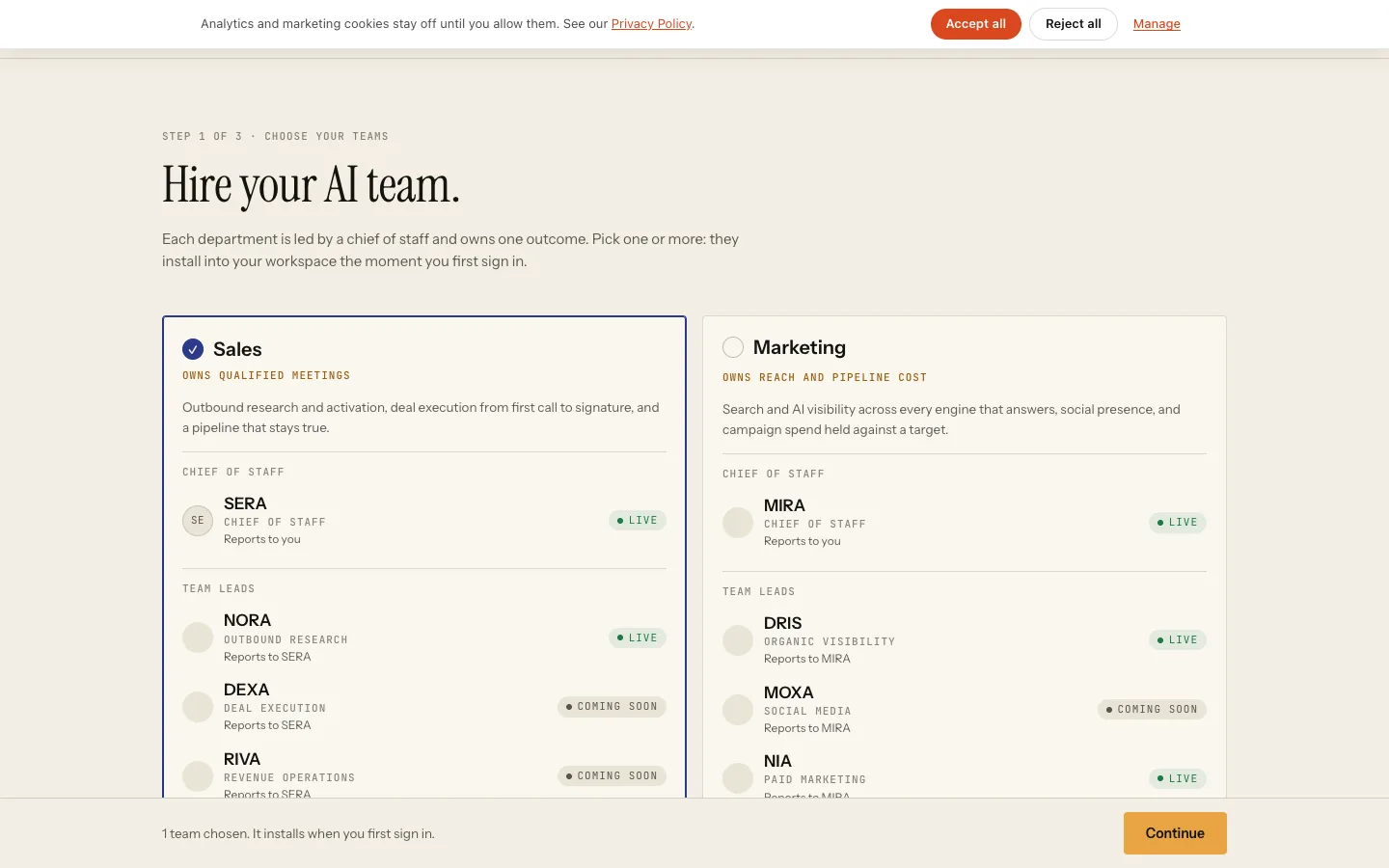
Hire ready-made AI teammates
Pick the departments you need on onboarding, and their teams activate in your workspace the moment you first sign in. Marketing, Sales and Content are each led by an AI Chief of Staff: MIRA, the AI Marketing Chief of Staff, SERA, the AI Sales Chief of Staff, and CREA, the AI Content Chief of Staff. Under them sit team leads such as DRIS for AI search and answer engine visibility, NIA, the AI performance marketing lead, and NORA, the AI Outbound Research Lead. Over the whole org is N, the head of the growth org, in Beta with a waitlist.
They all work with your people in the Room, on what the platform calls "one memory, one record and one ladder of trust". Nobody copies context from agent to agent, because they all work from one shared context.
Build your own agent from one sentence
When nothing ready-made fits, build it. In Agent Workbench you describe the job in one sentence, or start from a template. The builder asks a few questions, such as how much the agent may do on its own and its daily spending cap, then drafts the whole agent for you to review: its skills, tools, guardrails, model, autonomy and standing instructions. Nothing exists until you press Provision agent. The steps are in creating an agent, and if you are comparing builders, see the best AI agent builder platforms in 2026.
Extend the agents you have
Give an agent your own material through the Knowledge Hub, grant it the tools it needs one at a time, and set its level on the autonomy ladder, from L1 Observe to L5 Lead. Every agent arrives at L2 Assist. The system can nominate an agent for more room, but only a person raises its level, one step at a time.
Connect the tools you already run
Agents reach hundreds of tools via Composio, plus your own API, with Google Ads and Meta ad accounts connected directly. Developers can run the same agents from their own code through the REST API, an MCP server and signed webhooks, governed as they are inside Nagent. The details are at /developers.
Governance comes with the org rather than with each purchase. Up to L4 Represent, every public post and reply waits for a named person. When NIA proposes a live change to an ad account, she queues it for a person to approve. Agent work is metered in credits on every plan, visible in the workspace, and agent budgets are daily and monthly caps in credits, checked before every paid call.
How should an enterprise evaluate an AI agent marketplace or platform?
Ask every vendor the same questions, Nagent included.
Question to ask: Governance: who can install, block or remove an agent?, What a good answer looks like: Named admin roles, controls per user or group, and an audit trail you can export.
Question to ask: Approvals: what goes out without a person?, What a good answer looks like: A clear line for what publishes, sends or spends, and a named approver before it does.
Question to ask: Spend: how is spend capped?, What a good answer looks like: Daily and monthly caps checked before a paid call, and a way to stop an agent at once.
Question to ask: Shared context: where does the agent's knowledge come from?, What a good answer looks like: Several people and several agents working from the same record, not a fresh start each session.
Question to ask: Data access: what can the agent read, and where does it run?, What a good answer looks like: Access granted per tool, tenant isolation, a stated data location and a private cloud option.
Question to ask: Hand-offs: can agents pass work to each other?, What a good answer looks like: Hand-offs you can see and approve, not a person copying output between tabs.
Question to ask: Security evidence: what can they show?, What a good answer looks like: Certificates and audit reports, not a wall of logos.
Question to ask: Exit: what happens when you remove an agent?, What a good answer looks like: Your data and the work it produced stay with you.
For the record, Nagent's own answer on security: ISO/IEC 27001:2022 certified by InterCert; SOC 2 Type II in progress; tenant isolation, RBAC, append-only audit and private VPC available today. Nagent also deploys in the customer's private cloud.
When is a marketplace the right choice?
A marketplace is a good fit when:
your team lives in one suite and the job stays inside that suite's data, such as an agent for records that only exist in your CRM;
your IT team already buys software through one cloud account and wants the agent on the same bill;
you have developers who want components, such as MCP servers and templates, to build with;
the job is narrow, one agent can do it end to end, and nobody else needs its output.
A growth org fits better when the work crosses marketing, sales and content, when several people and several agents need the same context, and when you want approvals and budgets set once for the whole team. Many teams will use both: agents from a marketplace for jobs that live inside one suite, and a growth org for the work that connects them.
Frequently Asked Questions
Is there a marketplace for AI agents?
Yes. Salesforce AgentExchange, AWS Marketplace's AI Agents and Tools category, Google Cloud Marketplace, Microsoft's Agent Store in Microsoft 365 Copilot, HubSpot's Agent Marketplace and OpenAI's GPT Store all list agents or custom GPTs you can install. Each is tied to its vendor's platform.
Where can an enterprise buy AI agents from a marketplace?
Enterprises usually buy through the platform they already run on. Teams on AWS or Google Cloud can buy agents on their existing cloud account through AWS Marketplace or Google Cloud Marketplace. Microsoft 365 customers use the Agent Store, Salesforce customers use AgentExchange, and HubSpot customers install HubSpot's agents from its Agent Marketplace.
What are the best AI agent marketplaces for enterprise businesses?
There is no single best one. The right marketplace is usually the one attached to the platform where the work already happens. Judge each one on governance, approvals, spend caps, shared context and data access, using the questions above, rather than on how many agents it lists.
Is there a neutral AI agent marketplace?
Not in the full sense. Every marketplace above is run by a company whose platform its agents plug into, even where many partners list agents. If neutrality matters to you, look at where the agents run, what data they can reach, and whether they can work with the tools you already use.
What is an AI agent store?
Another name for an AI agent marketplace: a place to find, try and install agents built by a vendor, its partners or other users. Microsoft calls its own the Agent Store, and OpenAI calls its directory of custom GPTs the GPT Store. Nagent is not a store. It retired its agent marketplace on 9 October 2026 in favour of ready-made AI teammates that work in one shared context with your people.
What's next?
If you came looking for an AI agent marketplace because your growth team needs more hands, start with a team that already works together. Hire your AI growth team, see how the platform keeps people and agents in one context, or book a demo.