
Your product range is not your bottleneck: Nagent vs Stuv AI
Visual commerce agents make the product page perfect. A D2C brand grows somewhere else: demand, the sale and the second order. Nagent vs Stuv AI.
If your product pages are holding you back, Stuv AI's visual commerce agents for listings, content, websites and try on are a genuinely useful team. If your pages are already good and the number is still flat, the bottleneck is demand, sales conversations and repeat customers, which is the work of a growth team like Nagent.
Talk to the founder of almost any Indian D2C furniture or jewellery brand and you will hear the same story about the first two years. The product was beautiful. The photographs were not. Every new collection meant a shoot, a stylist, weeks of editing, and product pages that still looked flat next to the big marketplaces. So the founder did what founders do: she fixed what she could see. Better photographs. Better listings. A better website.
It is a completely rational instinct, and it is also the most common trap in D2C growth. The product range is the most visible part of the business, so it feels like the bottleneck. For most brands past their first year, it is not. The bottleneck is everything that happens before a customer reaches the product page and everything that happens after they leave it.
A product range that runs itself
Stuv AI is a thoughtful answer to the visible problem. Its homepage promises AI agents that automate and grow your business: a whole team of AI agents that run your business, from content and marketing to sales, that deeply understand your brand identity, marketing performance and organisational documents, so everything they build is made for your brand.
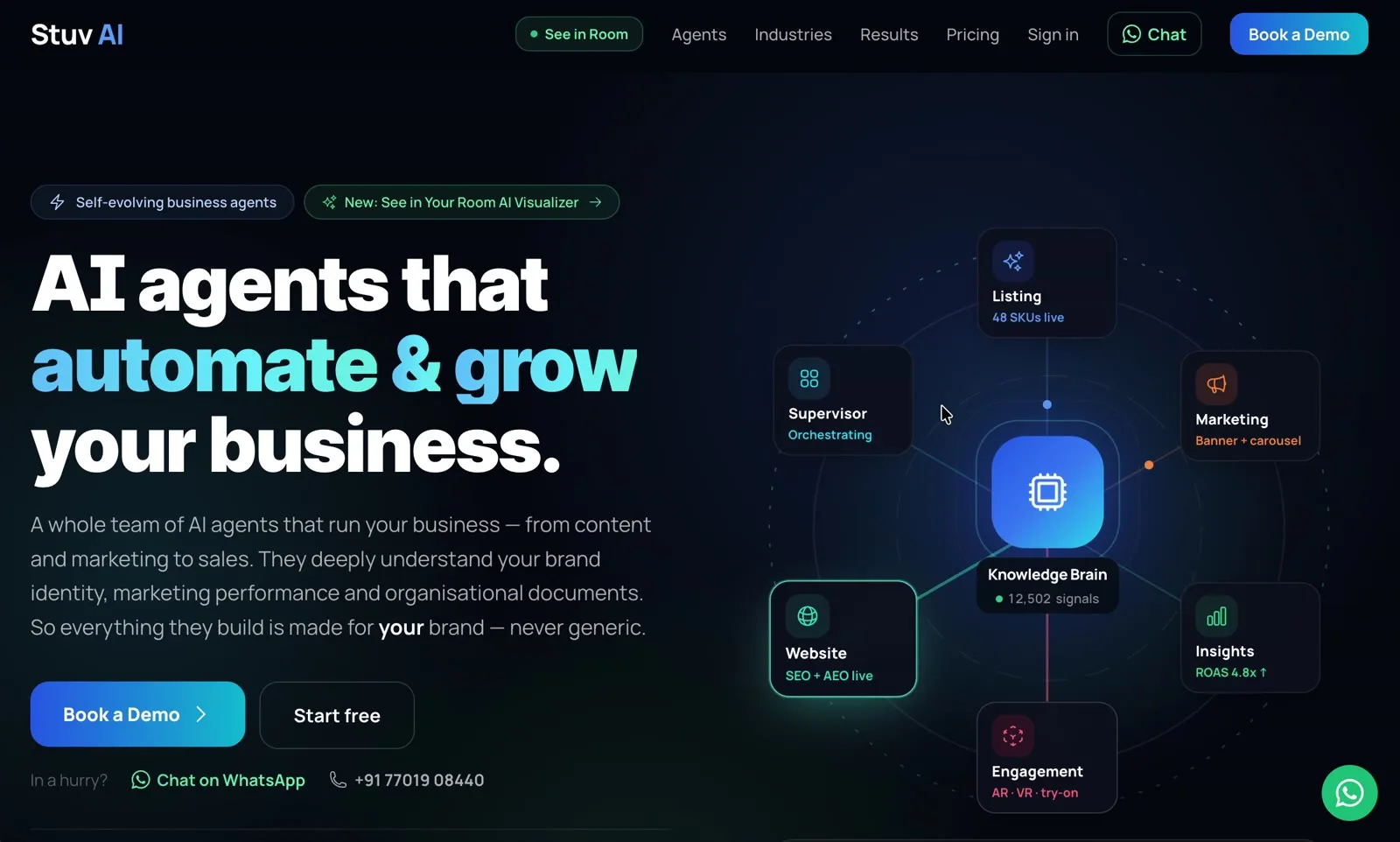
At the centre, its website describes a knowledge brain that reads your product range, your ads, your Shopify store, your chats and your brand, and writes back to it. Stuv describes it as self evolving: every agent reads and writes to it, with nightly reflection and weekly evolution turning feedback into sharper instructions. Around it, the site lists a roster built for visual commerce. A listing agent turns one product photo into studio, lifestyle and editorial images and live listings. A content agent writes copy that ranks and sells. A website agent and a mobile website agent build the storefront. There are marketing, insights and engagement agents, a see in your room agent that lets shoppers place furniture in their own space, and a supervisor agent that orchestrates the rest. The site describes specific editions for furniture and jewellery, and says more than 200 brands and 200,000 products are growing with Stuv.
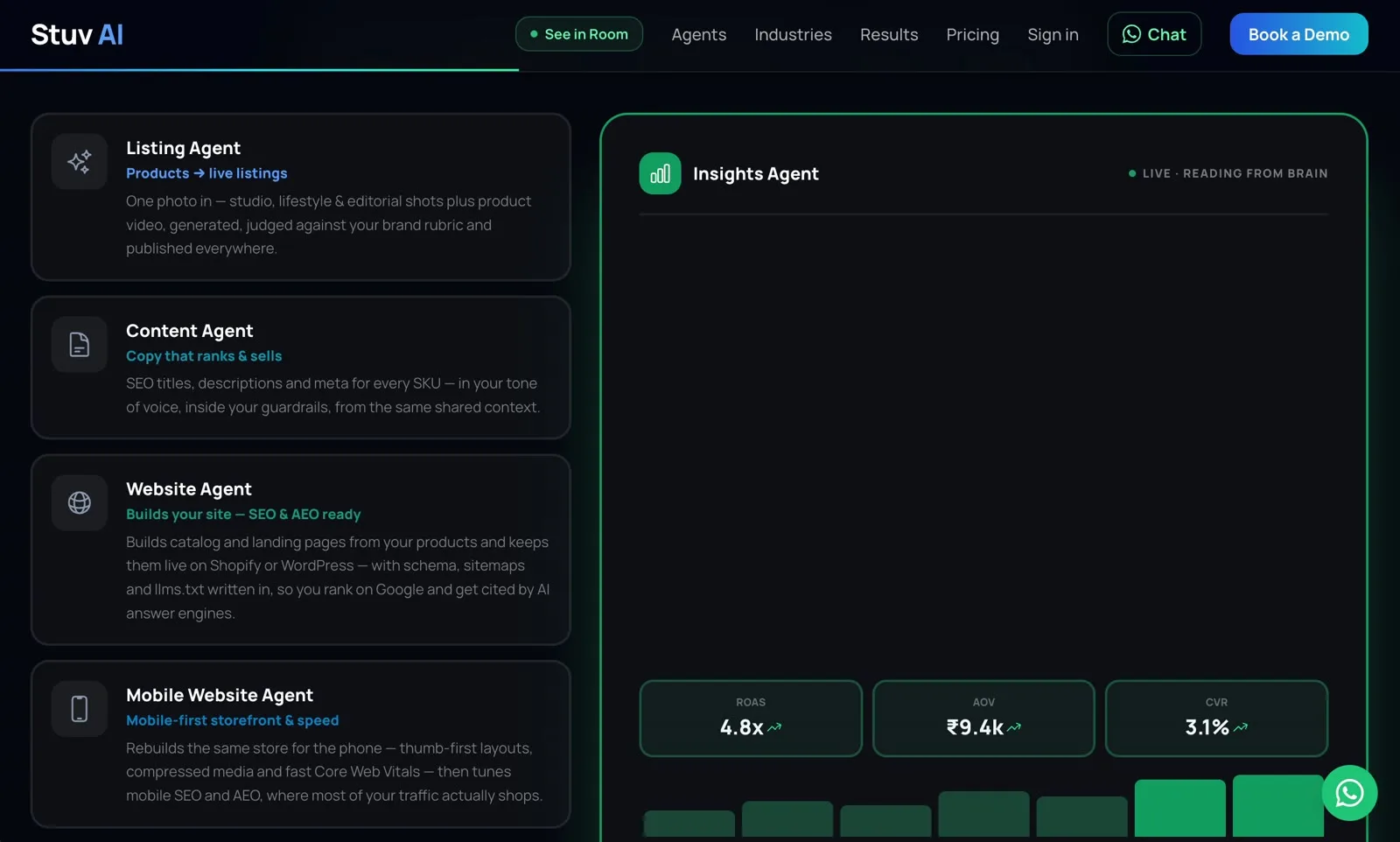
For a founder whose product pages are holding the brand back, this is a genuinely useful team. A furniture brand that can turn one photograph into a room scene, and let a shopper see the sofa in her own living room, has removed a real barrier to purchase.
The product page trap
But read the roster again, and notice where its weight sits. Listings. Content. Website. Mobile website. See in your room. The centre of gravity is the product range and the storefront: making the product look right and the page convert. That is the visible part of the business. It is not where most D2C brands actually stall.
We call this the product page trap. Once the product page is good, making it better yields less every month, while the real constraints sit elsewhere, quietly compounding.
The first is demand. A beautiful page that nobody visits sells nothing. Paid media on Meta and Google gets more expensive every quarter, organic search needs constant technical care, and a new channel has appeared that most D2C brands are not even measuring: the answer engines. When a buyer asks ChatGPT or Google's AI Overview for the best solid wood dining table under a lakh, whether your brand is named decides whether she ever reaches your listing.
The second is the sale itself. Furniture and jewellery are considered purchases. Buyers ask questions, compare, wait for a festival, bring a spouse or an interior designer into the decision. A large share of revenue for many of these brands comes from conversations: with trade buyers, architects, corporate gifting teams, wholesale partners. That is a pipeline, and a pipeline needs someone to research the account, write to the right person, follow up and keep the record.
The third is what happens after the order. Delivery windows, installation, returns, the second purchase. A brand that grows on repeat customers is built in the weeks after the first sale, not on the product page.
The founder's year two, in Nagent
Go back to our furniture founder. Her product pages are finally beautiful. Her number is still flat. In Nagent, the first screen she opens each morning is not her product pages. It is her growth team: AI coworkers that worked through the night on demand, sales and customers, and the few decisions that need her.
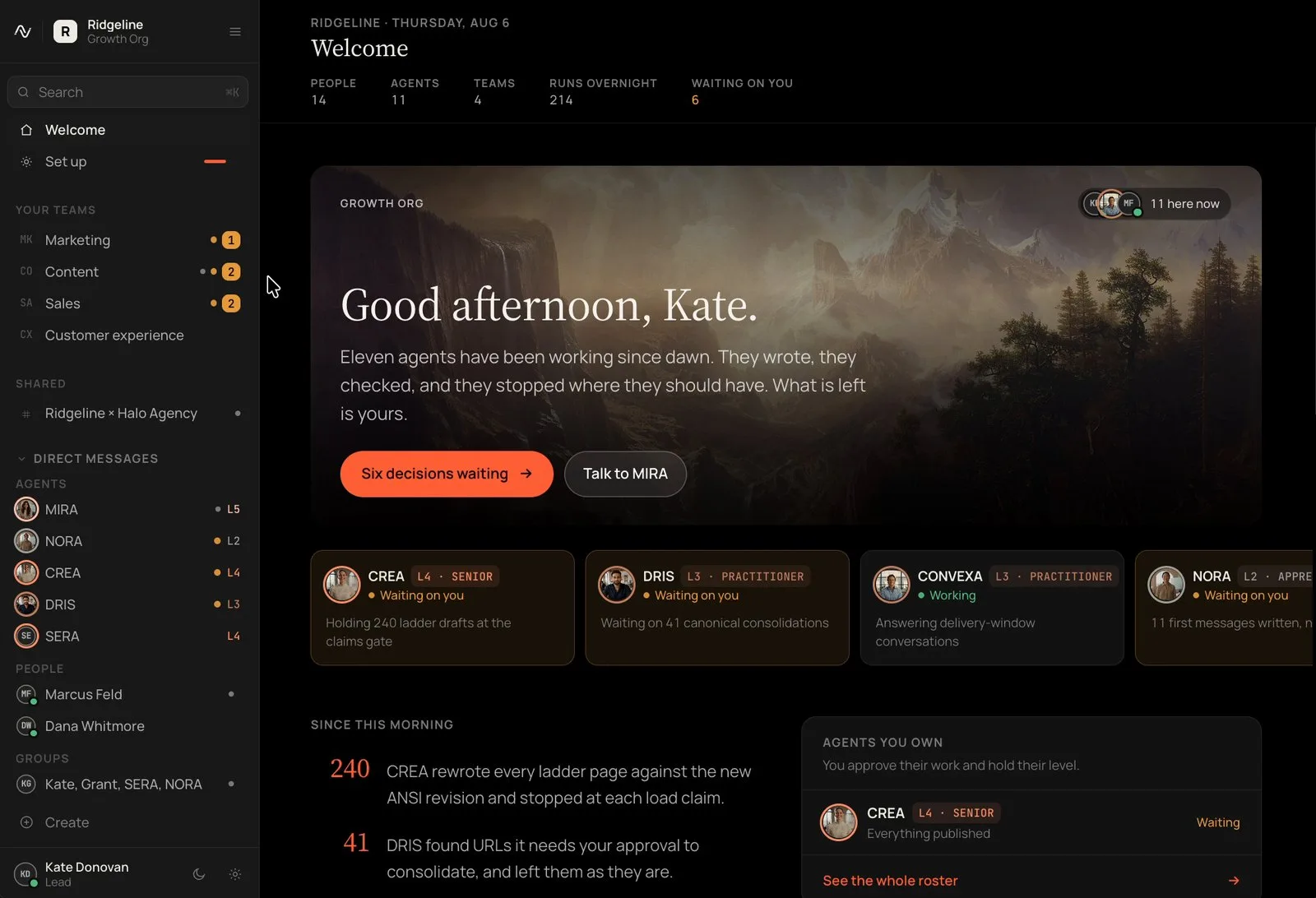
Demand. NIA, the AI coworker for paid ads, has tested creative on Meta and Google and staged a budget increase for the campaign that is selling, which waits for her approval. The AI coworker for search has checked that her product pages still show up on Google, and that her brand is named when a buyer asks an AI assistant for the best solid wood dining table. One team covers every channel that brings demand: paid, search and social in one view.

The sale. Furniture is a considered purchase, and much of her revenue comes from conversations: interior designers, architects, corporate gifting buyers. NORA, the AI coworker for outbound, researches the ones who showed interest and drafts a first message to the right person. Her team reads it before it is sent.
After the order. When a customer asks about a delivery window or installation, the customer experience coworker answers quickly, so the second purchase is earned in the weeks after the first.
She does not have to review everything forever. Every AI coworker starts like a new hire, with its work waiting for a person, and earns more freedom as it proves itself. The things that must always stay human, like spending more budget or sending to a customer, stay human. And where her plan includes it, a Nagent marketer sits in the same workspace and owns the number with her.
Where is your bottleneck?
If your product pages are holding you back, fix them first. But if your pages are already good and the number is still flat, the problem is demand you are not capturing, conversations nobody follows up and customers who never come back. That is the work of a growth team.
See what each plan includes on the pricing page, or book a walkthrough with the team.
At a glance
| Stuv AI | Nagent | |
|---|---|---|
| Built around | Your product range and storefront | Your growth number |
| Who does the work | Agents for listings, content, website and try on | AI coworkers and your people, in one workspace |
| Who decides what AI can do alone | Brand guardrails the agents learn | A track record each AI coworker earns, approved by you |
| How far the work reaches | Product pages, website and marketing | Demand, sales conversations and customer experience |
| Who owns the result | You | You, with a Nagent marketer where your plan includes it |
Frequently asked questions
What does Stuv AI offer a D2C furniture or jewellery brand?
On its public website, Stuv AI describes a team of agents around a self evolving knowledge brain that reads your product range, ads, Shopify store, chats and brand. Its roster is built for visual commerce: listing, content, website and mobile website agents, marketing, insights and engagement agents, a see in your room agent and a supervisor, with editions for furniture and jewellery.
What is the product page trap in D2C growth?
The product range is the most visible part of the business, so it feels like the bottleneck. Once the product page is good, making it better yields less every month, while the real constraints sit elsewhere, quietly compounding: demand before a customer reaches the page, the sale itself, and what happens after the order.
Where do most D2C brands actually stall after their first year?
In demand, in the sale and after the order. Paid media gets more expensive every quarter, organic search needs constant care and answer engines now decide whether a brand is named at all. Considered purchases run through conversations with designers, architects and gifting buyers. And repeat customers are built in the weeks after the first sale.
How does Nagent help a brand whose product pages are already good?
Its growth team works on demand, sales and customers. NIA, the AI coworker for paid ads, tests creative on Meta and Google and stages budget changes for approval. The AI coworker for search checks that the brand shows up on Google and in AI assistants. NORA researches interested buyers and drafts first messages, and the customer experience coworker answers delivery and installation questions.
Should a D2C brand fix its product pages before anything else?
If your product pages are holding you back, fix them first. But if your pages are already good and the number is still flat, the problem is demand you are not capturing, conversations nobody follows up and customers who never come back. That is the work of a growth team.
Do I have to approve everything a Nagent AI coworker does?
Not forever. Every AI coworker starts like a new hire, with its work waiting for a person, and earns more freedom as it proves itself. The things that must always stay human, like spending more budget or sending to a customer, stay human. Where your plan includes it, a Nagent marketer sits in the same workspace and owns the number with you.
Further reading
- The comparison hub: Nagent beside the agent platforms buyers shortlist, sourced and dated
- The Earned Autonomy Ladder: How much an AI agent may do alone, decided by its record
- Anatomy of an Agent: A Configuration, Not a Program: The ten declared parts every Nagent agent is built from
- How to evaluate an agentic AI platform: Six criteria, three grades of evidence and one bounded pilot
- Autonomy is not a setting: Nagent vs NoimosAI
- Nagent vs Jasper: a hundred agents is not a team
- Nagent vs Okara: the founder is not a queue
Sources
Facts about Stuv AI are as its own pages and the reports below stated them, checked on 30 Sep 2026. Products change; the linked pages are the current word.
More comparisons
All articlesNagent vs Claude Tag: one colleague or a whole team
Claude Tag puts one shared Claude colleague in a Slack channel. Nagent gives your growth function a whole team of AI coworkers that earn trust.
Multiplayer AINagent vs Microsoft Copilot: the default and the specialist
Microsoft gives you the tools to build agents for everything. Nagent gives growth teams AI coworkers that arrive hired and earn trust.
Multiplayer AINagent vs Buzz: a protocol and a product
Block's Buzz is an open protocol where engineers assemble their own agents. Nagent is a growth team that arrives hired. How they differ for growth.
Multiplayer AIMeet the team behind the number.
Multiplayer AI for Growth. See the plans, or book a walkthrough with the team.