
Top 10 AI SDR Agents for Outbound Prospecting (2026)
An AI SDR agent finds the accounts that fit your customer profile, researches them, writes the first e-mail and handles the follow-ups, so your people spend their time on replies instead of lists. The best ones in 2026 differ on one question: how much they do alone, and how much a person sees before anything is sent.
Disclosure: Nagent makes NORA, first on this list. The other nine are described from their own published claims and prices.
Outbound has two failure modes. Done properly, with an hour of research per account, it is slow. Done fast, it is generic, and the e-mail says nothing the reader did not already know. The tools below exist to close that gap. Some are full digital workers that run the whole motion; some are research and data layers your reps work on top of; some are inbound-first and only partly outbound.
How did we pick these tools?
Research depth: does it build a sourced picture of the account, or pull a few firmographic fields and a job title?
Control: what a person sees before a send, how spend is capped, and whether what the agent may do alone widens with evidence.
Reply handling: classification, cadence changes and a clean handoff when a prospect says yes.
Data and sending: whose data it searches, whose domain it sends from, and how it treats suppressed contacts.
Value: what the entry price buys, and whether it is public.
Prices are the vendor's published figure where there is one, checked October 2026, and marked approximate otherwise.
What are the 10 best AI SDR agents in 2026?
1. Nagent NORA
NORA is Nagent's AI outbound research lead. She finds accounts that match your customer profile, researches each one into a dossier with sources, drafts the first e-mail from that dossier, runs the follow-ups, reads the replies and hands a qualified prospect to a person with a meeting to run. She works on Nagent's Sales team under SERA, the Sales chief of staff, with the writers VANI and LIPI.
Try it: Hire NORA · See plans · Talk to the team
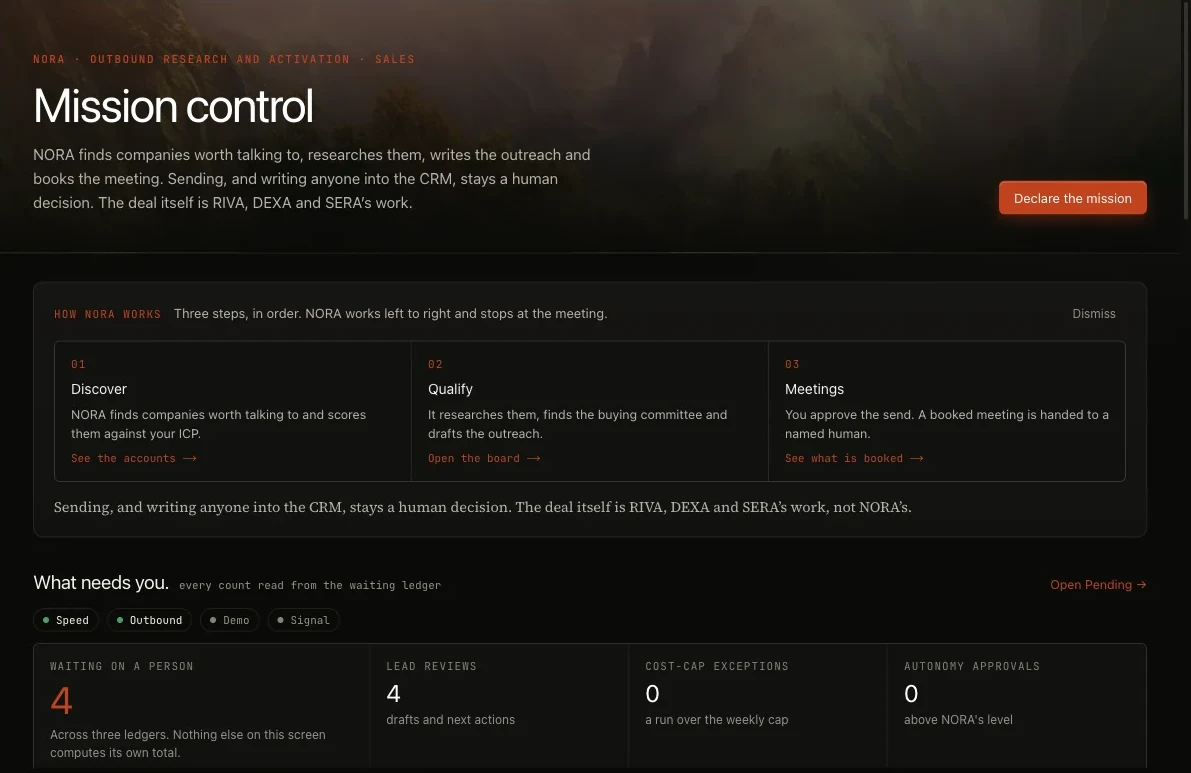
Mission control: what NORA did today, what it spent, and what is waiting on a person. Shown from a Nagent workspace.
How NORA runs outbound
Discover. She searches a contact data provider for companies and people that fit the active profile, as a one-time search or a saved campaign that runs daily or weekly, and scores each company 0 to 100. Customers and suppressed contacts are removed before anyone sees the list.
Qualify. A contact is revealed only for a company scoring 70 or more. She researches the shortlist into a dossier: an overview, why the company fits, its buying signals and its pitch hooks.
Draft. VANI writes the first touch from the dossier and your own knowledge shelves. Every claim about the prospect must trace to the dossier, or the draft is refused. With a thin dossier she asks one qualifying question instead of asserting.
Review and send. Drafts wait on her Messages surface to be read, edited, approved or rejected. On a new workspace every send waits for a person. Approved drafts go out from your own sending account and verified domain, inside the sending hours you set.
Cadence and replies. Follow-ups and a closing breakup run for prospects who have not replied. Each reply is classified as interested, objection, scheduling or unsubscribe, and the cadence stops or changes course.
Handoff. A qualified reply becomes a meeting and a handoff card with the dossier and the buying committee. A person acknowledges it, and a handoff nobody acknowledges within 36 hours escalates.
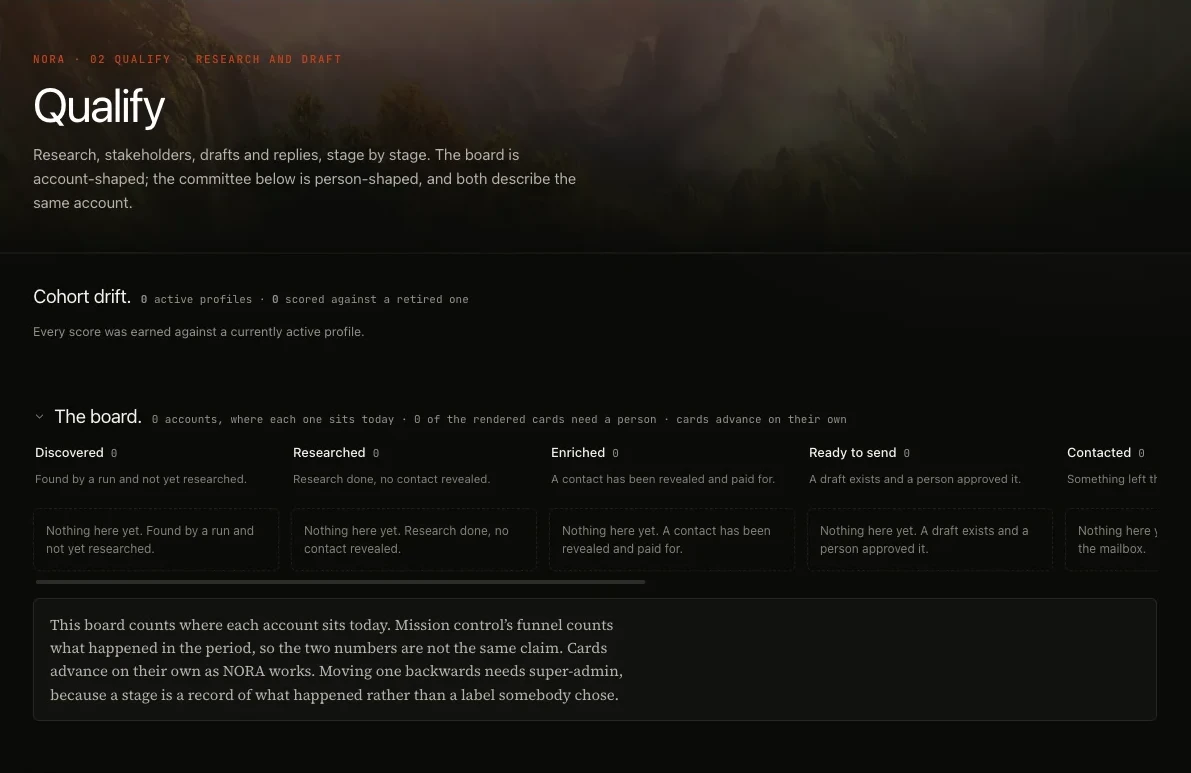
The Qualify board. A company moves only when something happened: research completed, people found, a draft approved, an e-mail sent.
Why NORA stands out
Every claim traces to the research. A draft cannot say something about the reader that the dossier does not support. That is the difference between personalised and merely merged.
Contacts revealed only for a fit. No contact data is spent on a company under the 70 threshold.
Spend has a ceiling. Research and reveals run against a daily outreach budget and a cost-cap exception queue, and every agent on Nagent has a daily and a monthly spending cap.
Autonomy is earned, not configured. Once she has at least 20 scored actions in 30 days, a strong record and no overrides, Nagent proposes widening what she may do alone, and a workspace admin accepts or declines. Repeated overrides propose narrowing it.
The handoff is a human step. Her job ends when a person has a meeting to run. A booked meeting nobody owns is treated as a failure to escalate, not a success to count.
One room with your people. Ask her in the Sales room and the answer comes back in a thread with its sources. Everything said there is attributed and kept.
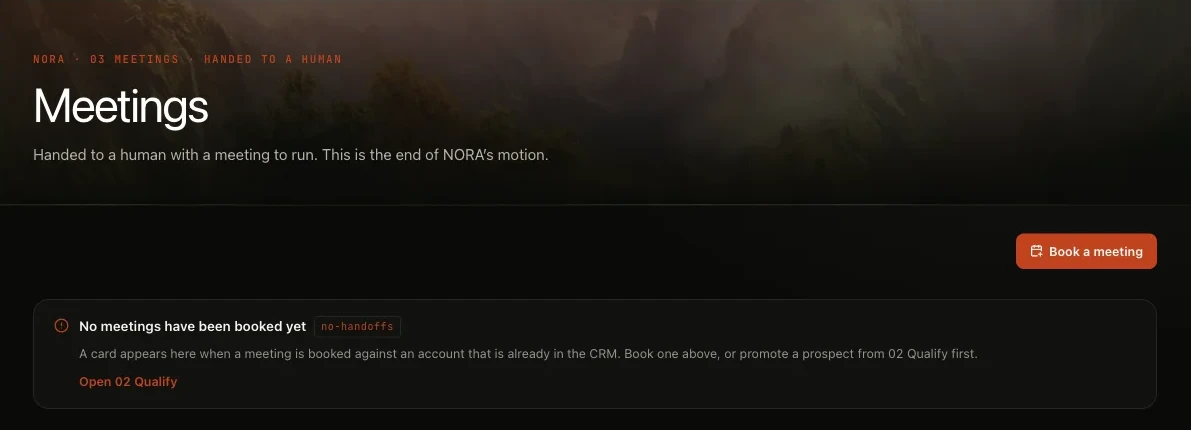
Meetings and handoff. The dossier and the committee travel with the card.
Limits to know
She sends e-mail only. Social templates can be written, and a person sends them.
Her CRM view reads the workspace's own lead records. An outside CRM can be connected as a tool, but her pipeline does not sync with it.
No phone or voice channel.
Pricing
NORA works on the Sales team. Nagent plans: Solo $29.99/mo ($19.99/mo billed annually), Team $299/mo ($199/mo annually), Business $1,499/mo ($999/mo annually), and Enterprise by quote. See pricing for which plans include the Sales team.
Best for: founders and heads of sales who run outbound without a research desk and want every send seen by a person until the agent has earned more.
2. 11x
Digital sales workers for prospecting, outreach and phone-based engagement. 11x positions its workers as autonomous: they execute multi-channel pipeline generation and learn from outcomes.
Standout: the most "hands off" of the full workers, with a phone channel the others lack.
Watch for: the published entry price is from $3,750 a month, so it suits teams already spending on headcount.
Best for: companies that want a worker running the whole motion, including calls, and have the volume to justify it.
3. Artisan
An AI BDR platform combining prospect research, enrichment, personalised outreach and meeting booking in one product. Artisan's claim is that an AI BDR can automate most of the outbound workflow from targeting to meetings.
Standout: research, data and sending in one place, with a single "employee" to manage.
Watch for: pricing is by custom quote.
Best for: teams that want one vendor for data and outreach and are comfortable with a quote-based contract.
4. Unify
An outbound agent that combines CRM context, data, research, intent signals and multichannel sequencing. Unify's claim is signal-triggered prospecting, qualification and outreach on autopilot.
Standout: signals first. Website visits, hiring and other intent events start the play rather than a static list.
Also does: multichannel sequences and CRM-aware routing.
Best for: teams with a working CRM and intent data who want outreach to start from a signal. Published entry price $20 per seat per month, with usage on top.
5. Regie.ai
An AI sales engagement and prospecting platform built for reps and agent-assisted workflows. Regie.ai's claim is that agents and reps generate more pipeline together than either alone.
Standout: the agent prioritises and drafts; the rep stays in the seat. The cheapest published entry point on this list at $49 a month.
Best for: rep-led teams that want AI inside the existing sequence tool rather than a replacement for the rep.
6. Clay
A GTM data and orchestration platform with research agents, signals, workflows and sales execution. Clay positions agent-powered research and data infrastructure as the foundation for a repeatable revenue motion.
Standout: the deepest data layer here, with waterfall enrichment across many providers and research agents you can shape yourself.
Watch for: it is a builder's tool. Someone on the team owns the tables and workflows, and pricing is by actions and data credits.
Best for: revenue operations teams that want to build their own outbound engine and feed it to a sequencer.
7. Common Room
A revenue operating layer that unifies buyer and conversation context for human and AI execution. Common Room's claim is that buyer intelligence can power pipeline workflows from first signal through close.
Standout: identity resolution across community, product and web activity, so the signal behind each account is visible.
Watch for: published entry price from $2,500 a month.
Best for: product-led and community-led companies with a lot of buyer activity to read.
8. Qualified
A Salesforce-owned inbound AI SDR platform. Its agent, Piper, engages website visitors and routes qualified meetings, with broader Agentforce collaboration under development.
Standout: the strongest inbound agent on this list, built for the Salesforce stack.
Watch for: inbound first. It is not an outbound research tool, and pricing is sales-led.
Best for: Salesforce shops whose pipeline starts on the website.
9. Apollo.io
A contact database and sequencing platform that has added AI research and drafting on top of its own data.
Standout: a large B2B contact database and sequences in one subscription, at a low per-user price.
Watch for: the AI layer personalises from database fields more than from research, so drafts can read generic without a person's edit.
Best for: small teams that want data, sequences and a first pass of AI writing without a second vendor. Approximately $49 per user per month on paid plans.
10. AiSDR
A managed AI SDR that runs outbound e-mail and LinkedIn campaigns from your customer profile, with a human success team behind it.
Standout: low setup effort; the vendor's team configures and tunes the campaigns with you.
Watch for: less visibility into why a given account or line was chosen, and pricing is in the region of $900 a month.
Best for: teams that want outbound run for them rather than a tool to operate.
How do they compare at a glance?
Tool: Nagent NORA, What it is: Outbound research lead on an AI Sales team, Research depth: Sourced dossier per account; every claim traces to it, Who sees a send: A person approves every send on a new workspace; autonomy widens on evidence, Entry price: Nagent plans from $29.99/mo (check which include Sales)
Tool: 11x, What it is: Autonomous digital worker, e-mail and phone, Research depth: Firmographic and signal, Who sees a send: Worker sends; review is configurable, Entry price: From $3,750/mo
Tool: Artisan, What it is: AI BDR with its own data, Research depth: Enrichment plus research, Who sees a send: Agent sends; review is configurable, Entry price: Custom quote
Tool: Unify, What it is: Signal-triggered outbound agent, Research depth: Signals plus CRM context, Who sees a send: Agent runs plays; review is configurable, Entry price: $20/seat/mo plus usage
Tool: Regie.ai, What it is: Agent-assisted sales engagement, Research depth: Prioritisation and drafting, Who sees a send: The rep, Entry price: $49/mo
Tool: Clay, What it is: GTM data and orchestration, Research depth: Waterfall enrichment, custom research agents, Who sees a send: Your sequencer, Entry price: Actions and data credits
Tool: Common Room, What it is: Revenue operating layer, Research depth: Identity and activity signals, Who sees a send: Your workflows, Entry price: From $2,500/mo
Tool: Qualified, What it is: Inbound AI SDR (Salesforce), Research depth: Visitor and CRM context, Who sees a send: Agent engages on site, Entry price: Sales-led quote
Tool: Apollo.io, What it is: Database plus sequences with AI writing, Research depth: Database fields, Who sees a send: The rep, Entry price: ~$49/user/mo
Tool: AiSDR, What it is: Managed AI SDR, Research depth: Profile-based, Who sees a send: Vendor-run campaigns, Entry price: ~$900/mo
Prices change often; check each vendor's pricing page before buying. Entries 2 to 8 paraphrase the vendor's own published claims as recorded in Nagent's comparison research.
How do you choose the right one?
Start from who should see a send. If the answer is "a person, until the agent has proved itself", you want NORA or Regie.ai. If the answer is "nobody, we want volume", you want 11x or Artisan and the budget that comes with them. If you already own a data layer and a sequencer, Clay or Unify slot in without replacing either. If pipeline starts on your website and you run Salesforce, Qualified is the inbound half of the problem.
Then check three things on a trial:
Ask for the evidence behind one e-mail. A good agent can show the source for every claim about the reader. A weak one shows a template with fields filled in.
Find the spend cap. Research and contact reveals cost money per account. Know where the ceiling is before the first campaign runs.
Send a reply that says yes. Watch what happens next: who is told, how fast, and what they receive. The handoff is where most tools go quiet.
Frequently Asked Questions
What is an AI SDR agent?
Software that does the work of a sales development rep: finding accounts that fit a customer profile, researching them, writing and sending the first outreach, following up and passing interested replies to a person. The tools differ on how much of that runs without review.
Do AI SDR agents replace SDRs?
They replace the list-building and first-draft work. The judgement calls, the reply conversations and the meetings still belong to people, and the better tools are designed around that handoff rather than around removing it.
How much do AI SDR agents cost?
From under $50 a month for an agent-assisted tool like Regie.ai, to $2,500 to $3,750 a month and up for autonomous workers like Common Room and 11x. Nagent plans start at $29.99 a month; see the pricing page for which plans include the Sales team.
Will an AI SDR send e-mail without my approval?
It depends on the tool and its settings. NORA holds every send for a person on a new workspace and widens what she may do alone only on a record of scored actions. Several autonomous workers send by default and make review a configuration.
What should I check before trusting the research?
Ask where each fact in a draft came from. If the tool cannot point to a source, treat the personalisation as decoration.
What should you do next?
Ready to run outbound that is researched before it is sent? NORA finds the accounts, builds the dossier, drafts the e-mail and hands you the meeting. Hire NORA → · Read the NORA Field Manual · Why GTM agents are collapsing the SDR org
See an AI team at work
Book a 15-minute demo and watch a Nagent team plan, do and hand back real work in its room.