The Nagent Times
All the Intelligence That Executes
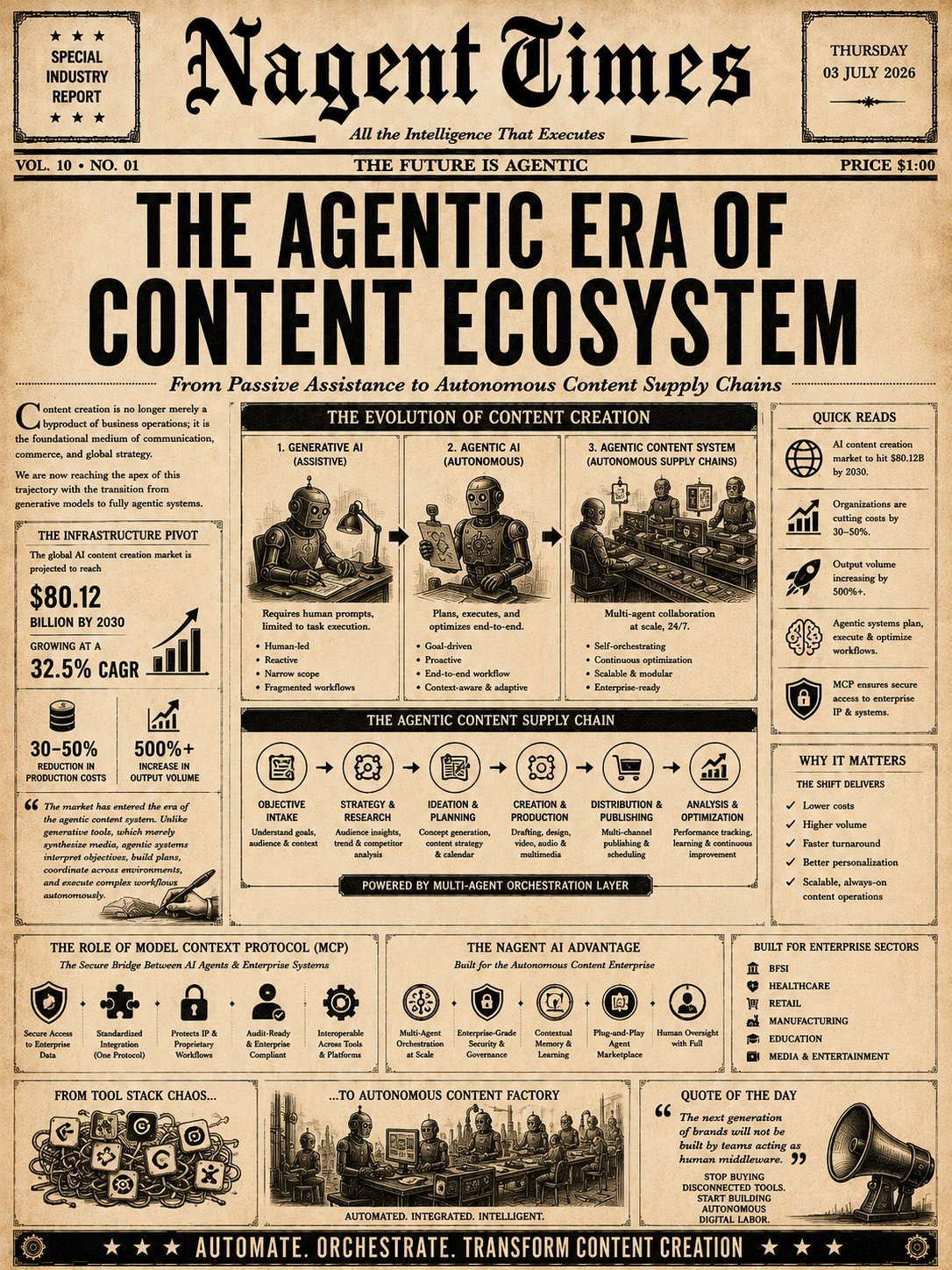
The Agentic Era of Content Ecosystem
Executive Summary: The Infrastructure Pivot
Content creation is no longer merely a byproduct of business operations; it is the foundational medium of communication, commerce, and global strategy. Over the past three decades, the digital landscape has witnessed a systematic dismantling of the barriers to media production. We are now reaching the apex of this trajectory with the transition from generative models to fully agentic systems.
The global AI content creation market is projected to reach $80.12 billion by 2030, growing at a 32.5% CAGR. This exponential growth is driven entirely by the shift from reactive AI assistants to agentic systems that autonomously plan, execute, and refine entire content pipelines. Generative artificial intelligence addressed friction by democratizing the creative act, but it functioned primarily as an assistive mechanism requiring constant human prompting and oversight.
Today, organizations that utilize AI for content creation are reducing production costs by 30-50% while simultaneously increasing output volume by over 500%. The market has entered the era of the agentic content system. Unlike generative tools, which merely synthesize media, agentic systems possess the capacity to interpret objectives, construct plans, coordinate across digital environments, and execute complex workflows autonomously.
In this edition, we unpack the structural collapse of legacy content workflows, the critical role of the Model Context Protocol (MCP) in securing enterprise IP, and how intelligent orchestration layers, such as those built at Nagent AI, are providing the multi-agent blueprint for the autonomous content factory.
The Ontological Shift: The Death of the Manual Content API
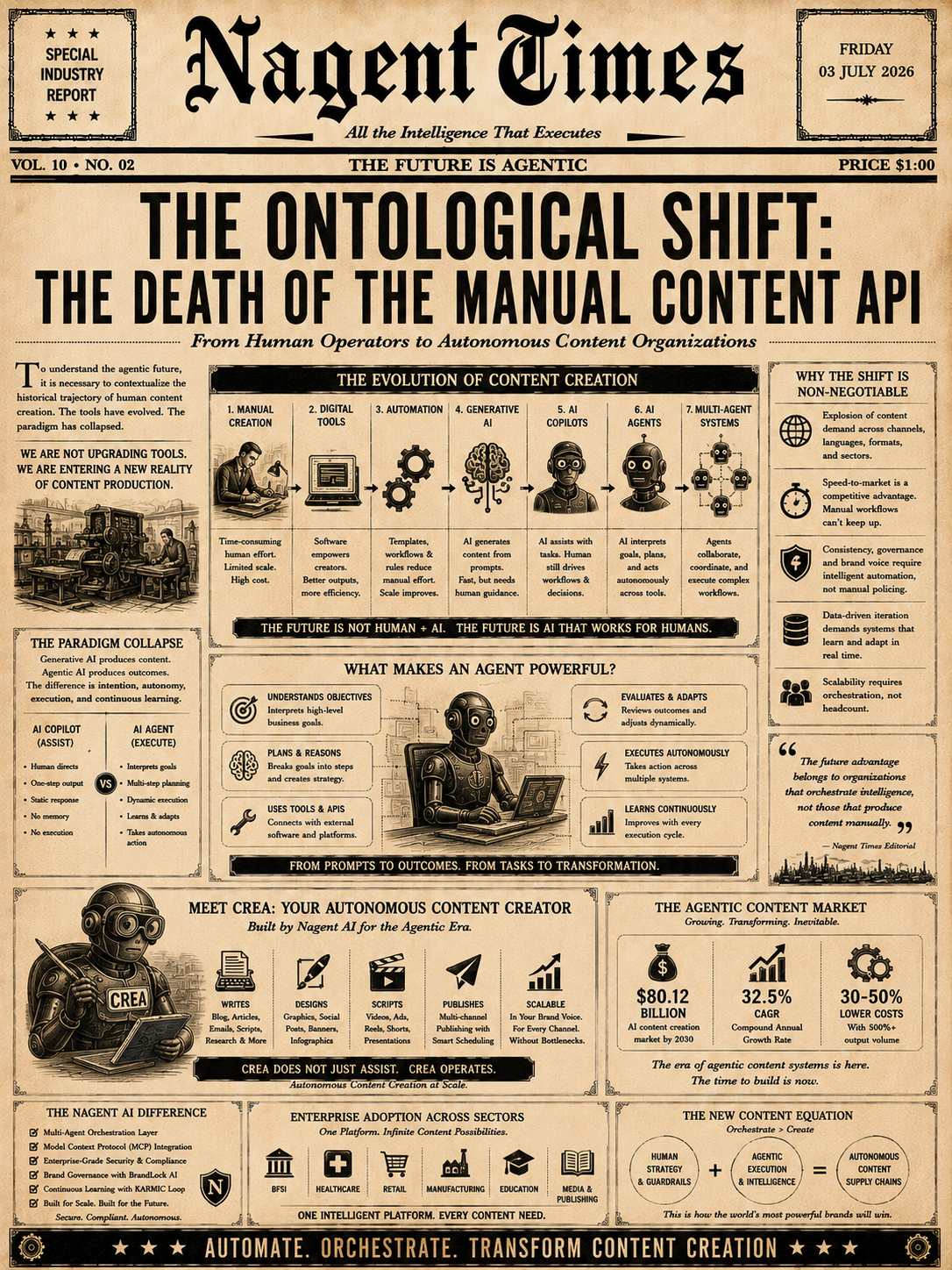
To understand the agentic future, it is necessary to contextualize the historical trajectory of human content creation. The evolutionary progression of content creation tools follows a distinct path: Manual Creation transitioned to Digital Tools, which evolved into Automation, followed by Generative AI, AI Copilots, AI Agents, Multi-Agent Systems, and ultimately, Self-Improving Content Organizations.
Market analysts and strategic consulting firms sharply differentiate between generative and agentic artificial intelligence. Generative systems rely on human prompts to produce a static output, excelling at pattern recognition and content synthesis. Conversely, agentic systems can reason, plan, coordinate, and autonomously execute multi-step work.
An agent can interpret a high-level business objective, formulate a multi-stage strategy, interface with external software tools, evaluate its intermediate results, and dynamically adjust its approach in response to environmental feedback. This is the difference between an AI copilot and an AI agent.
The requirement to rapidly produce, localize, govern, and iterate upon materials across distinct sectors underlines why the transition to agentic workflows is not merely a marketing optimization, but a foundational operational imperative for the modern enterprise. In this era, the sheer volume of required media necessitates an industrialized, continuously learning production ecosystem where the primary competitive advantage is no longer the ability to create, but the ability to orchestrate.
At Nagent AI, we engineered the CREA Content & Creative Agent exactly for this reality. CREA does not just assist; it operates as an autonomous content creator that writes, designs, scripts, and publishes content at scale in your brand voice, for every channel, entirely without the traditional production bottleneck.
The Multi-Agent Content Factory and Multimodal Disruption
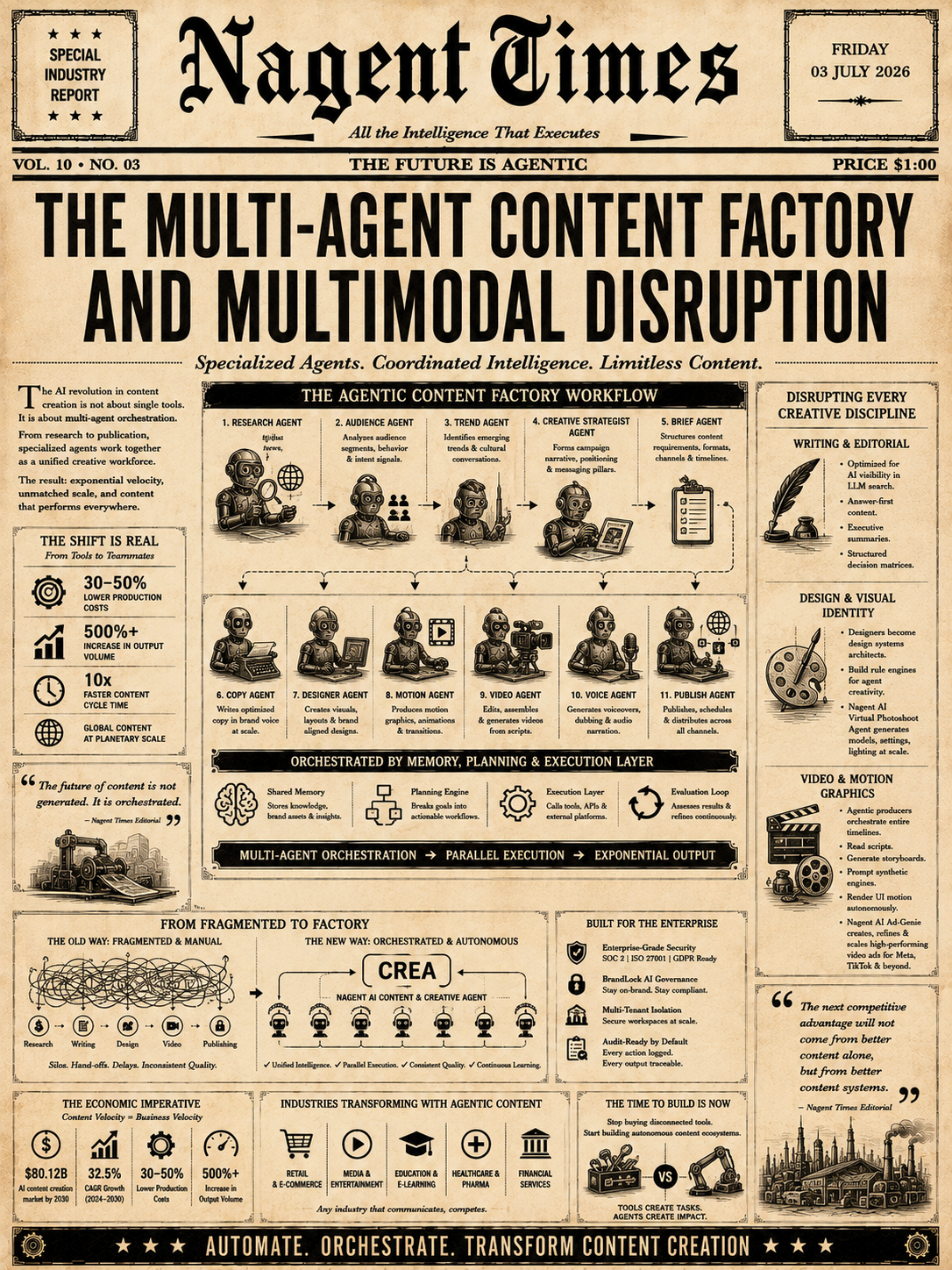
The true power of the artificial intelligence revolution lies not in isolated capabilities, but in the orchestration of multi-agent systems. The market is decidedly shifting from single conversational interfaces toward automated content factories where specialized agents act as coordinated teammates with planning, memory, and execution capabilities.
In an agentic content factory, workflows are divided among highly specialized entities. A Research Agent continuously monitors global market trends and API feeds. It passes this data to an Audience Agent and a Trend Agent, which synthesize the demographic implications. A Creative Strategist Agent formulates a campaign narrative and hands it to a Brief Agent, who structures specific asset requirements. Simultaneously, a Copy Agent, Designer Agent, Motion Agent, Video Agent, and Voice Agent execute the creative production.
This multi-agent orchestration is disrupting every traditional creative discipline:
- Writing and Editorial: AI engines are now optimizing for "AI visibility" inside conversational search engines like Google AI Overviews and ChatGPT. AI agents generate answer-first content blocks, executive summaries, and structured decision matrices because these formats improve logical flow, contextual understanding, and answer extraction for LLMs.
- Design and Visual Identity: Designers are transitioning into design systems architects, building the rules engines that constrain and guide the aesthetic output of autonomous agents. The Nagent AI Virtual Photoshoot Agent exemplifies this, generating custom models, weather, settings, and lighting at scale without a physical studio.
- Video and Motion Graphics: Agentic video production introduces systems capable of orchestrating entire timelines. An agentic producer will read a script, generate a storyboard, prompt synthetic video engines for specific shots, and render UI motion autonomously. The Nagent AI Ad-Genie agent natively generates, refines, and scales high-performing video ads for platforms like Meta and TikTok.
The October industry guide
Infrastructure, Governance, and The Model Context Protocol
While the output of agentic systems commands public attention, the underlying infrastructure constitutes the true competitive advantage. Building a single agent is a relatively solved technical challenge; ensuring that multiple autonomous systems collaborate without producing chaotic, contradictory outputs requires highly structured orchestration.
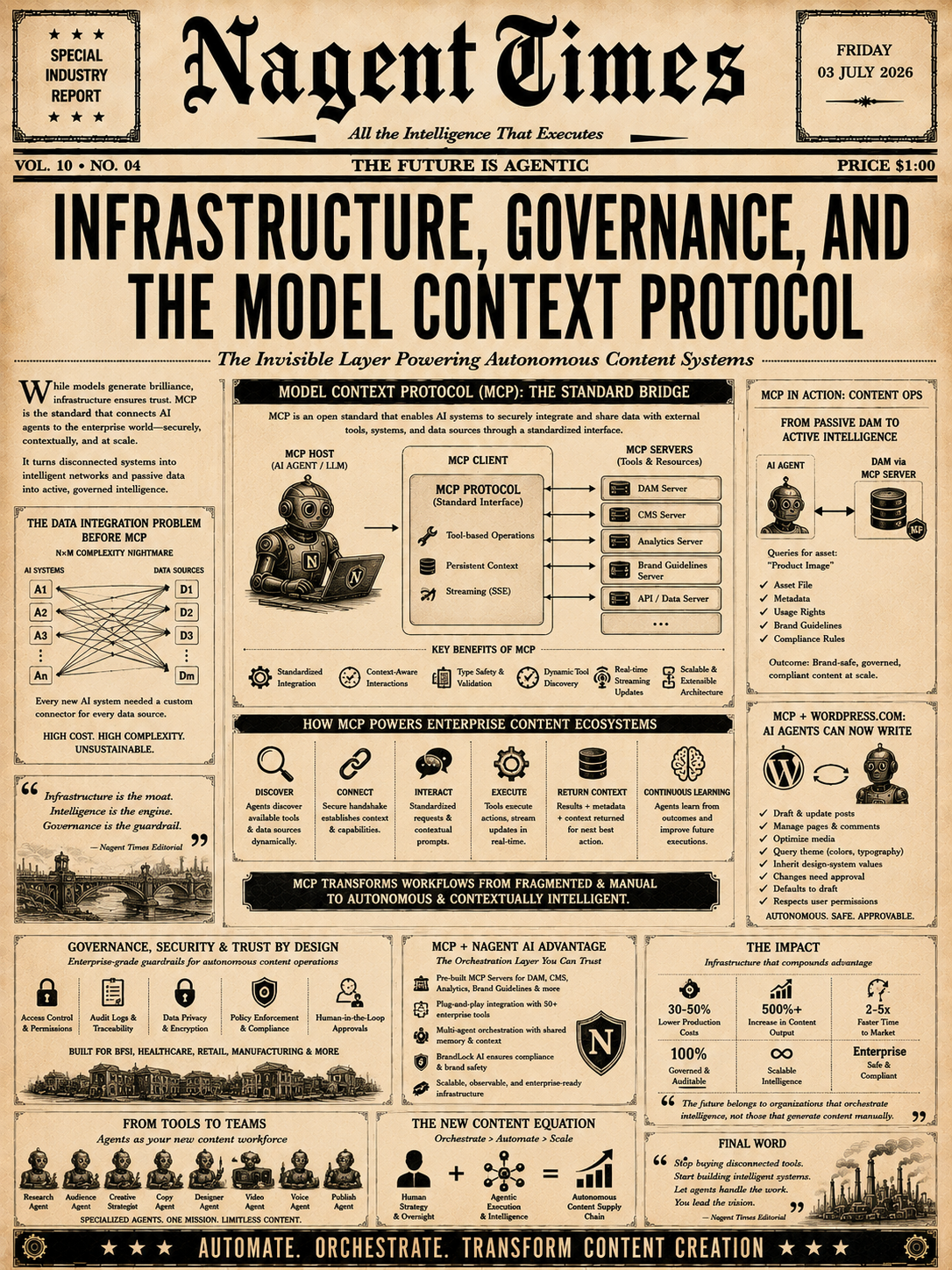
The critical bridge between raw computational models and enterprise utility is the Model Context Protocol (MCP). MCP is an open standard and open-source framework introduced to standardize the way AI systems integrate and share data with external tools, systems, and data sources. It provides a standardized interface for reading files, executing functions, and handling contextual prompts. Before MCP, developers had to build custom connectors for each data source, resulting in an "N×M" data integration problem.
MCP operates on three main principles: tool-based operations, persistent context across interactions, and streaming communication using Server-Sent Events (SSE) for real-time updates during long-running tasks like video generation. The protocol distinguishes between an MCP host (typically the AI agent interacting with the LLM), MCP clients, and MCP servers (which provide specific tools or resources). This architecture enables semantic and context-aware interaction, providing type safety and dynamic tool discovery.
In content operations, MCP transforms a passive Digital Asset Management (DAM) system into an active intelligence provider. When an AI agent requires a corporate logo or product specification, it queries the DAM via an MCP server. The server returns not only the asset but also its governed metadata, usage rights, and brand guidelines, ensuring strict regulatory and brand compliance.
Furthermore, MCP is enabling unprecedented workflows in content management systems. For instance, WordPress recently expanded its MCP capabilities to give AI agents write access. AI agents can now autonomously draft posts, update pages, manage comments, and optimize media directly within WordPress. Crucially, before generating a page, agents can query the site's active theme to retrieve its color palette and typography settings, meaning the generated content inherits design-system values for brand-safe outputs. To manage risks, changes require user approval, default to draft status, and respect existing permissions.
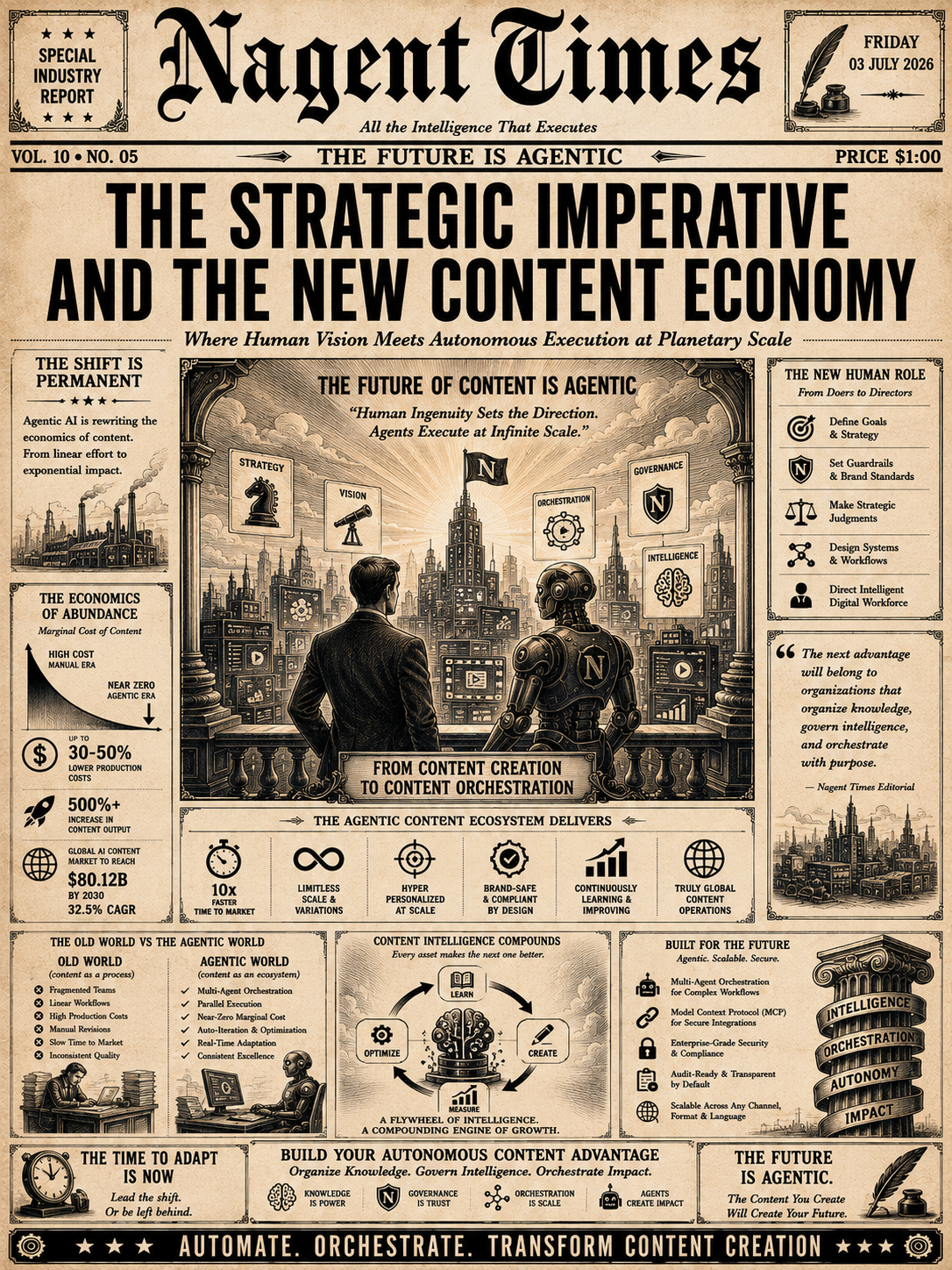
The Strategic Imperative and the New Content Economy
The integration of agentic artificial intelligence initiates a profound economic restructuring of the content ecosystem. The fundamental shift is characterized by the economics of abundance. Historically, the production of high-fidelity media required linear increases in capital and human labor. Artificial intelligence entirely decouples this relationship, driving the marginal production cost of digital content effectively toward zero.
As the burden of manual execution is absorbed by multi-agent systems, the shift from creation to orchestration accelerates. Human value is decisively shifting toward defining goals, making strategic judgments, maintaining brand standards, and directing autonomous systems, rather than manually producing every asset. Designers, writers, and editors are becoming systems architects, governing the parametric rules that dictate autonomous visual and textual output.
The future of content is undeniably agentic, defined by a symbiotic ecosystem in which human ingenuity provides the strategic imperative and intelligent systems execute with unprecedented velocity and scale. Organizations that effectively organize, govern, and expose their brand, product, customer, and creative knowledge will decisively outperform those that merely adopt standard foundation models.