The Nagent Times
All the Intelligence That Executes
The Agentic Era of Manufacturing: From Factory Optimization to Ecosystem Orchestration
Executive Summary: The Industrial Infrastructure Pivot
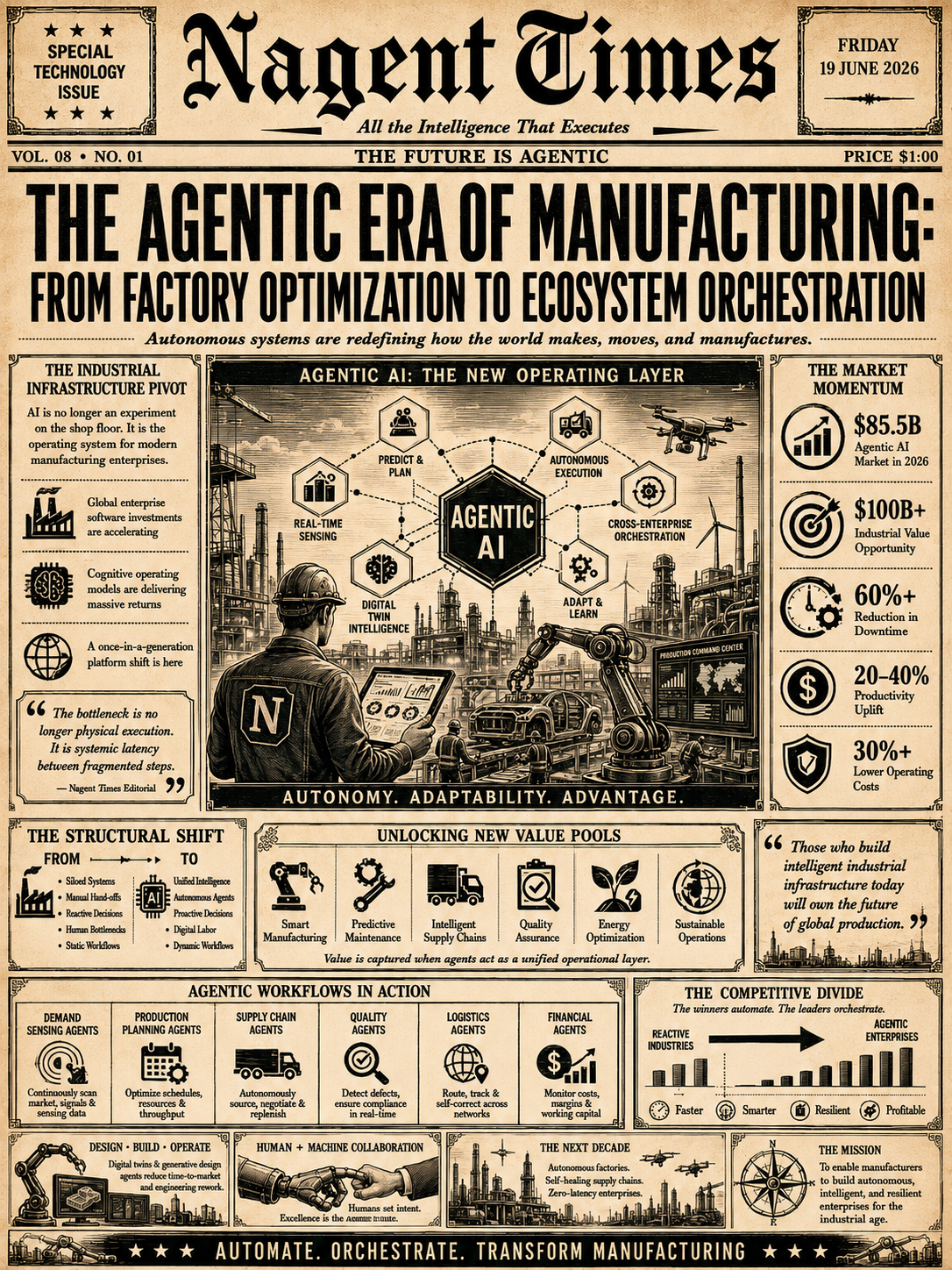
The global industrial sector has crossed a definitive threshold, transitioning from localized automation routines to the deployment of autonomous industrial infrastructure. Across the global economy, artificial intelligence is no longer an experimental feature bolted onto an existing facility. It has become the foundational operating layer rearchitecting how industrial enterprises manage risk, optimize supply chains, and scale output. The magnitude of this structural shift is confirmed by capital deployment, with global enterprise software investments accelerating rapidly as companies establish cognitive operating models.
For manufacturing and industrial operations, we are observing a once in a generation platform shift. Traditional industrial software solutions historically operated within rigid silos, requiring manual data handling to bridge information gaps between production floors and corporate boardrooms. The defining characteristic of the new industrial landscape is the rise of agentic systems capable of independent reasoning, dynamic planning, and cross enterprise workflow execution. Organizations treating AI as core infrastructure rather than an isolated tool are capturing massive operational leverage, generating returns that permanently alter the competitive dynamics of heavy industry.
The bottleneck in modern manufacturing is no longer the speed of physical execution, but the systemic latency that occurs between fragmented operational steps. In this thought leadership report, we outline the structural collapse of legacy data hierarchies, explore the emergence of embodied intelligence, and detail how advanced multi agent orchestration layers are providing the ultimate blueprint for the fully autonomous enterprise. By shifting the operational paradigm from human input to digital labor, forward thinking manufacturers are unlocking new value pools that will dictate global competitiveness over the next decade.
The Ontological Shift: Orchestration Over Optimization
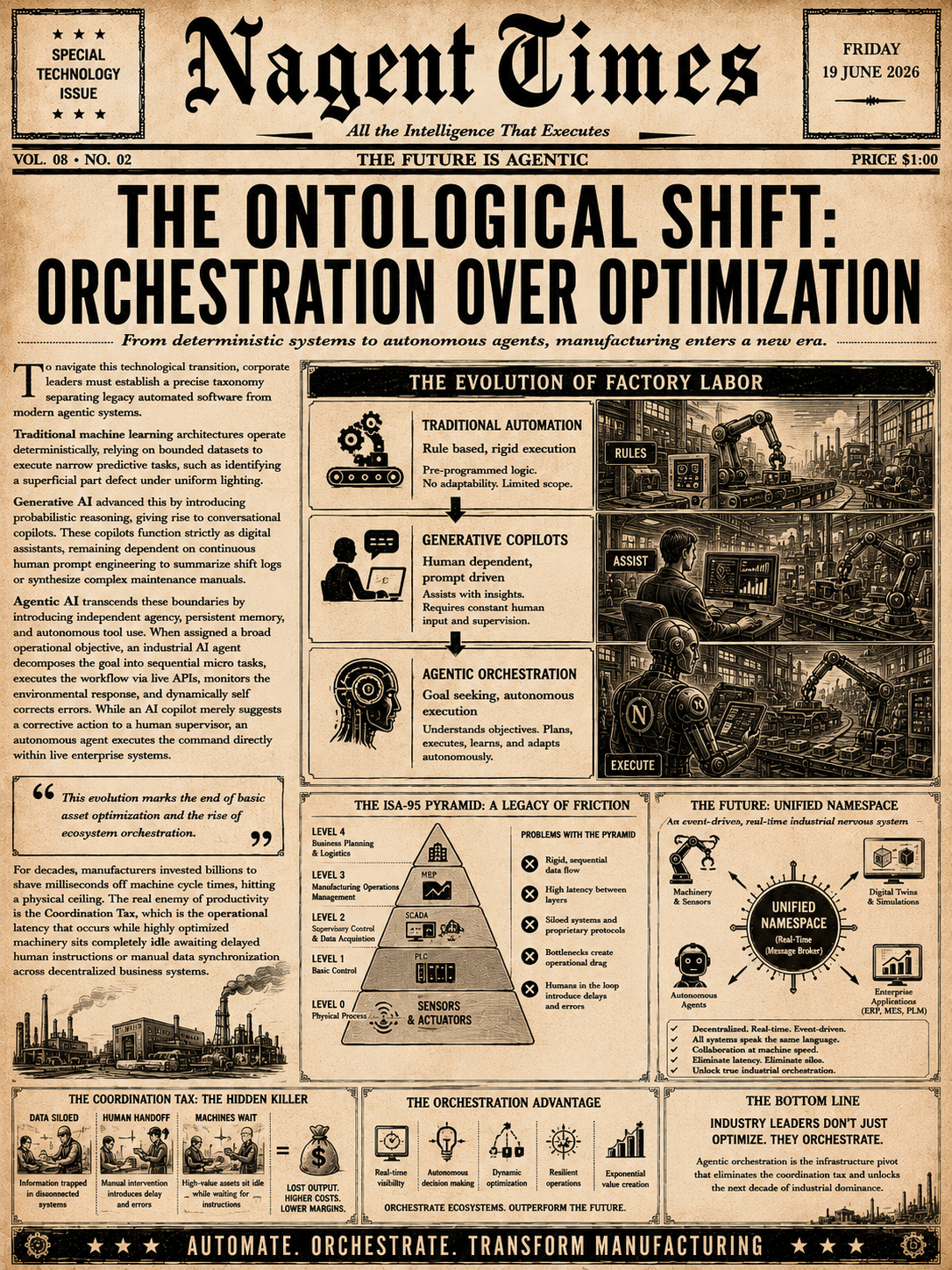
To navigate this technological transition, corporate leaders must establish a precise taxonomy separating legacy automated software from modern agentic systems. Traditional machine learning architectures operate deterministically, relying on bounded datasets to execute narrow predictive tasks, such as identifying a superficial part defect under uniform lighting. Generative AI advanced this by introducing probabilistic reasoning, giving rise to conversational copilots. These copilots function strictly as digital assistants, remaining dependent on continuous human prompt engineering to summarize shift logs or synthesize complex maintenance manuals.
Agentic AI transcends these boundaries by introducing independent agency, persistent memory, and autonomous tool use. When assigned a broad operational objective, an industrial AI agent decomposes the goal into sequential micro tasks, executes the workflow via live APIs, monitors the environmental response, and dynamically self corrects errors. While an AI copilot merely suggests a corrective action to a human supervisor, an autonomous agent executes the command directly within live enterprise systems.
This evolution marks the end of basic asset optimization and the rise of ecosystem orchestration. For decades, manufacturers invested billions to shave milliseconds off machine cycle times, hitting a physical ceiling. The real enemy of productivity is the Coordination Tax, which is the operational latency that occurs while highly optimized machinery sits completely idle awaiting delayed human instructions or manual data synchronization across decentralized business systems.
Realizing true orchestration requires the total dismantling of the traditional five layer ISA 95 data pyramid. The rigid, sequential routing of data from sensor to programmable logic controller, SCADA, manufacturing execution system, and enterprise resource planning network introduces severe friction. In its place, advanced enterprises are deploying an event driven Unified Namespace. The Unified Namespace functions as a decentralized, real time message broker where machinery, digital twins, and autonomous software agents subscribe to a centralized data hub, collaborating at machine speed without human latency.
Industrial Architectures in Action: Cross-Functional Sub-Industry Gains
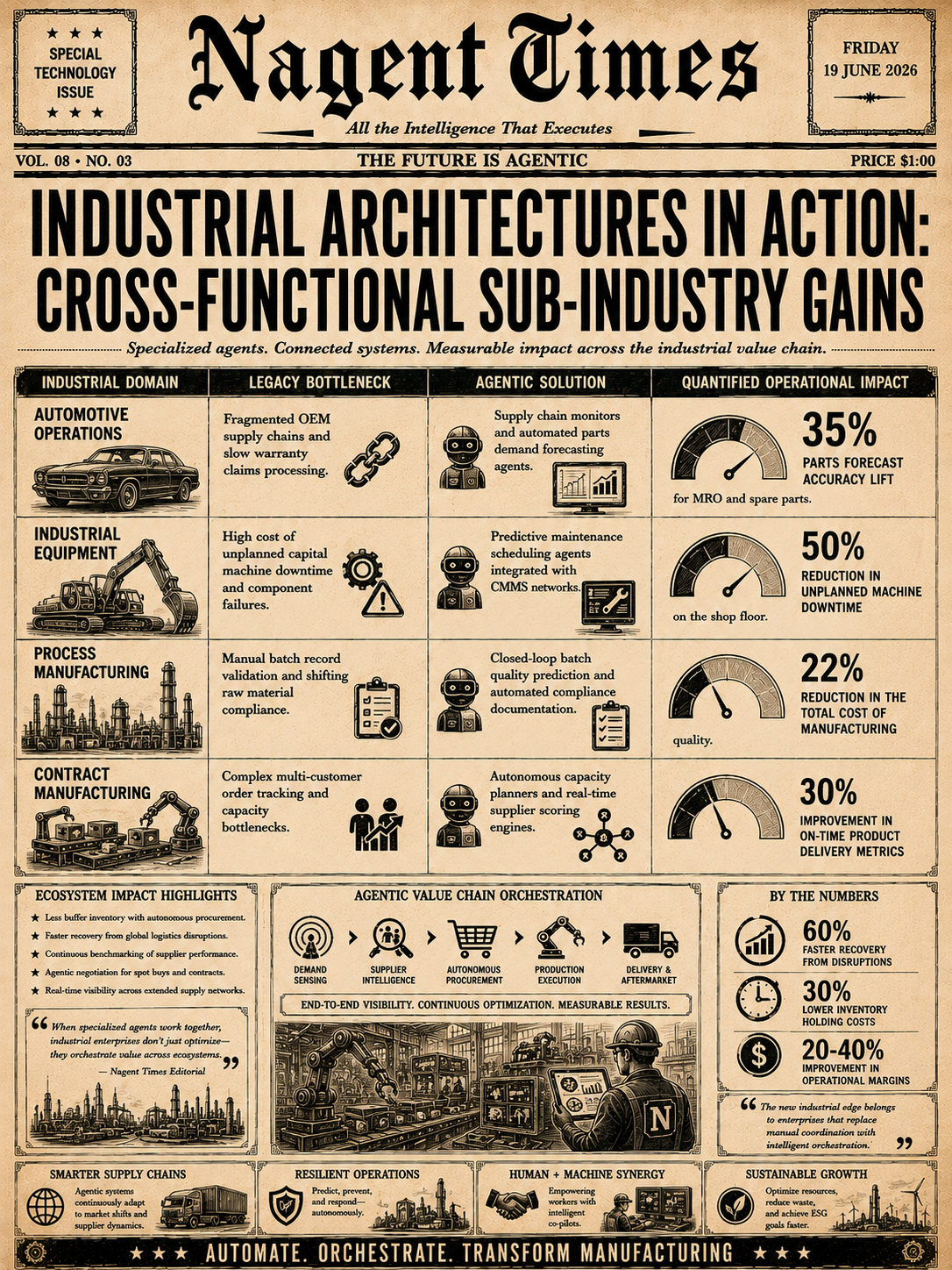
The commercial viability of multi agent infrastructure is validated by its exhaustive deployment across core manufacturing sub industries. Platforms built on Nagent AI are proving that when specialized agents are interconnected, they eliminate lead leakages, optimize working capital, and accelerate production velocity.
In automotive ecosystems, original equipment manufacturers are deploying agentic frameworks to modernise legacy codebases and handle massive data volumes from connected vehicle networks. This allows teams to collapse engineering timelines that previously took months into single digit days. Concurrently, heavy machinery providers utilize edge based agents to navigate unstructured outdoor environments, optimizing asset deployment through real time job site telemetry.
In process and contract intensive environments, the deployment of autonomous procurement agents is changing the nature of supplier relationships. Instead of relying on disconnected spreadsheets, these systems continuously assess material availability, benchmark vendor performance, and autonomously negotiate spot purchases. This shift ensures that organizations carry significantly less buffer inventory while recovering from global logistics disruptions sixty percent faster.
The October industry guide
The Technical Blueprint: Secure Edge Execution and Action Risk
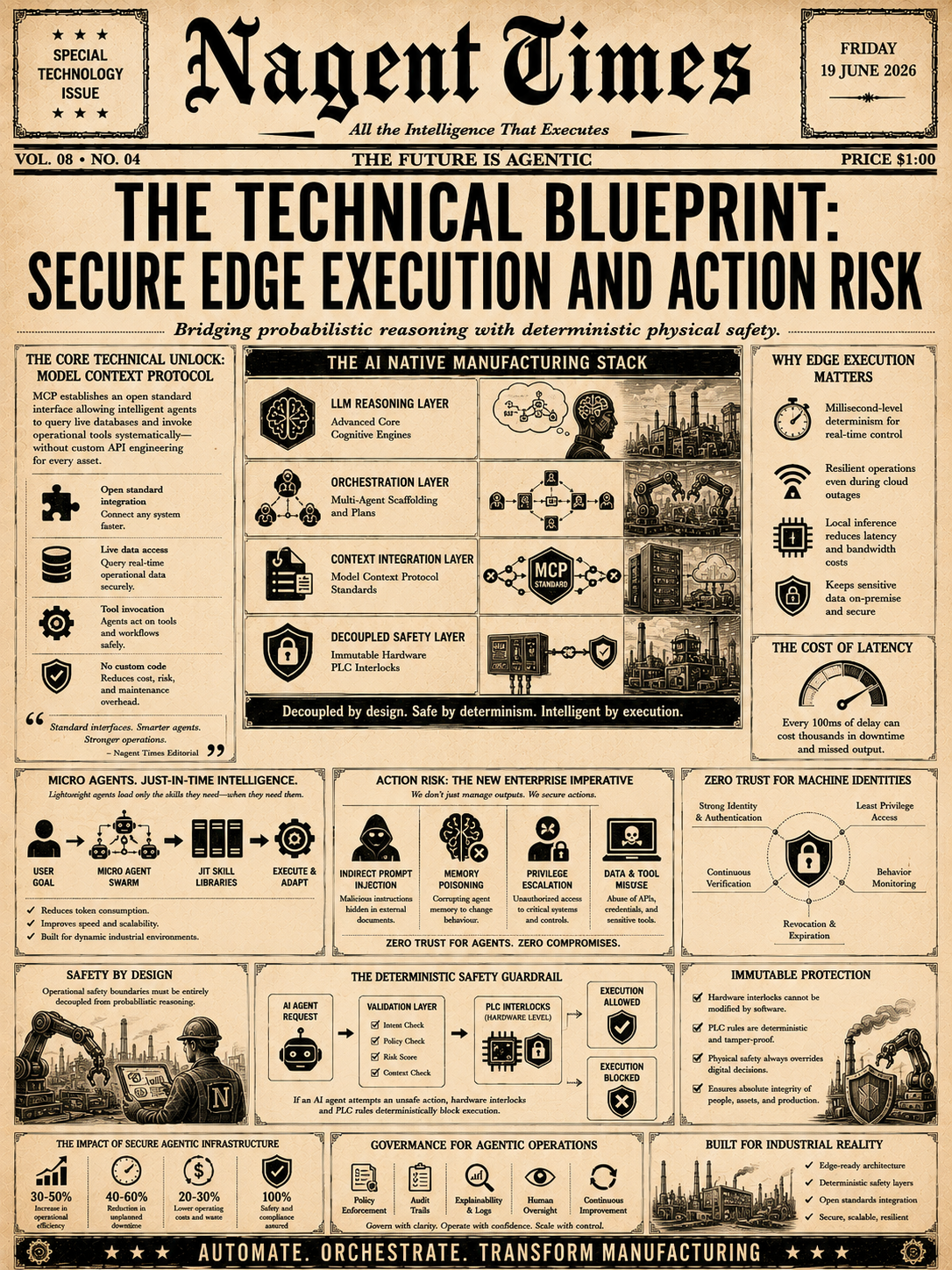
The successful execution of agentic labor within heavy industry depends on an architectural stack that bridges probabilistic reasoning with deterministic physical safety. The core technical unlock facilitating this integration is the Model Context Protocol. Historically, connecting a language model to a proprietary manufacturing execution system required building brittle, custom software code. The Model Context Protocol establishes an open standard interface allowing intelligent agents to query live databases and invoke operational tools systematically without requiring custom API engineering for every asset.
To manage the token consumption and latency costs that plague enterprise deployments, advanced platforms reject monolithic agent structures. Instead, they implement lightweight micro agents that load specific skill libraries Just In Time. Furthermore, because industrial safety is critical, inference must be pushed directly to the industrial edge. Utilizing edge frameworks ensures millisecond level determinism, allowing local AI decisions to remain completely synchronized with high speed machine cycles even during intermittent cloud connectivity failures.
This architectural shift fundamentally alters the enterprise risk profile. Traditional software governance focused on output risk, managing issues like data privacy and textual inaccuracies. Agentic AI mandates a governance framework centered on action risk, actively securing API write access and preventing privilege escalation. Manufacturers face sophisticated threat vectors like indirect prompt injection and memory poisoning, where malicious instructions are covertly embedded within external technical documents to hijack an agent's long term memory.
To defend against these vectors, security architectures must enforce strict Zero Trust guidelines for machine identities, paired with exhaustive content filtering. Most critically, safety by design principles dictate that operational safety boundaries must be entirely decoupled from the probabilistic reasoning of the language model. If an AI agent attempts to alter a machine parameter erroneously to meet a production quota, immutable hardware level interlocks and programmable logic controller rules must deterministically block the execution, ensuring absolute physical integrity.
The Strategic Mandate and the Nagent Blueprint
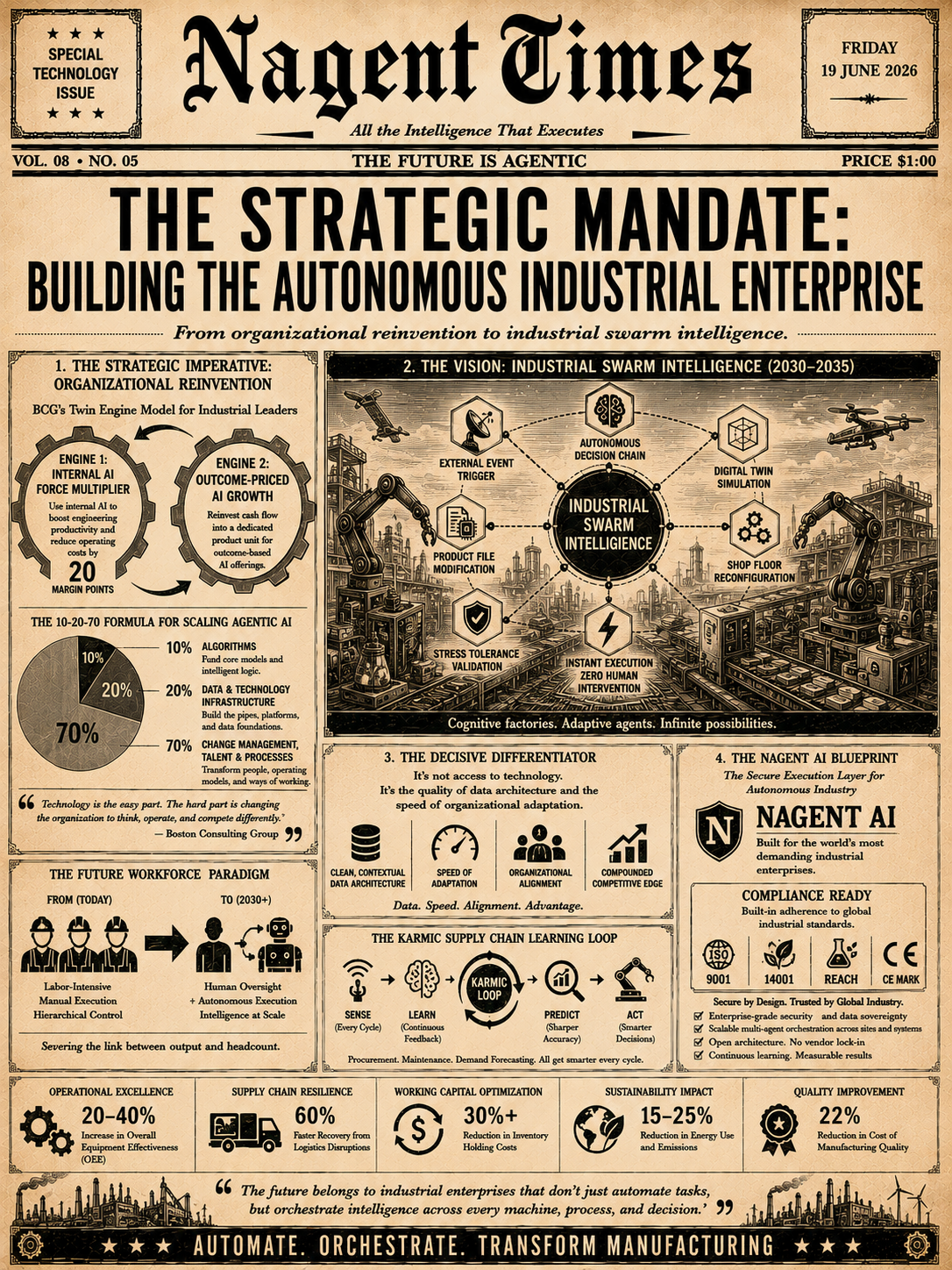
Top tier management consulting practices universally agree that agentic AI requires a complete organizational reinvention. Boston Consulting Group advocates for a Twin Engine Model, urging technology and industrial firms to use internal AI to force multiply engineering and reduce operating costs by twenty margin points, while utilizing the expanded cash flow to fund a dedicated product unit focused on outcome priced AI structures. Successful scaling requires following the ten twenty seventy formula: allocating ten percent of enterprise effort to algorithms, twenty percent to data and technology infrastructure, and seventy percent to change management, talent transformation, and process realignment.
Looking toward 2030 and 2035, the deep convergence of agentic workflows and high volume physical AI will sever the historical linkage between manufacturing output and manual human headcount. As general purpose spatial reasoning matures, cognitive factories will populate with highly adaptable digital labor capable of executing complex physical tasks based purely on semantic instructions. Smart factories will operate via industrial swarm intelligence, where an external event triggers an autonomous chain reaction, directing agents to modify product files, validate stress tolerances via synthetic digital twin simulations, and reconfigure shop floor machinery instantaneously with zero human intervention.
The decisive differentiator in the agentic era is not access to technology, but the quality of data architecture and the speed of organizational adaptation. This is the exact infrastructure we are delivering at Nagent AI. Built fully compliance ready across ISO 9001, ISO 14001, REACH, and CE Mark standards, Nagent AI functions as the secure execution layer for the autonomous industrial enterprise.
Through our proprietary KARMIC Supply Chain Learning feedback loop, our procurement, maintenance, and demand forecasting models compound in accuracy with every production cycle, improving inventory velocity without manual data science intervention.