The Nagent Times
All the Intelligence That Executes
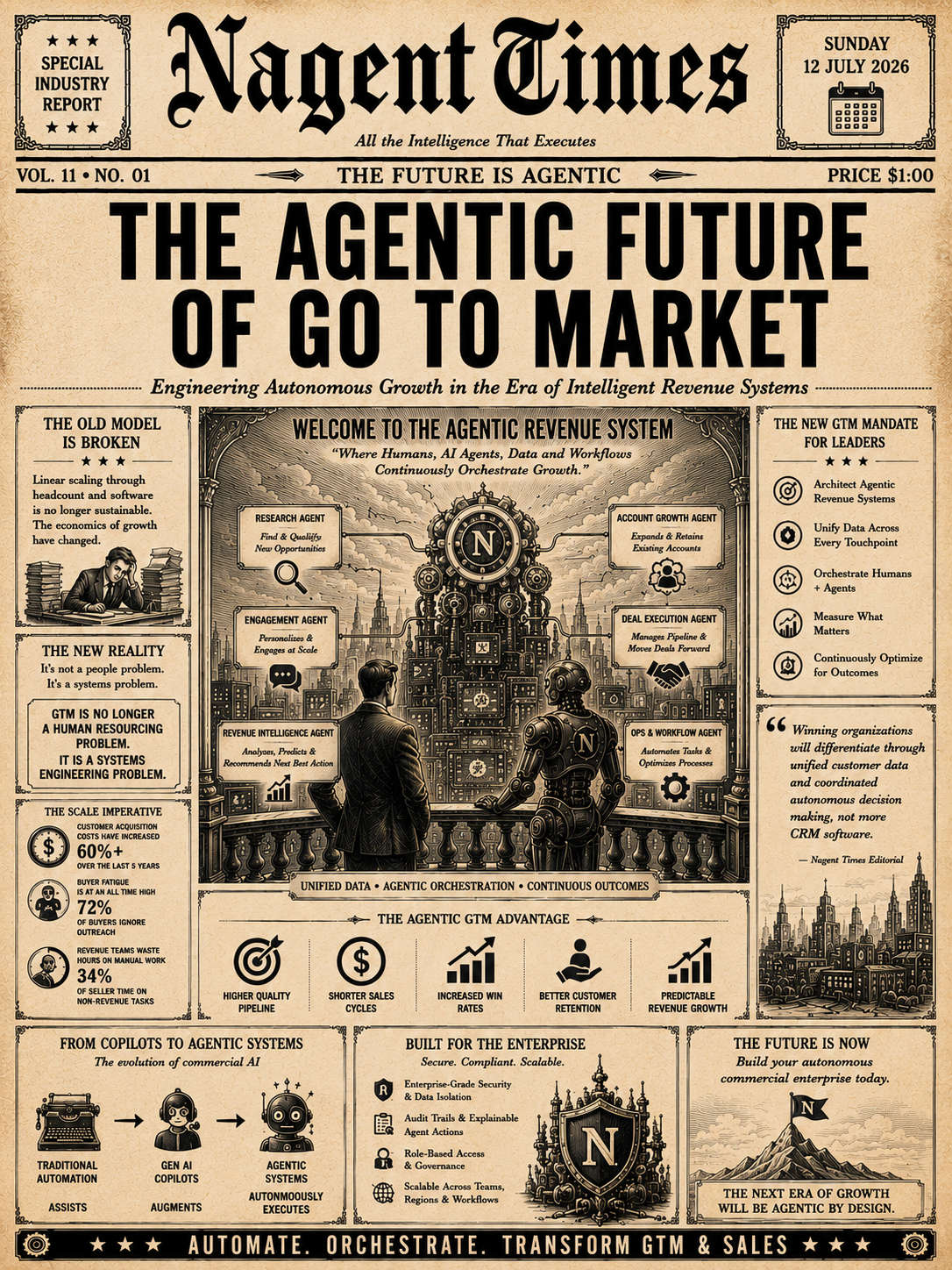
The Agentic Future of Go to Market
Executive Summary: The Infrastructure Pivot
For three decades, enterprise growth relied on a simple, predictable equation: generating more pipeline required hiring more sales development representatives, which in turn required more managers and software licenses. This linear scaling model has officially collapsed. Skyrocketing customer acquisition costs and profound buyer fatigue have rendered brute force volume automation mathematically unviable. Go to market is no longer a human resourcing problem; it is a systems engineering problem.
The global commercial function is evolving from a collection of human managed departments into an intelligent, agentic revenue system. In this emerging paradigm, humans, artificial intelligence agents, customer data, and enterprise workflows continuously coordinate to acquire, grow, retain, and expand customer relationships. Winning organizations are differentiating themselves through unified customer data and coordinated autonomous decision making rather than simply buying more CRM software.
The market has crossed a critical threshold. We are moving past generative copilots that merely assist human sellers into the era of Agentic Revenue Systems where software reasons, plans, and independently executes multi step commercial workflows. In this edition, we unpack the structural transformation of the modern revenue engine and how intelligent orchestration layers engineered at Nagent AI are providing the blueprint for the autonomous commercial enterprise.
The Ontological Shift: The End of Linear Sales Scaling
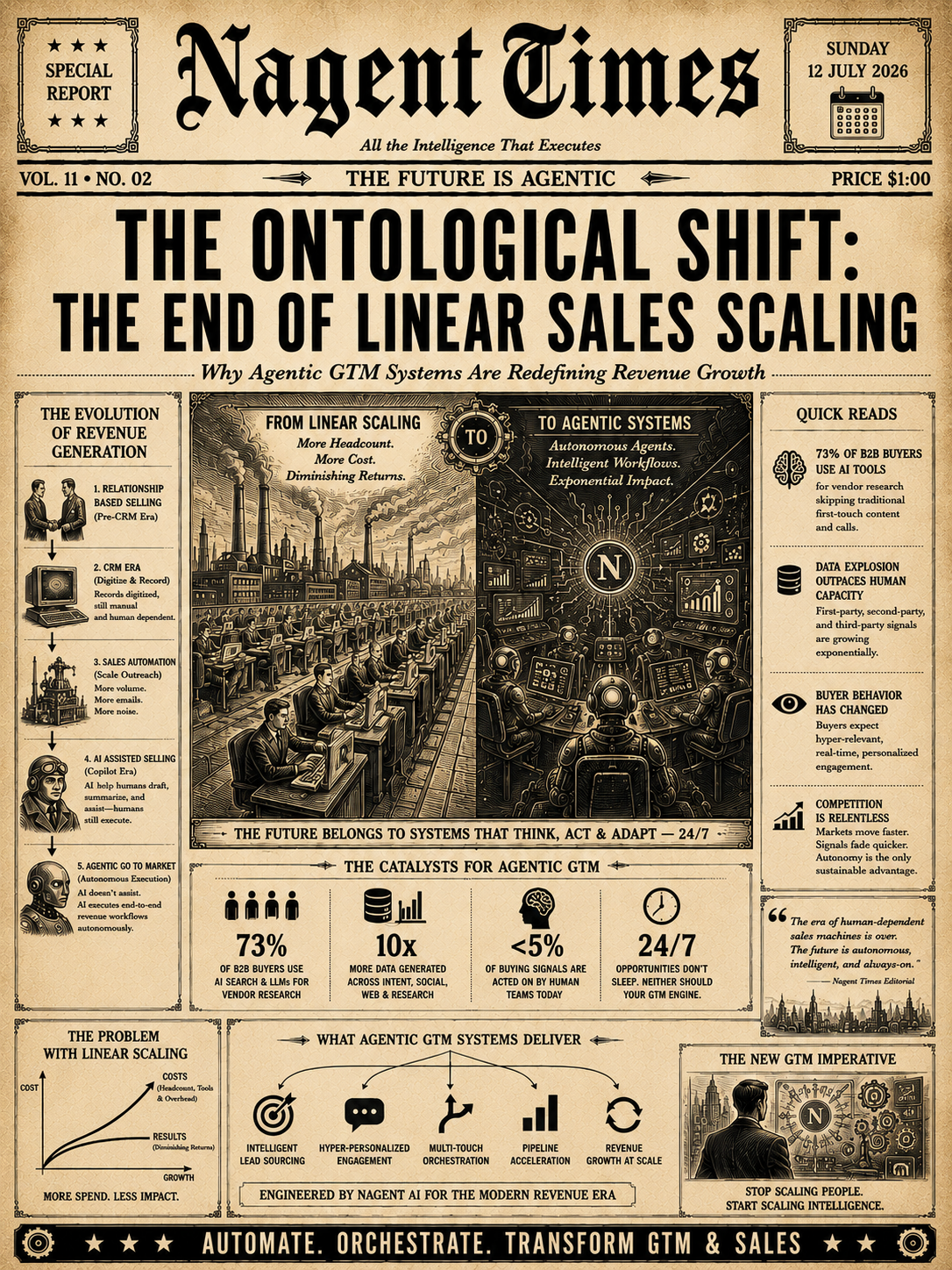
To understand the magnitude of this transition, we must examine the historical evolution of revenue generation. The industry progressed from relationship based field selling to the CRM era, which digitized records but relied entirely on manual human data entry. The subsequent sales automation phase utilized software to scale outreach exponentially. However, this volume based approach degraded the buyer experience, forcing buyers to tune out generic messaging.
Recently, the deployment of large language models ushered in the AI assisted selling era. Generative copilots helped human sellers by drafting emails or summarizing meeting transcripts. Yet, the human remained the operational bottleneck. The next evolution is Agentic Go to Market. In this architecture, AI software does not merely assist; it executes.
A confluence of macroeconomic and behavioral forces is accelerating this architectural shift. Today, seventy three percent of B2B buyers utilize AI search tools and language models for vendor research, frequently bypassing traditional gated content and early stage sales conversations. This necessitates a shift toward ensuring that brand narratives and product specifications are machine legible for the AI agents conducting research on behalf of buyers.
Simultaneously, the data explosion has surpassed human cognitive capacity. Commercial teams must process first party website intent, second party social activity, and third party research signals simultaneously. Human operators simply cannot synthesize this volume of data quickly enough to act on fleeting buying signals. Driven by intense global competition, established enterprises are being forced to adopt autonomous, always on revenue engines.
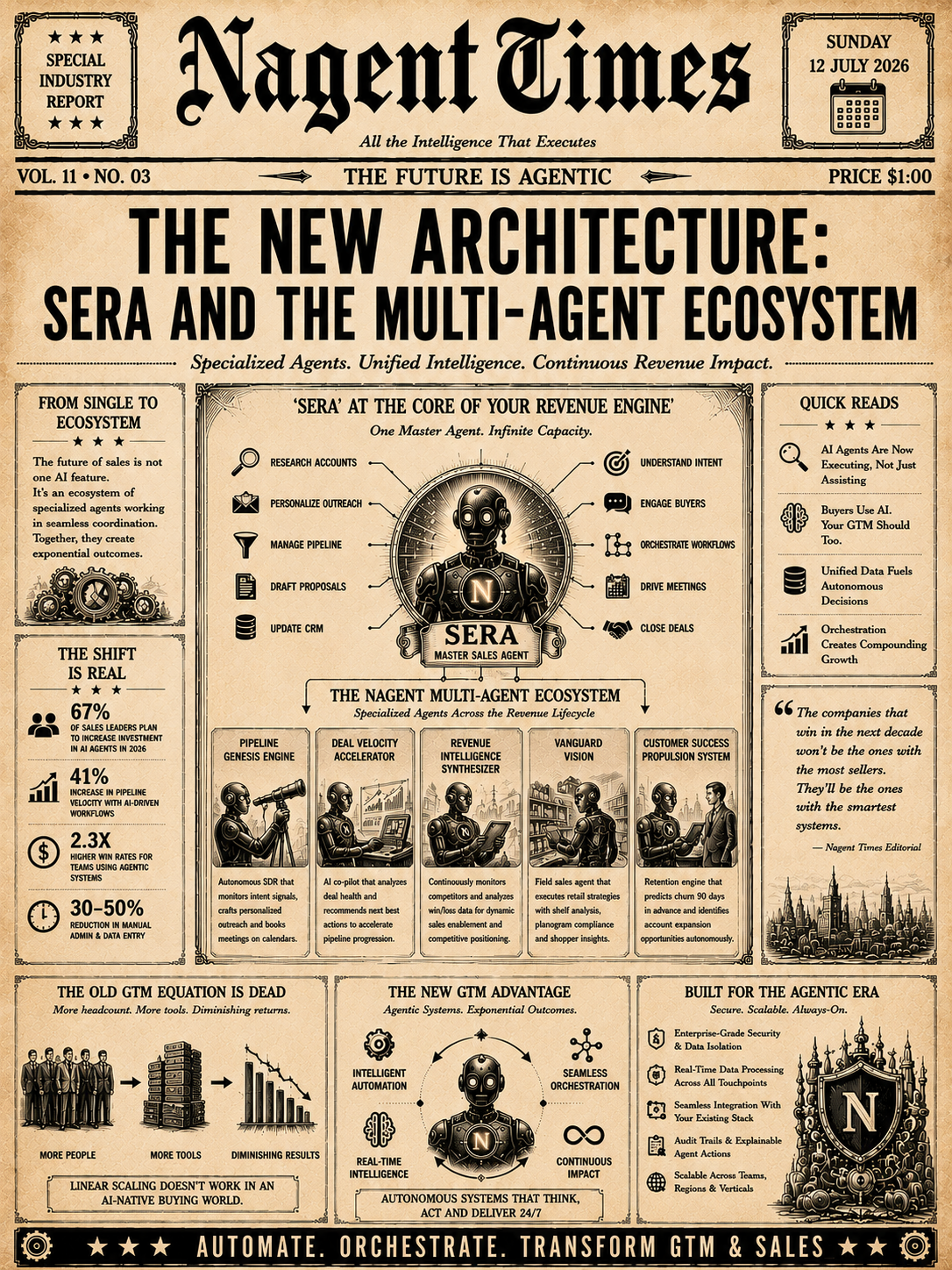
The New Architecture: SERA and the Multi Agent Ecosystem
The core architecture of the future commercial function abandons isolated AI features embedded within individual applications in favor of an ecosystem of specialized commercial agents. At Nagent AI, we have engineered this exact ecosystem. The foundation of our sales infrastructure is SERA, our dedicated master Sales Agent. SERA researches accounts, personalizes outreach, manages the pipeline, drafts proposals, and updates the CRM, allowing your team to close deals rather than fill in forms.
Beneath SERA operates a highly specialized workforce of ready to deploy vertical agents available in the Nagent Agent Marketplace. This multi agent ecosystem partitions work to enable seamless parallelism across the entire revenue lifecycle:
- Pipeline Genesis Engine: An autonomous SDR that actively monitors intent signals, crafts highly personalized outreach, and books meetings directly onto calendars.
- Deal Velocity Accelerator: An AI co pilot that continuously analyzes deal health and recommends the exact next best actions to accelerate pipeline progression and manage deals.
- Revenue Intelligence Synthesizer: An agent that continuously monitors competitors and analyzes win and loss data for dynamic sales enablement and competitive positioning.
- Vanguard Vision: A specialized field sales agent that executes retail execution strategies, offering shelf analysis, planogram compliance, and deep shopper behavior insights.
- Customer Success Propulsion System: A retention engine that monitors product telemetry to predict churn ninety days in advance while autonomously identifying account expansion opportunities.
The October industry guide
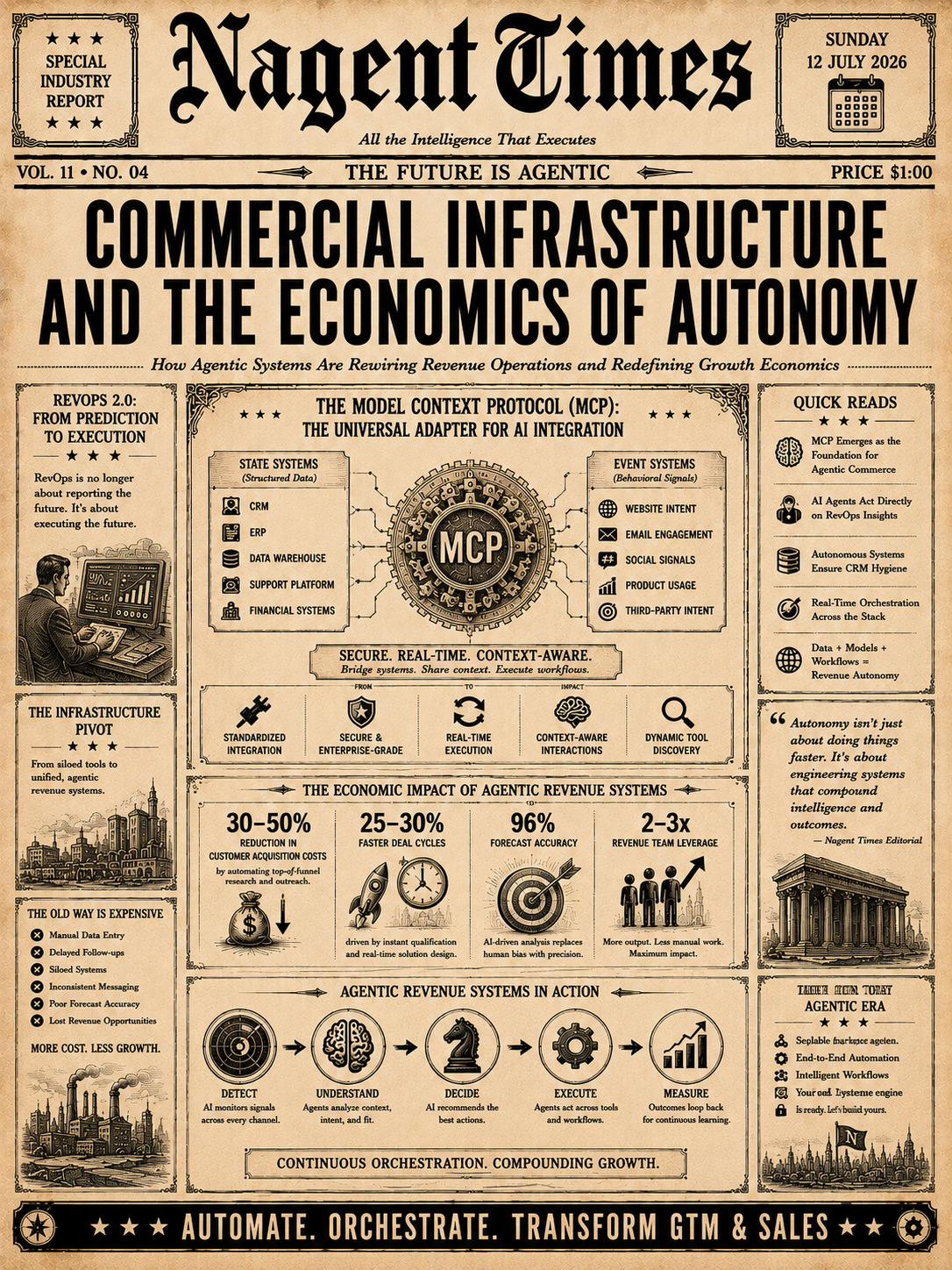
Commercial Infrastructure and The Economics of Autonomy
The transition to an agentic revenue organization requires a fundamental rewiring of commercial infrastructure. Revenue Operations represents arguably the most profound transformation in this shift. RevOps is experiencing a defining transition from a discipline of prediction to one of execution. Historically, RevOps built dashboards to forecast pipeline health. Today, agentic systems act directly on those insights, autonomously enforcing CRM hygiene, flagging stalled opportunities, and adjusting territory planning dynamically.
The critical breakthrough enabling this agentic execution is the Model Context Protocol. This protocol acts as a universal adapter for AI integration, providing a standardized, secure framework that allows AI models to natively read and write to enterprise systems. It bridges state systems like CRMs with event systems like behavioral intent, allowing agents to execute complex workflows securely and in real time.
The economic impact of deploying these agentic revenue systems represents a step change in commercial efficiency. By automating the execution layer, organizations fundamentally alter the economics of growth. Early adopters are reporting thirty to fifty percent reductions in customer acquisition costs by automating top of funnel research and outreach. Deal cycles are compressing by twenty five to thirty percent due to instantaneous qualification and real time solution design. Furthermore, forecast accuracy is approaching ninety six percent as subjective human optimism is replaced by objective, AI driven pipeline analysis.
The Strategic Imperative and Workforce Transformation
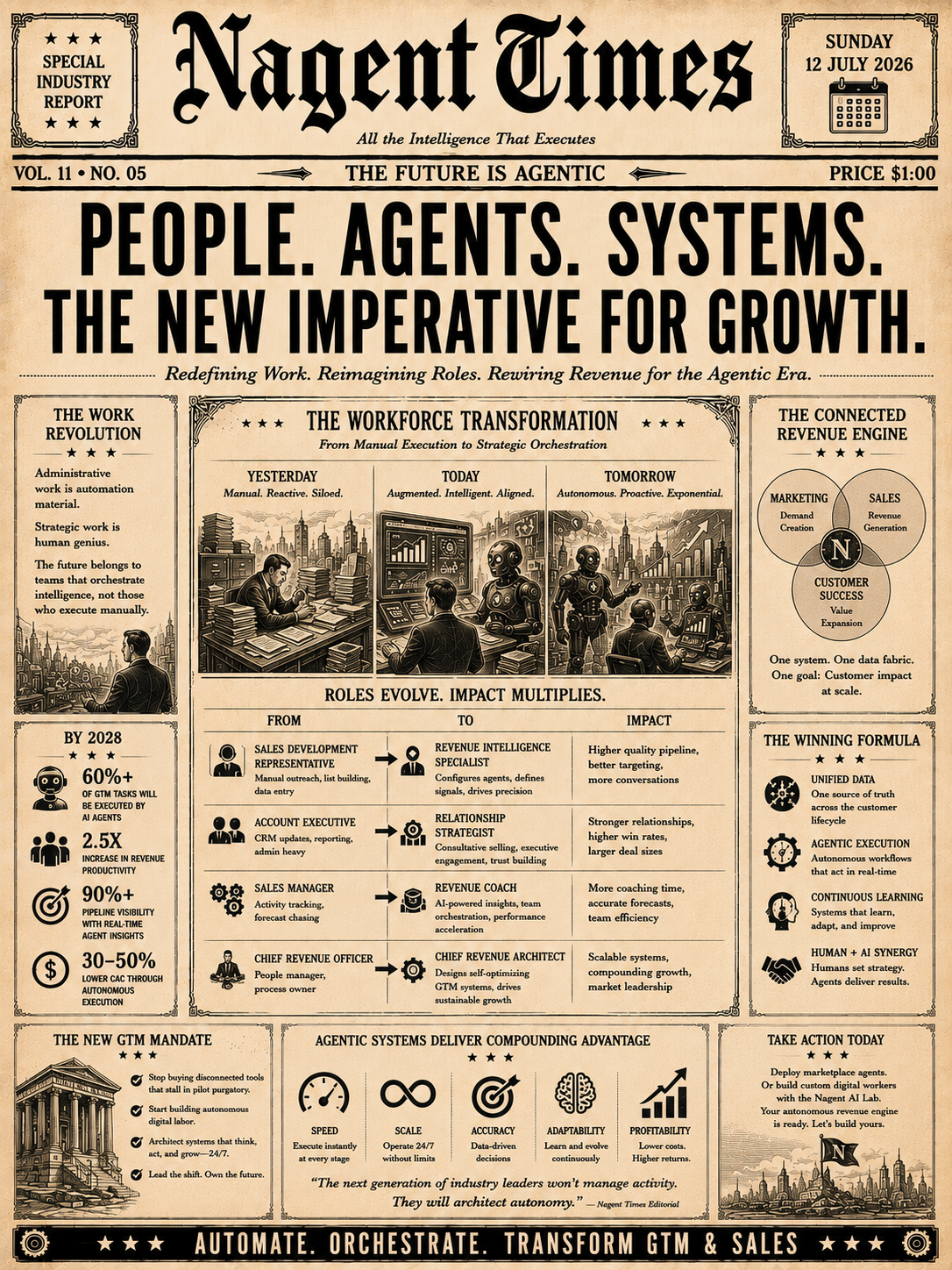
The integration of agentic systems triggers a massive workforce transformation. Administrative work, data enrichment, CRM updates, and repetitive outreach are being automated entirely. This does not mean the end of the human seller; rather, it elevates them. Relationship building, complex negotiation, strategic account management, and executive decision making remain fiercely human centered.
As agents absorb the administrative burden, traditional roles are redefined. Sales Development Representatives evolve into Revenue Intelligence Specialists, focusing on configuring agent prompts and defining signal thresholds. Account Executives shift entirely away from data entry, acting as Relationship Strategists who leverage agent prepared intelligence to build trust and navigate enterprise politics. The future role of the Chief Revenue Officer will evolve from managing human capital to architecting self optimizing go to market systems.
The organizations winning the next decade will treat revenue as a connected system, where marketing, sales, and customer success operate as one coordinated commercial engine. The shift from prediction to execution is the defining mandate for modern enterprises.