The Nagent Times
All the Intelligence That Executes
The Agentic Era of Media and Entertainment: From Linear Flows to Autonomous Orchestration
The Infrastructure Inflection Point
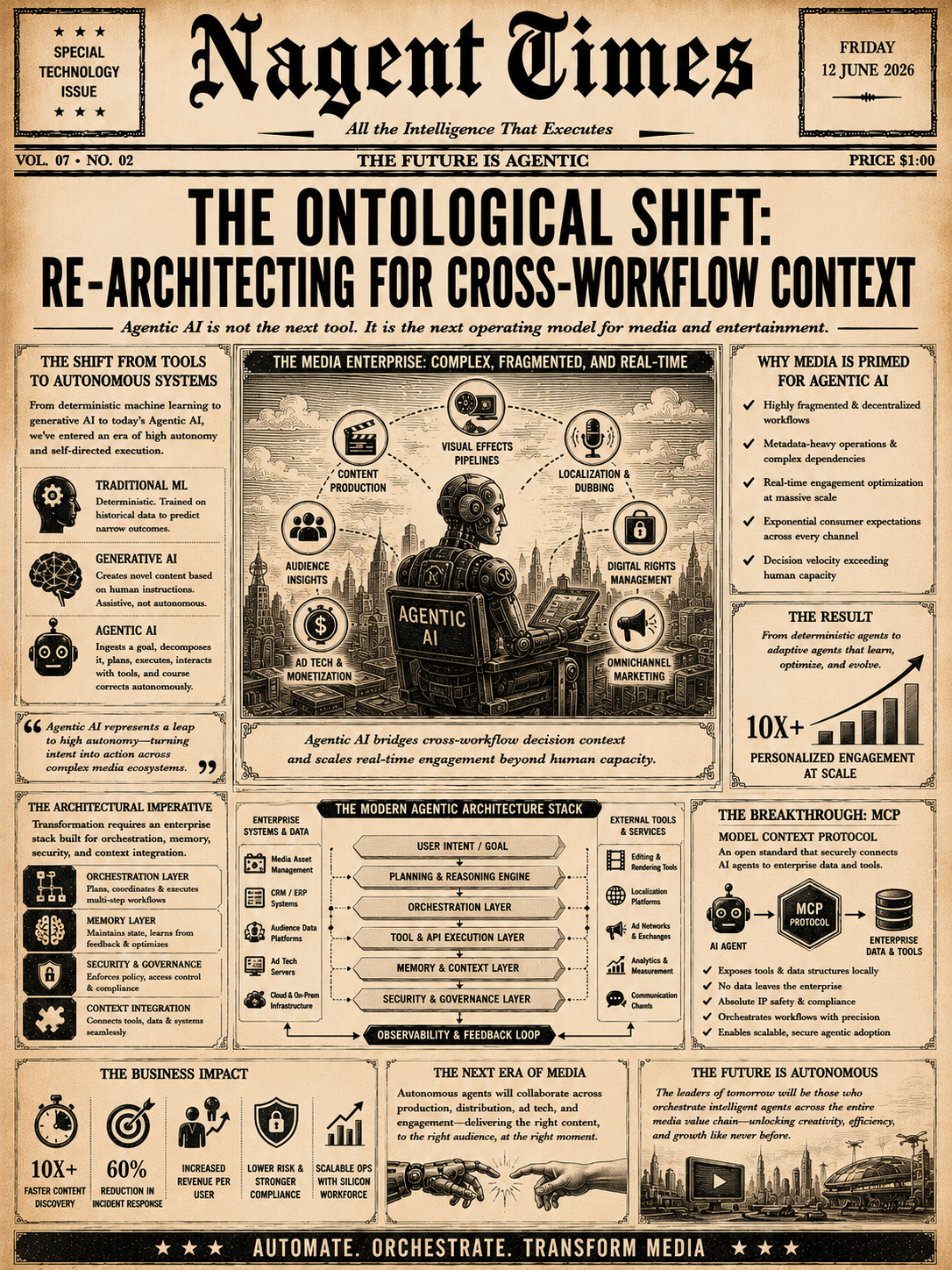
The global Media and Entertainment sector has reached a critical architectural inflection point. The industry is transitioning rapidly from the experimental deployment of generative AI, a technology defined by human prompted, assistive content creation, to the operational integration of Agentic AI. This new paradigm is characterized by autonomous, goal oriented software systems capable of planning, reasoning, and executing complex, multi step workflows across highly fragmented digital supply chains. This evolution represents a fundamental shift in enterprise operating models, moving artificial intelligence from a passive productivity tool to an active, silicon based workforce that orchestrates production, distribution, advertising, and audience personalization.
Industry forecasts project the autonomous AI agent orchestration market to scale to eighty five hundred million dollars by 2026, with trajectories indicating an expansion to thirty five billion dollars by 2030. Within the media sector specifically, the commercial value of these systems is profound. Elite consulting firms estimate a one hundred billion dollar market opportunity centered entirely on utilizing AI agents to automate cross workflow decision context, which is the complex, historically human driven coordination between isolated media asset management systems, enterprise resource planning software, and real time ad tech servers.
Early enterprise grade implementations are already demonstrating unprecedented operational returns. The National Football League deployed an agentic workflow that successfully reduced media discovery and retrieval times from an average of over 10 minutes to 30 seconds while maintaining a 95% accuracy rate. Similarly, global media networks are utilizing agentic frameworks to automate cloud infrastructure monitoring and remediation, driving a sixty percent reduction in incident response times. Concurrently, streaming platforms, advertising networks, and gaming studios are utilizing current cycles to debut fully agentic ad purchasing ecosystems, dynamic procedural content generation tools, and self optimizing personalization engines.
The Ontological Shift: Re Architecting for Cross Workflow Context
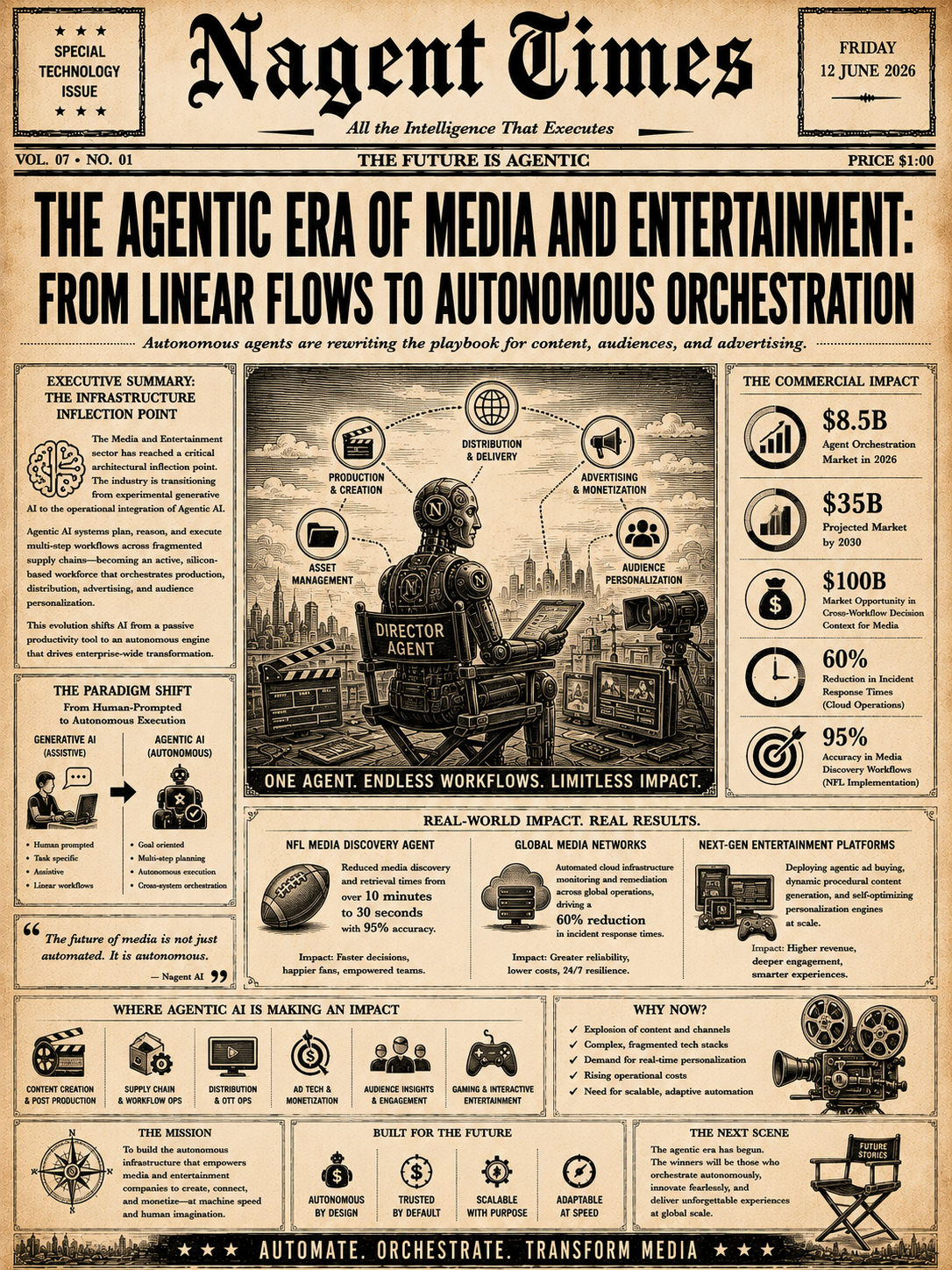
To understand the strategic implications of Agentic AI, media executives must distinguish it from previous technological paradigms. Traditional machine learning operates deterministically, trained on historical data to predict narrow outcomes, such as a recommendation engine suggesting a film based on viewing history. Generative AI advanced this by utilizing large language models to create novel text, code, or media based on explicit human instructions. However, generative AI remains fundamentally an assistive technology, requiring a human in the loop to initiate, guide, and compile the outputs. Agentic AI represents a leap to high autonomy where an AI system can ingest a high level goal, autonomously decompose that goal into a logical sequence of sub tasks, plan an execution route, interact with external software tools, and course correct if it encounters an error.
The media sector is uniquely predisposed to benefit from agentic automation due to its structural complexities. Media operations are characterized by highly fragmented workflows. A single global film release requires the coordination of decentralized visual effects pipelines, metadata heavy localization and dubbing across dozens of languages, complex digital rights management clearing, and omnichannel marketing distribution. Agentic AI addresses these metadata heavy operations by bridging the cross workflow decision context. Furthermore, consumer demands for real time engagement optimization, such as dynamically altering a streaming interface based on time of day, or inserting personalized, localized advertisements into a live sports broadcast, generate a volume and velocity of decision making that exceeds human capacity.
By shifting from deterministic media agents to adaptive media agents that learn and optimize based on environmental feedback, media conglomerates can scale personalized audience engagement exponentially. True transformation requires an architectural stack that goes far beyond simply licensing an API from a foundation model provider. The infrastructure must prioritize orchestration, memory, security, and context integration. One of the most significant technological breakthroughs enabling enterprise agentic adoption is the Model Context Protocol. Developed as an open standard, this protocol solves the historical bottleneck of data access. Instead of moving massive video files or sensitive audience data into an external language model, protocol servers expose well defined tools and data structures to the AI agent locally, ensuring absolute IP safety while orchestrating workflows.
Sub Industry Dynamics and Quantifiable Operational Use Cases
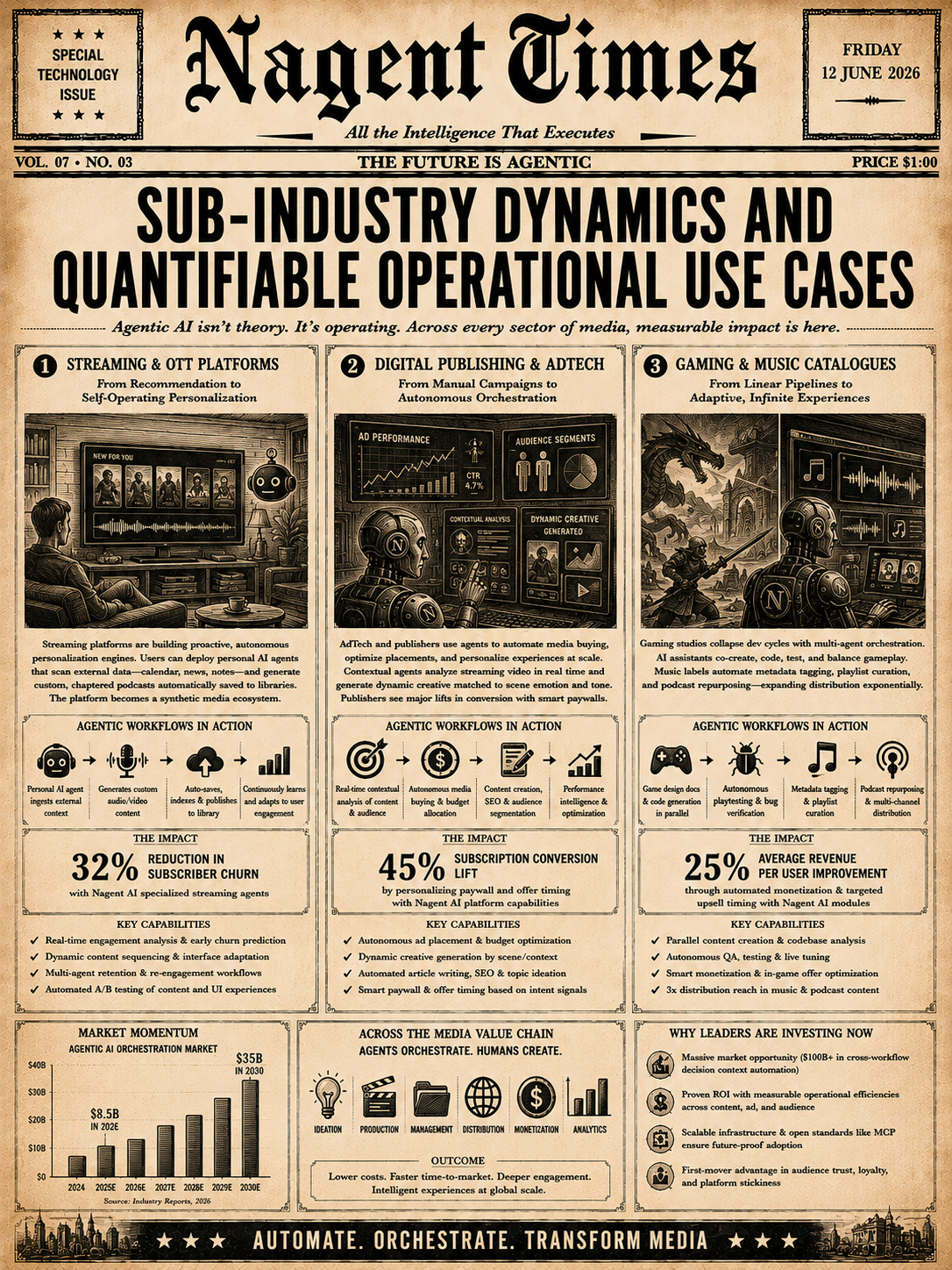
The theoretical potential of Agentic AI is actively being translated into quantifiable operational impact across every sector of the media industry, rewriting the underlying unit economics of content platforms.
Streaming and OTT Platforms Streaming platforms are migrating from passive recommendation engines to proactive, self operating personalization infrastructures. Major platforms utilize advanced foundation models to continuously adapt and extend content delivery strategies based on real time engagement feedback. Through multi agent workflows, platforms can now allow users to deploy personal AI agents to autonomously scan external data, such as calendar events, news feeds, or academic notes, and generate custom, chaptered personal podcasts that are automatically saved and published to the platform library. This effectively transforms the streaming platform from a content distributor into a synthetic media ecosystem. By deploying Nagent AI specialized streaming agents, platforms are unlocking a thirty two percent reduction in subscriber churn through personalized retention and early intervention.
Digital Publishing and AdTech The advertising sector is leveraging agentic AI to solve the massive complexity of cross platform ad orchestration. Media conglomerates are increasingly positioning themselves in the outcomes and performance business, using agents to automate media buying transactions, optimize ad placements, and surface performance intelligence without human intervention. Contextual analysis agents conduct real time evaluation of streaming video, allowing brands to autonomously deploy dynamic creative generation tailored specifically to the emotional or visual context of the scene a user is watching. In digital publishing, teams are utilizing agents for automated article writing assistance, SEO optimization, and audience segmentation. Incorporating Nagent AI platform capabilities allows publishers to achieve a forty five percent subscription conversion lift by personalizing paywall and offer timing.
Gaming and Music Catalogues Gaming studios are utilizing multi agent orchestration to collapse development cycles and create infinitely adaptive gameplay. Through specialized planning modes, developers utilize an AI assistant that acts as a multi step, multi disciplinary partner that analyzes codebases, generates comprehensive game design documents, executes coding tasks in parallel, and deploys autonomous playtesting agents that verify game physics. In audio infrastructure, music labels are utilizing agents for automated music catalogue metadata tagging, playlist curation, and podcast content repurposing, lifting content distribution reach by three times. Nagent AI gaming and audio modules allow studios to achieve twenty five percent average revenue per user improvements through automated monetization and targeted upsell timing.
The October industry guide
The Silicon Workforce: Governance, Risk, and Inference Economics
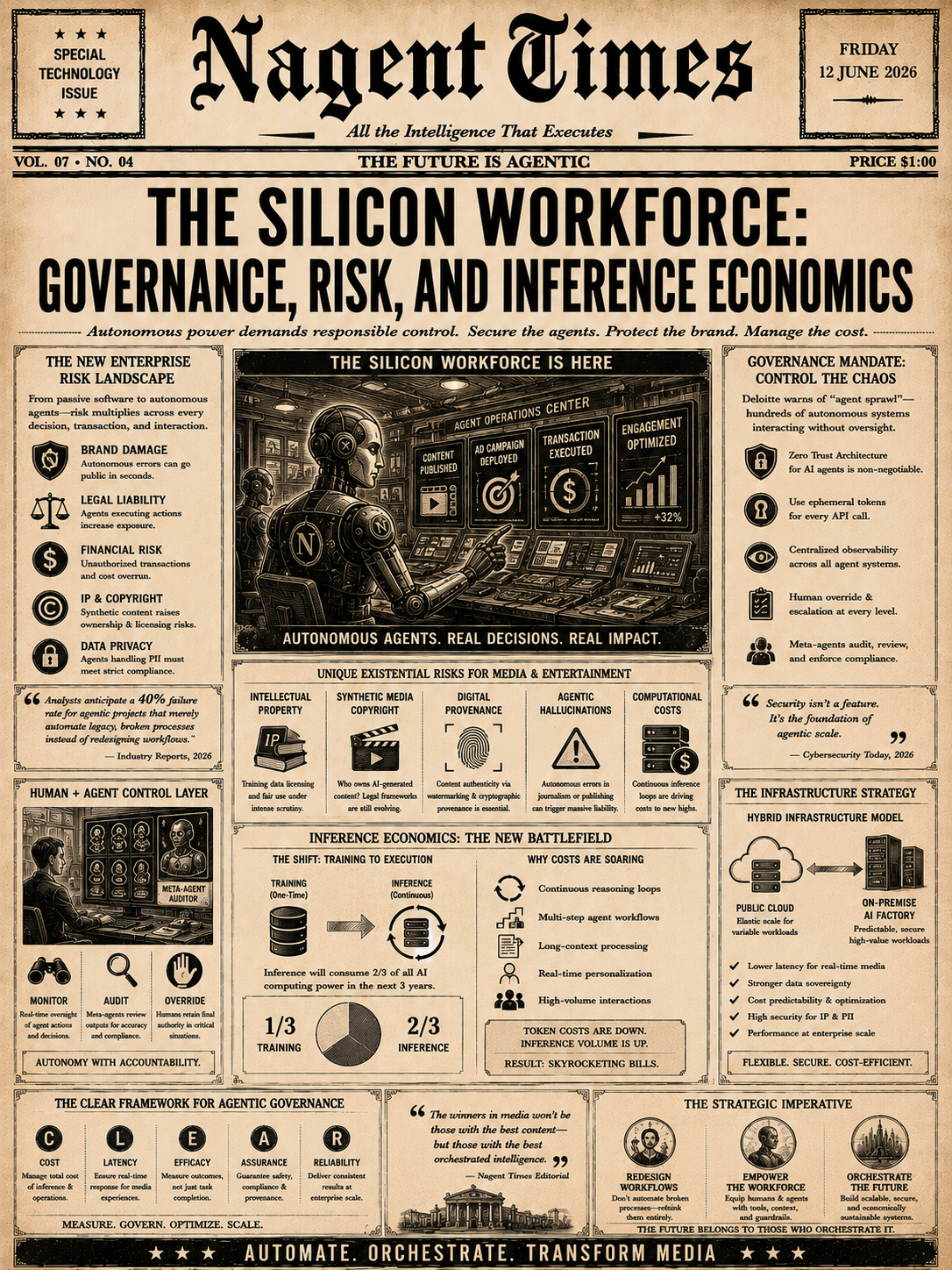
The transition from passive software to autonomous agents fundamentally alters an enterprise risk profile. When agents are empowered to execute financial transactions, publish content, and interact dynamically with consumers, the potential for brand damage and legal liability increases exponentially. Analysts anticipate a forty percent failure rate for agentic projects that merely attempt to automate legacy, broken processes rather than radically redesigning the underlying workflows. Deloitte warns that as enterprises scale, they risk agent sprawl, which is the proliferation of hundreds of autonomous systems interacting without centralized oversight. To secure the silicon based workforce, IT departments must implement a Zero Trust Architecture for AI agents, forcing agents to utilize ephemeral authentication tokens to execute API calls.
Furthermore, the media industry faces unique existential risks regarding intellectual property, synthetic media copyright, digital provenance, and skyrocketing computational costs. The reliance of foundational models on vast training datasets has triggered intense scrutiny regarding licensing and fair use. When deploying agentic systems for synthetic media orchestration, enterprises must guarantee digital provenance through content authenticity protocols, such as cryptographic watermarking integrated directly into the agentic rendering pipeline. In sectors like journalism and publishing, agentic hallucinations are catastrophic. While a generative AI hallucination can be caught by a human editor, an autonomous newsroom agent that hallucinates a statistic and autonomously publishes it to a live feed could trigger massive liability. Consequently, high performing AI enterprises deploy rigid human override systems and meta agents specifically designed to audit the outputs of primary worker agents.
The commercial narrative surrounding Agentic AI is defined by a tension between massive operational efficiency gains and the staggering infrastructure costs required to power continuous autonomous inference. Transitioning from model training to scale level execution is immensely costly. Industry data highlights that inference will consume two thirds of all AI computing power. Enterprises are discovering that while token costs have decreased, the sheer volume of continuous agentic reasoning loops results in soaring monthly computing bills. To manage these inference economics, media companies are abandoning purely cloud based strategies and adopting hybrid infrastructures, utilizing public clouds for elastic scaling alongside on premise AI factories for predictable, highly secure workloads.
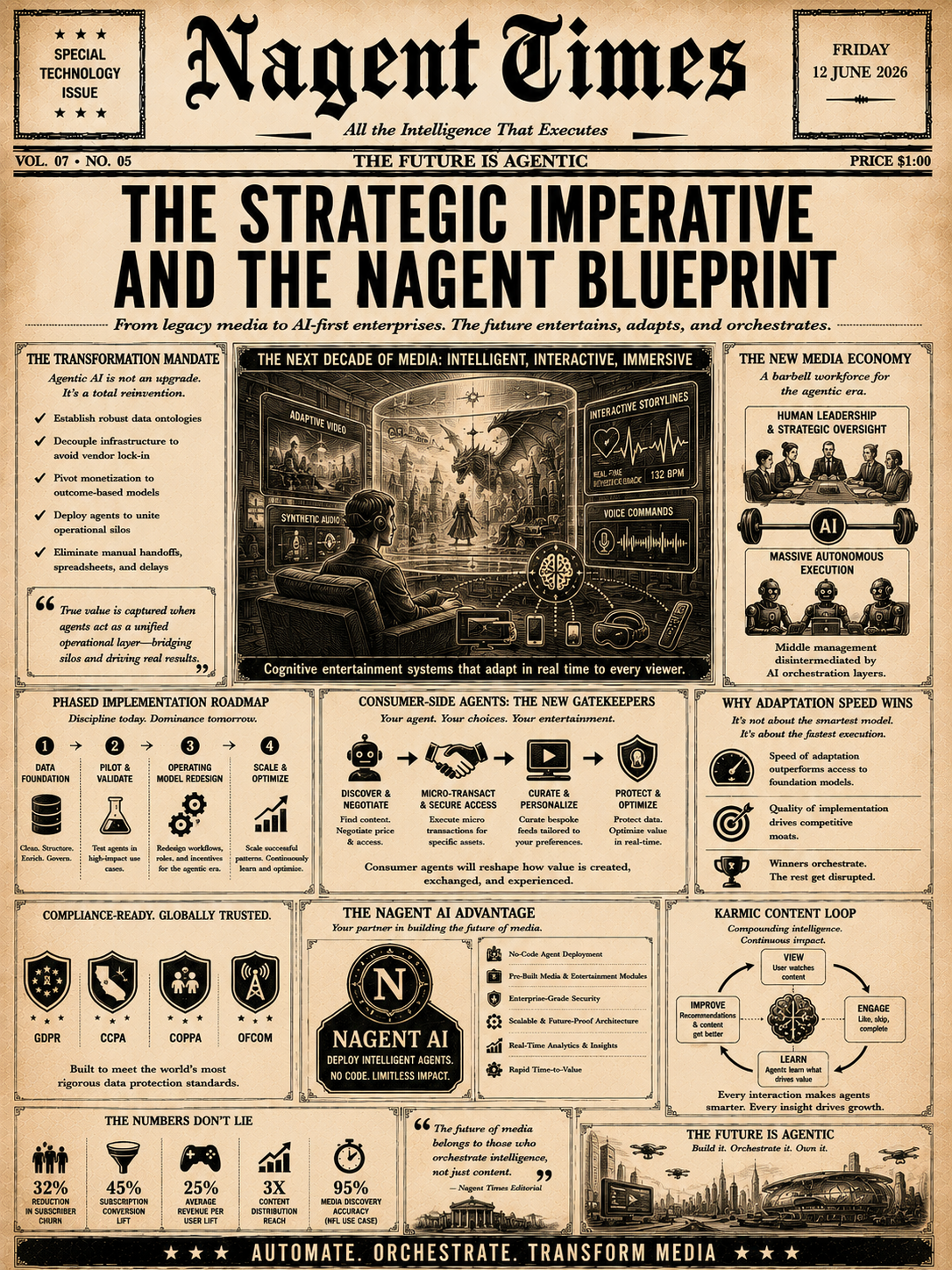
The Strategic Imperative and the Nagent Blueprint
Transforming a legacy media conglomerate into an AI first enterprise requires a highly disciplined, phased implementation strategy that sequences data hygiene, pilot validation, and operating model redesign. CEOs and board members must recognize that agentic AI is not an incremental IT upgrade; it is a fundamental transformation of labor economics. Leaders must mandate the establishment of robust data ontologies, decouple their technical infrastructure to avoid vendor lock in, and aggressively pivot their monetization strategies toward outcome based models. True value is captured when agents act as a unified operational layer that bridges functional silos, eliminating manual email handoffs and spreadsheet updates.
Looking toward the next decade, the concept of static media consumption will entirely erode. Streaming platforms will evolve into cognitive entertainment systems where content is interactive and adaptive, dynamically rendering videos, synthesizing audio, and altering plots based on real time biometric engagement or voice commands. The traditional model of a centralized streaming platform dictating the user experience will be challenged by consumer side agents that negotiate micro transactions for specific media assets and curate entirely bespoke entertainment feeds. The workforce structure will resemble a barbell, consisting of highly strategic human leadership and oversight on one end, and massive autonomous execution on the other, with traditional middle management largely disintermediated by AI orchestration layers.
The decisive factor in this era is not access to foundation models; it is the speed and quality of organizational adaptation. This is the exact execution layer we are providing at Nagent AI. Built compliance ready across GDPR, CCPA, COPPA, and OFCOM standards, Nagent AI allows content platforms and entertainment brands to deploy intelligent agents without code.
Through our proprietary KARMIC Feedback Loop, our recommendation agents improve with every view, skip, and completion, while our content agents continuously learn which specific topics drive subscriptions rather than just traffic, compounding accuracy without manual data science retraining.