The Nagent Times
All the Intelligence That Executes
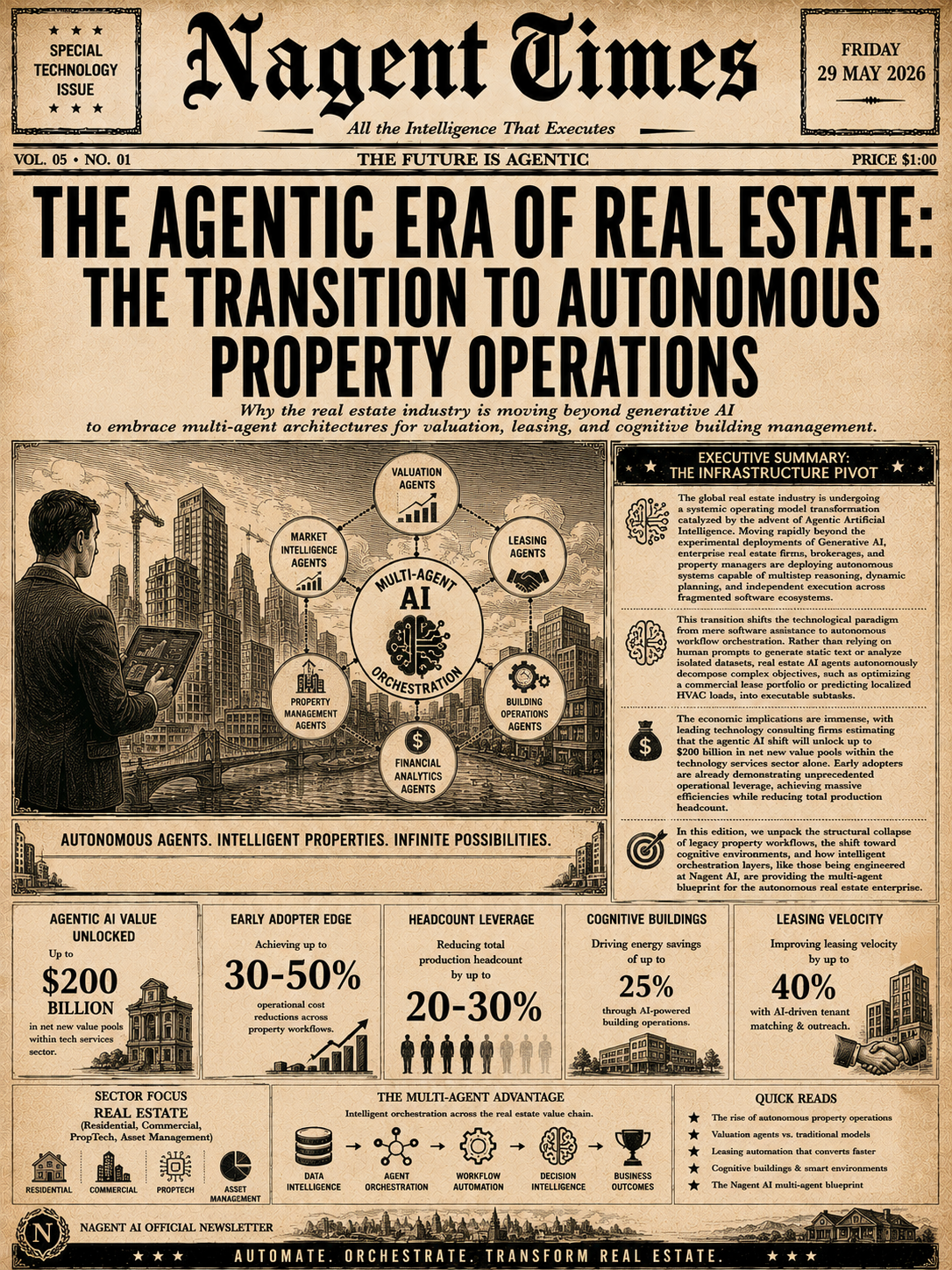
The Agentic Era of Real Estate: The Transition to Autonomous Property Operations
The global real estate industry is undergoing a systemic operating model transformation catalyzed by the advent of Agentic Artificial Intelligence. Moving rapidly beyond the experimental deployments of Generative AI, enterprise real estate firms, brokerages, and property managers are deploying autonomous systems capable of multistep reasoning, dynamic planning, and independent execution across fragmented software ecosystems.
This transition shifts the technological paradigm from mere software assistance to autonomous workflow orchestration. Rather than relying on human prompts to generate static text or analyze isolated datasets, real estate AI agents autonomously decompose complex objectives, such as optimizing a commercial lease portfolio or predicting localized HVAC loads, into executable subtasks.
The economic implications are immense, with leading technology consulting firms estimating that the agentic AI shift will unlock up to $200 billion in net new value pools within the technology services sector alone. Early adopters are already demonstrating unprecedented operational leverage, achieving massive efficiencies while reducing total production headcount.
In this edition, we unpack the structural collapse of legacy property workflows, the shift toward cognitive environments, and how intelligent orchestration layers, like those being engineered at Nagent AI, are providing the multi-agent blueprint for the autonomous real estate enterprise.
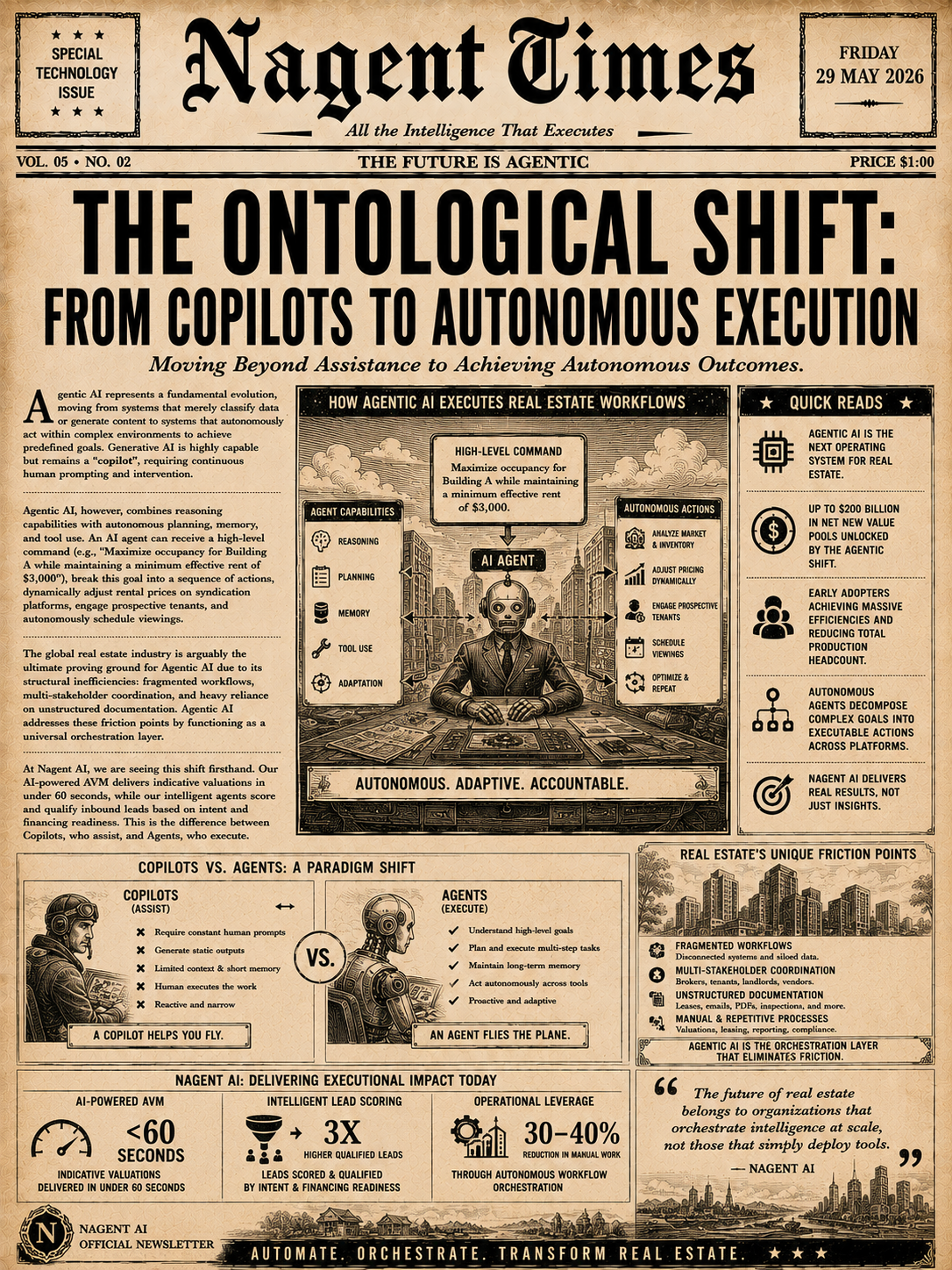
The Ontological Shift: From Copilots to Autonomous Execution
Agentic AI represents a fundamental evolution, moving from systems that merely classify data or generate content to systems that take autonomous action within complex environments to achieve predefined goals. Generative AI is highly capable but remains a "copilot", requiring continuous human prompting and intervention.
Agentic AI, however, combines reasoning capabilities with autonomous planning, memory, and tool use. An AI agent can receive a high-level command (e.g., "Maximize occupancy for Building A while maintaining a minimum effective rent of $3,000"), break this goal into a sequence of actions, dynamically adjust rental prices on syndication platforms, engage prospective tenants, and autonomously schedule viewings.
The global real estate industry is arguably the ultimate proving ground for Agentic AI due to its structural inefficiencies: fragmented workflows, multi-stakeholder coordination, and heavy reliance on unstructured documentation. Agentic AI addresses these friction points by functioning as a universal orchestration layer.
At Nagent AI, we are seeing this shift firsthand. Our AI-powered AVM delivers indicative valuations in under 60 seconds, while our intelligent agents score and qualify inbound leads based on intent and financing readiness. This is the difference between Copilots, who assist, and Agents, who execute.
The Real Estate Use Cases of Agentic AI
The commercial viability of Agentic AI is validated by its exhaustive application across the entire real estate lifecycle.
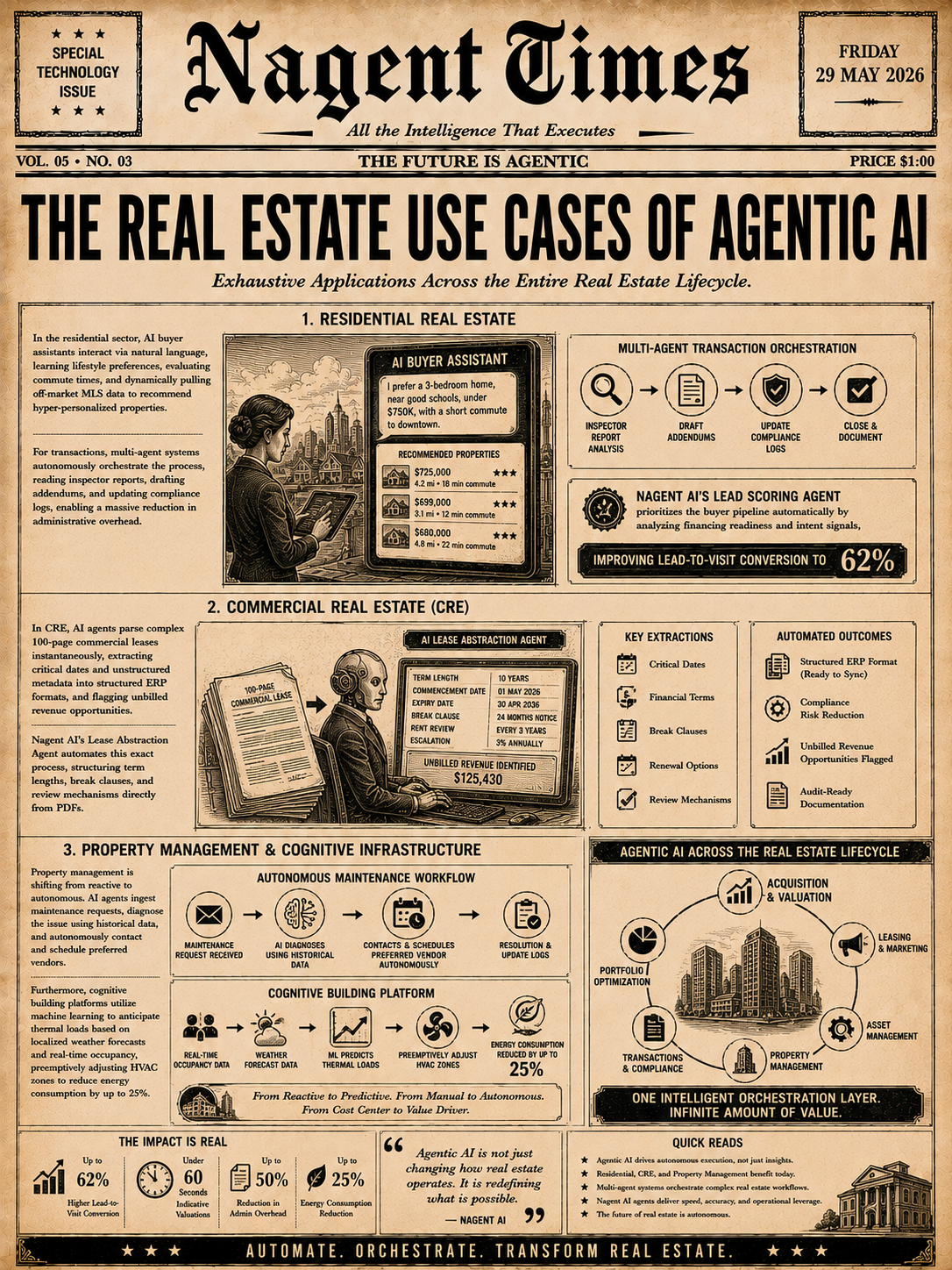
Residential Real Estate In the residential sector, AI buyer assistants interact via natural language, learning lifestyle preferences, evaluating commute times, and dynamically pulling off-market MLS data to recommend hyper-personalized properties. For transactions, multi-agent systems autonomously orchestrate the process, reading inspector reports, drafting addendums, and updating compliance logs, enabling a massive reduction in administrative overhead. Nagent AI’s Lead Scoring Agent, for example, prioritizes the buyer pipeline automatically by analyzing financing readiness and intent signals, improving lead-to-visit conversion to 62%.
Commercial Real Estate (CRE) In CRE, AI agents parse complex 100-page commercial leases instantaneously, extracting critical dates and unstructured metadata into structured ERP formats, and flagging unbilled revenue opportunities. Nagent AI’s Lease Abstraction Agent automates this exact process, structuring term lengths, break clauses, and review mechanisms directly from PDFs.
Property Management & Cognitive Infrastructure Property management is shifting from reactive to autonomous. AI agents ingest maintenance requests, diagnose the issue using historical data, and autonomously contact and schedule preferred vendors. Furthermore, cognitive building platforms utilize machine learning to anticipate thermal loads based on localized weather forecasts and real-time occupancy, preemptively adjusting HVAC zones to reduce energy consumption by up to 25%.
The October industry guide
Governance, Security, and The Architecture of Trust
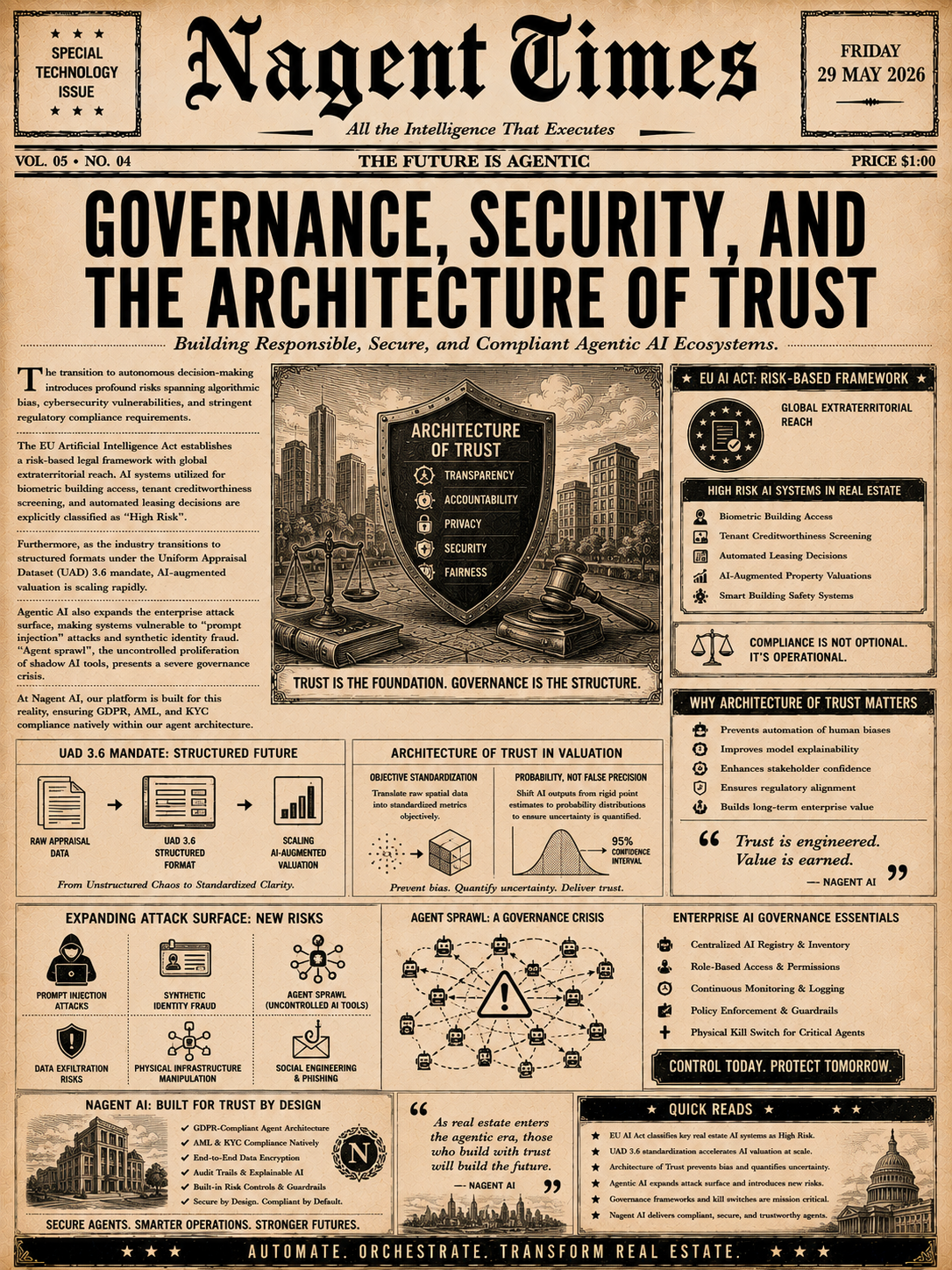
The transition to autonomous decision-making introduces profound risks spanning algorithmic bias, cybersecurity vulnerabilities, and stringent regulatory compliance requirements.
The EU Artificial Intelligence Act establishes a risk-based legal framework with global extraterritorial reach. AI systems utilized for biometric building access, tenant creditworthiness screening, and automated leasing decisions are explicitly classified as "High Risk".
Furthermore, as the industry transitions to structured formats under the Uniform Appraisal Dataset (UAD) 3.6 mandate, AI-augmented valuation is scaling rapidly. To prevent systems from merely automating human biases, researchers propose an "Architecture of Trust". This involves translating raw spatial data into standardized metrics objectively and shifting AI outputs from rigid point estimates to probability distributions to ensure uncertainty is quantified.
Agentic AI also expands the enterprise attack surface, making systems vulnerable to "prompt injection" attacks and synthetic identity fraud. "Agent sprawl", the uncontrolled proliferation of shadow AI tools, presents a severe governance crisis. CISOs must establish centralized AI registries and implement physical kill switches for agents interacting with critical physical infrastructure. At Nagent AI, our platform is built for this reality, ensuring GDPR, AML, and KYC compliance natively within our agent architecture.
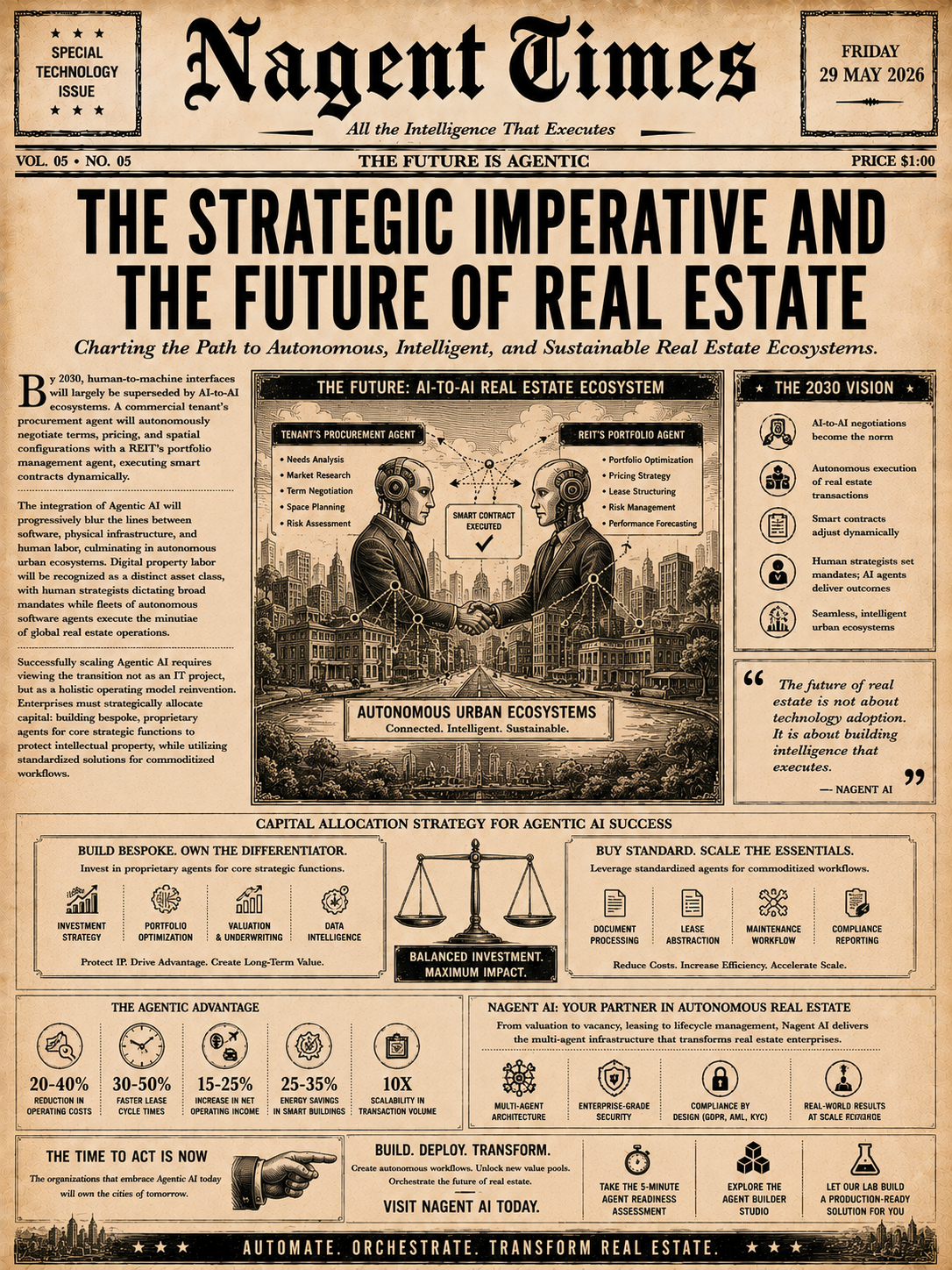
The Strategic Imperative and The Future of Real Estate
By 2030, human-to-machine interfaces will largely be superseded by AI-to-AI ecosystems. A commercial tenant's procurement agent will autonomously negotiate terms, pricing, and spatial configurations with a REIT's portfolio management agent, executing smart contracts dynamically.
The integration of Agentic AI will progressively blur the lines between software, physical infrastructure, and human labor, culminating in autonomous urban ecosystems. Digital property labor will be recognized as a distinct asset class, with human strategists dictating broad mandates while fleets of autonomous software agents execute the minutiae of global real estate operations.
Successfully scaling Agentic AI requires viewing the transition not as an IT project but as a holistic reinvention of the operating model. Enterprises must strategically allocate capital: building bespoke, proprietary agents for core strategic functions to protect intellectual property, while utilizing standardized solutions for commoditized workflows.