The Nagent Times
All the Intelligence That Executes
The Agentic Era of Travel: From Search to Autonomous Execution
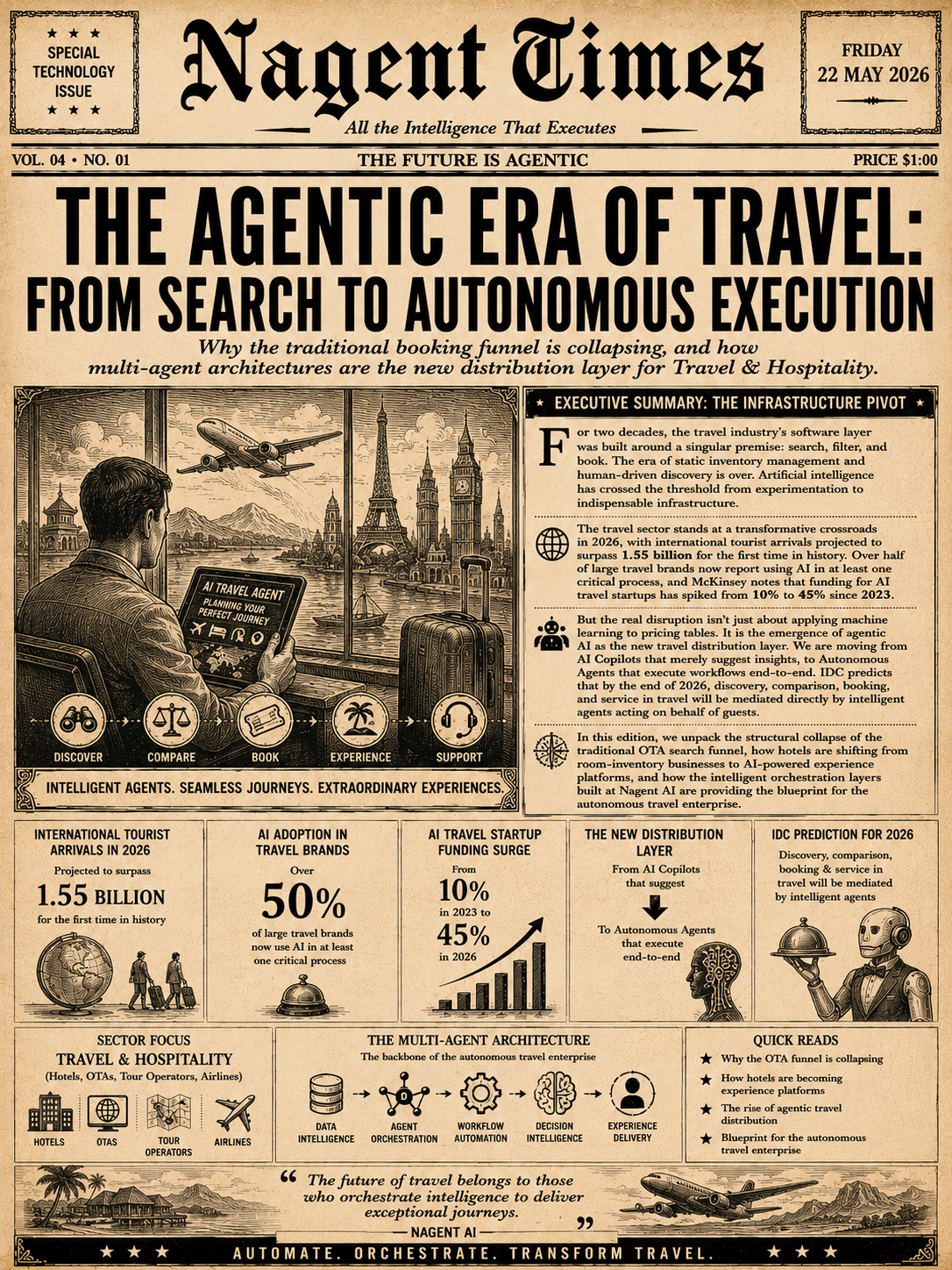
For two decades, the travel industry’s software layer was built around a singular premise: search, filter, and book. The era of static inventory management and human-driven discovery is over. Artificial intelligence has crossed the threshold from experimentation to indispensable infrastructure.
The travel sector stands at a transformative crossroads in 2026, with international tourist arrivals projected to surpass 1.55 billion for the first time in history. Over half of large travel brands now report using AI in at least one critical process, and McKinsey notes that funding for AI travel startups has spiked from 10% to 45% since 2023.
But the real disruption isn't just about applying machine learning to pricing tables. It is the emergence of agentic AI as the new layer of travel distribution. We are moving from AI Copilots that merely suggest insights, to Autonomous Agents that execute workflows end-to-end. IDC predicts that by the end of 2026, discovery, comparison, booking, and service in travel will be mediated directly by intelligent agents acting on behalf of guests.
In this edition, we unpack the structural collapse of the traditional OTA search funnel, how hotels are shifting from room-inventory businesses to AI-powered experience platforms, and how the intelligent orchestration layers built at Nagent AI are providing the blueprint for the autonomous travel enterprise.
The Macro Shift: The Death of the Legacy OTA Funnel
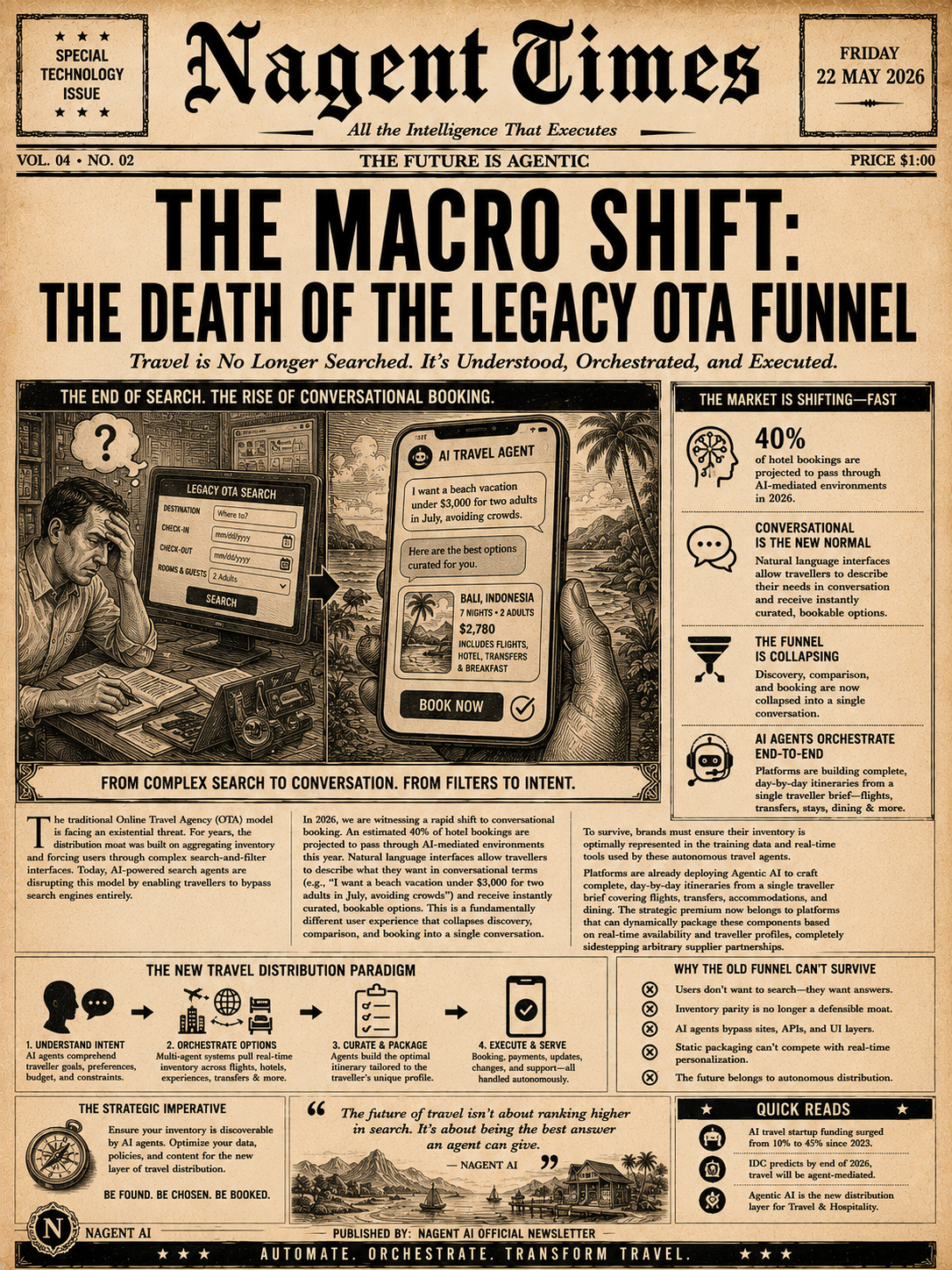
The traditional Online Travel Agency (OTA) model is facing an existential threat. For years, the distribution moat was built on aggregating inventory and forcing users through complex search-and-filter interfaces. Today, AI-powered search agents are disrupting this model by enabling travelers to bypass search engines entirely.
In 2026, we are witnessing a rapid shift to conversational booking. An estimated 40% of hotel bookings are projected to pass through AI-mediated environments this year. Natural language interfaces allow travelers to describe what they want in conversational terms (e.g., "I want a beach vacation under $3,000 for two adults in July, avoiding crowds") and receive instantly curated, bookable options. This is a fundamentally different user experience that collapses discovery, comparison, and booking into a single conversation.
To survive, brands must ensure their inventory is optimally represented in the training data and real-time tools used by these autonomous travel agents.
Platforms are already deploying Agentic AI to craft complete, day-by-day itineraries from a single traveler brief covering flights, transfers, accommodations, and dining. The strategic premium now belongs to platforms that can dynamically package these components based on real-time availability and traveler profiles, completely sidestepping arbitrary supplier partnerships.
Re-architecting Hospitality: Ambient Intelligence & Autopilot Revenue
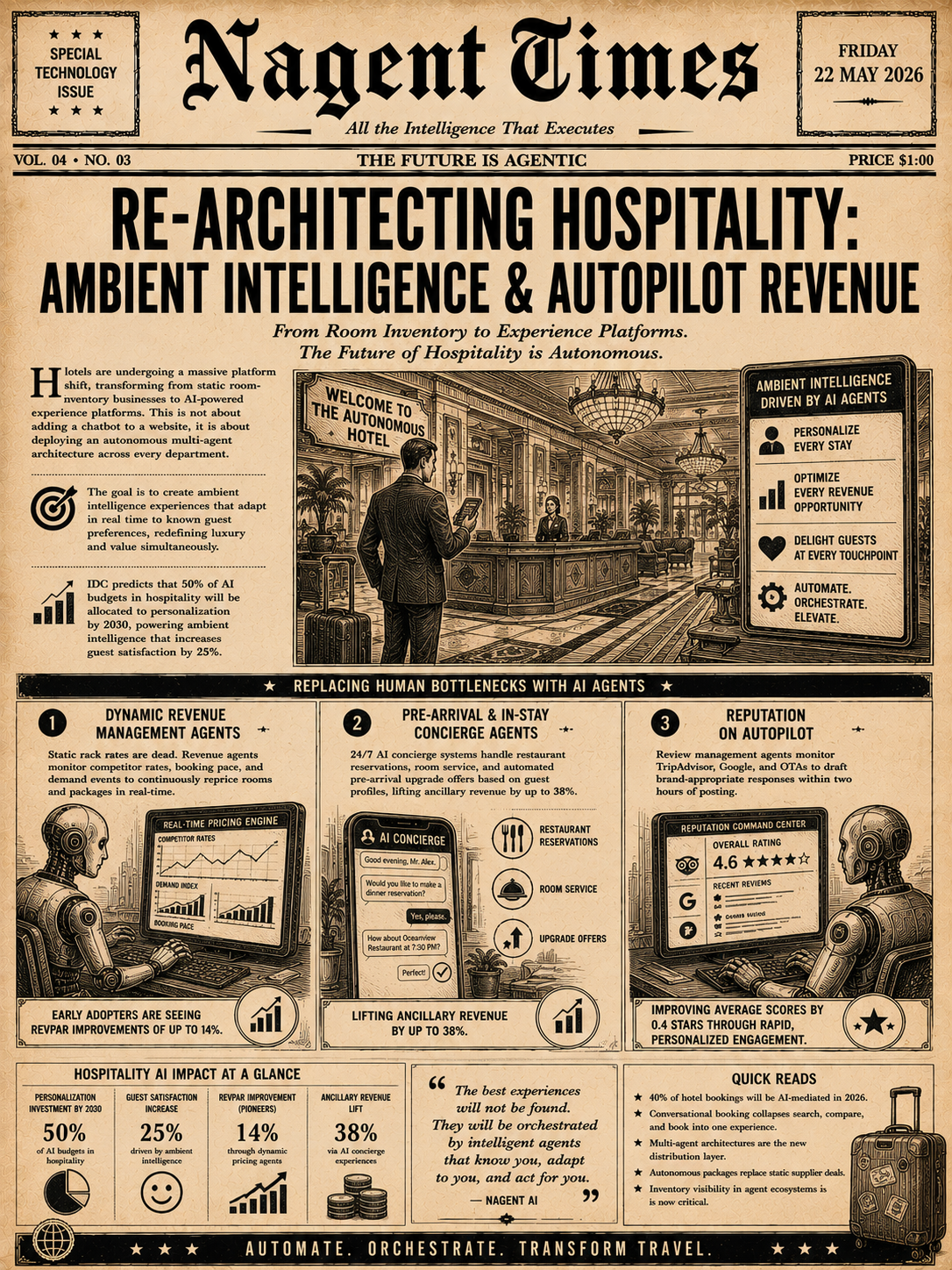
Hotels are undergoing a massive platform shift, transforming from static room-inventory businesses to AI-powered experience platforms. This is not about adding a chatbot to a website; it is about deploying an autonomous multi-agent architecture across every department.
The goal is ambient intelligence experiences that adapt in real-time to known guest preferences, redefining luxury and value simultaneously. IDC predicts that 50% of AI budgets in hospitality will be allocated to personalization by 2030, powering ambient intelligence that increases guest satisfaction by 25%.
Forward-thinking properties are replacing human bottlenecks with highly specialized AI agents:
Dynamic Revenue Management Agents: Static rack rates are dead. Revenue agents monitor competitor rates, booking pace, and demand events to continuously reprice rooms and packages in real-time. Early adopters are seeing RevPAR improvements of up to 14%.
Pre-Arrival & In-Stay Concierge Agents: 24/7 AI concierge systems handle restaurant reservations, room service, and automated pre-arrival upgrade offers based on guest profiles, lifting ancillary revenue by up to 38%. This frees human staff to focus on high-touch, complex interactions.
Reputation on Autopilot: Review management agents monitor TripAdvisor, Google, and OTAs to draft brand-appropriate responses within two hours of posting. By closing the loop between experience and rating, properties are improving their average scores by 0.4 stars purely through rapid, personalized engagement.
The October industry guide
Tour Operators & Airlines: Autonomous Operations
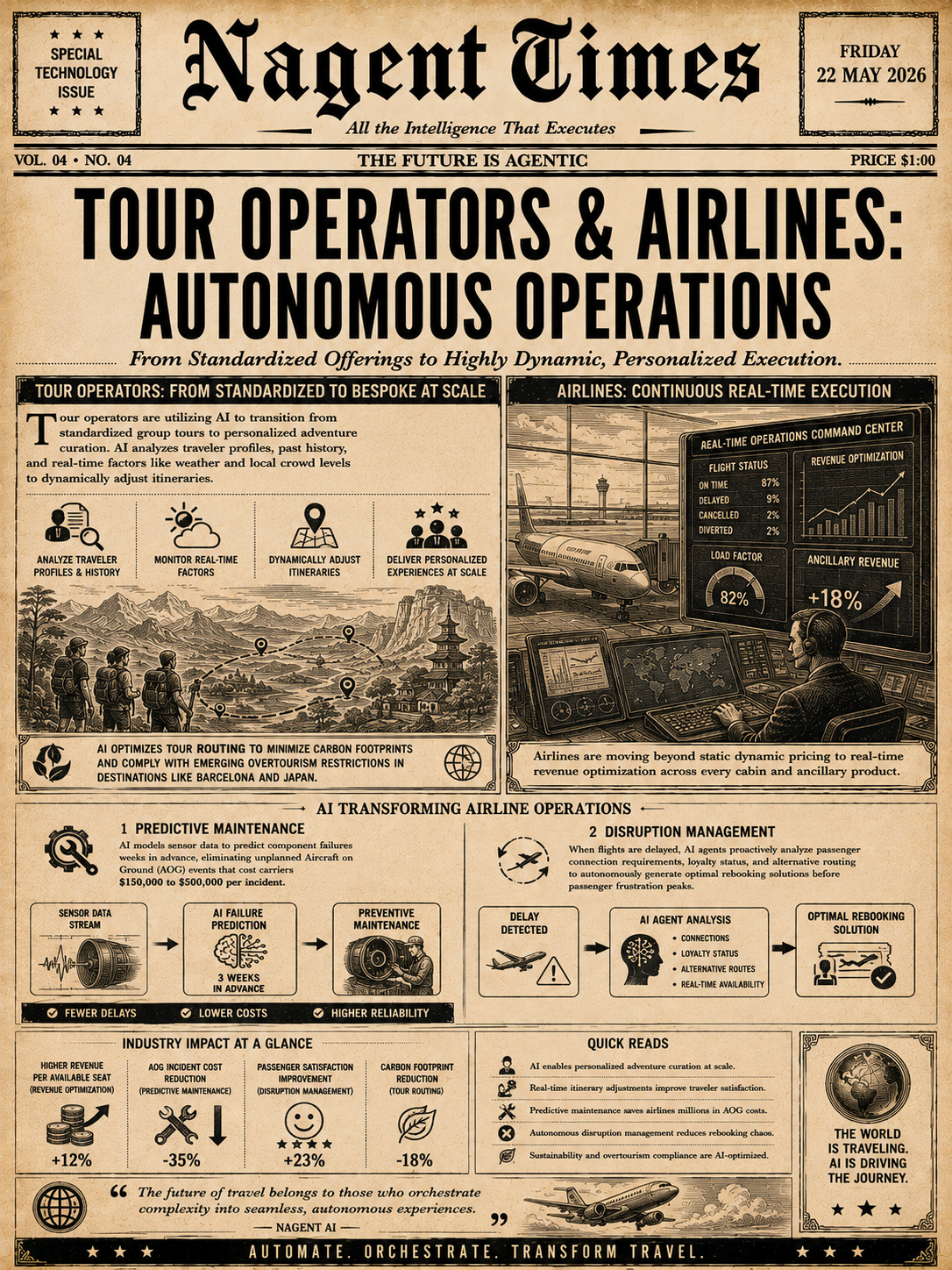
The shift to Agentic AI extends deeply into complex logistical operations, moving the industry from standardized offerings to highly dynamic, personalized execution.
Tour Operators: From Standardized to Bespoke at Scale
Tour operators are utilizing AI to transition from standardized group tours to personalized adventure curation. AI analyzes traveler profiles, past history, and real-time factors like weather and local crowd levels to dynamically adjust itineraries. Furthermore, AI is optimizing tour routing to minimize carbon footprints and comply with emerging overtourism restrictions in destinations like Barcelona and Japan.
Airlines: Continuous Real-Time Execution
Airlines, heavily data-rich, are moving beyond static dynamic pricing to real-time revenue optimization across every cabin and ancillary product.
More critically, AI is transforming airline operations:
Predictive Maintenance: AI models sensor data to predict component failures weeks in advance, eliminating unplanned Aircraft on Ground (AOG) events that cost carriers $150,000 to $500,000 per incident.
Disruption Management: When flights are delayed, AI agents proactively analyze passenger connection requirements, loyalty status, and alternative routing to autonomously generate optimal rebooking solutions before passenger frustration peaks.
The ROI Imperative & The Nagent Blueprint
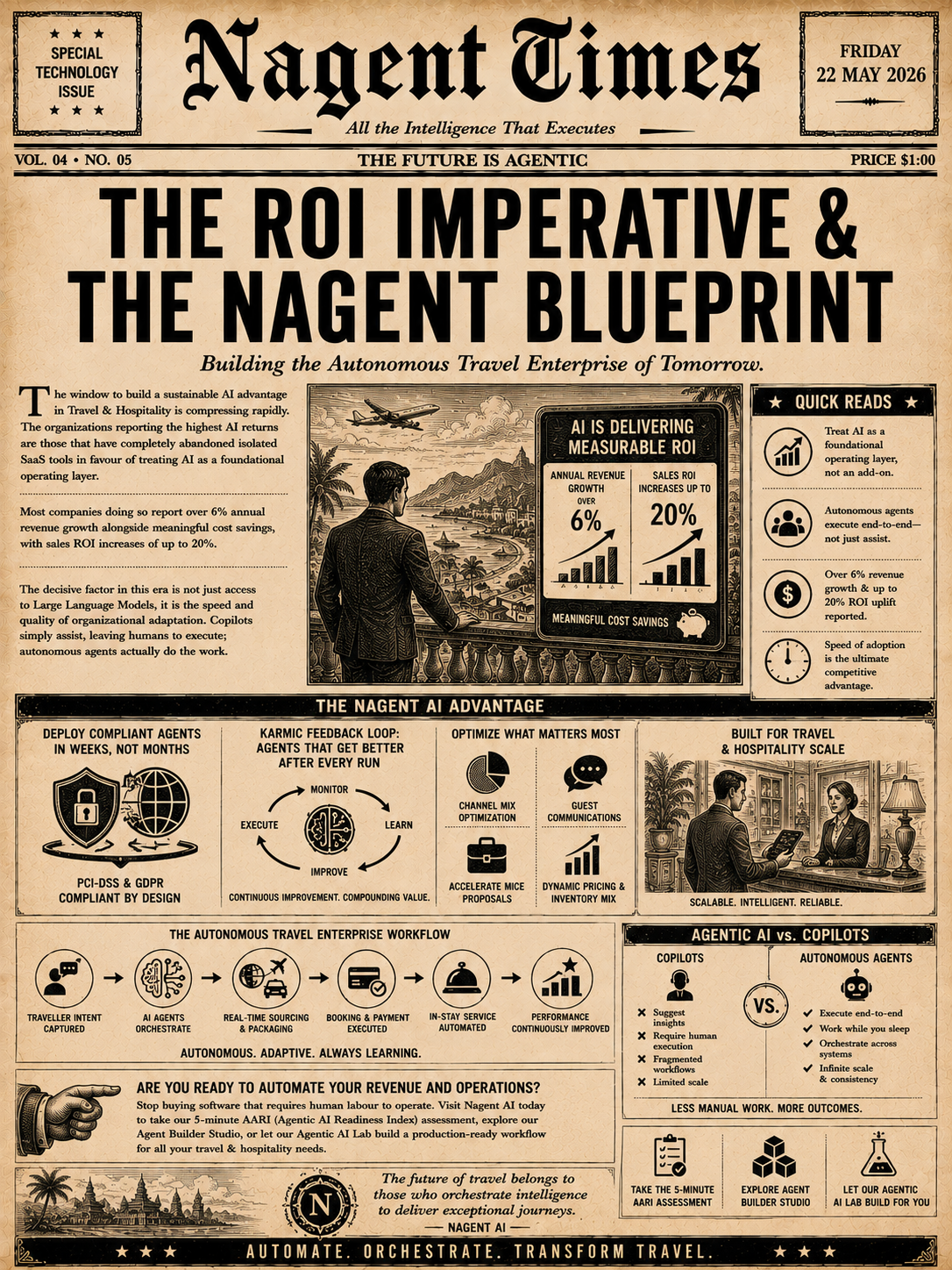
The window to build a sustainable AI advantage in Travel & Hospitality is compressing rapidly. The organizations reporting the highest AI returns are those that have completely abandoned isolated SaaS tools in favor of treating AI as a foundational operating layer. Most companies doing so report over 6% annual revenue growth alongside meaningful cost savings, with sales ROI increases of up to 20%.
The decisive factor in this era is not just access to Large Language Models, but also the speed and quality of organizational adaptation. Copilots simply assist, leaving humans to execute; autonomous agents actually do the work.
At Nagent AI, we are providing the execution layer for the autonomous travel enterprise. Our platform lets you deploy PCI-DSS- and GDPR-compliant agents in weeks, not months. With our proprietary KARMIC feedback loop, your agents continuously improve their performance after every run optimising channel mix, handling guest communications, and accelerating corporate MICE proposals.