The Nagent Times
All the Intelligence That Executes
The Autonomous Transition: Software as Labor and the Death of the SaaS Seat
Executive Summary: The Infrastructure Pivot
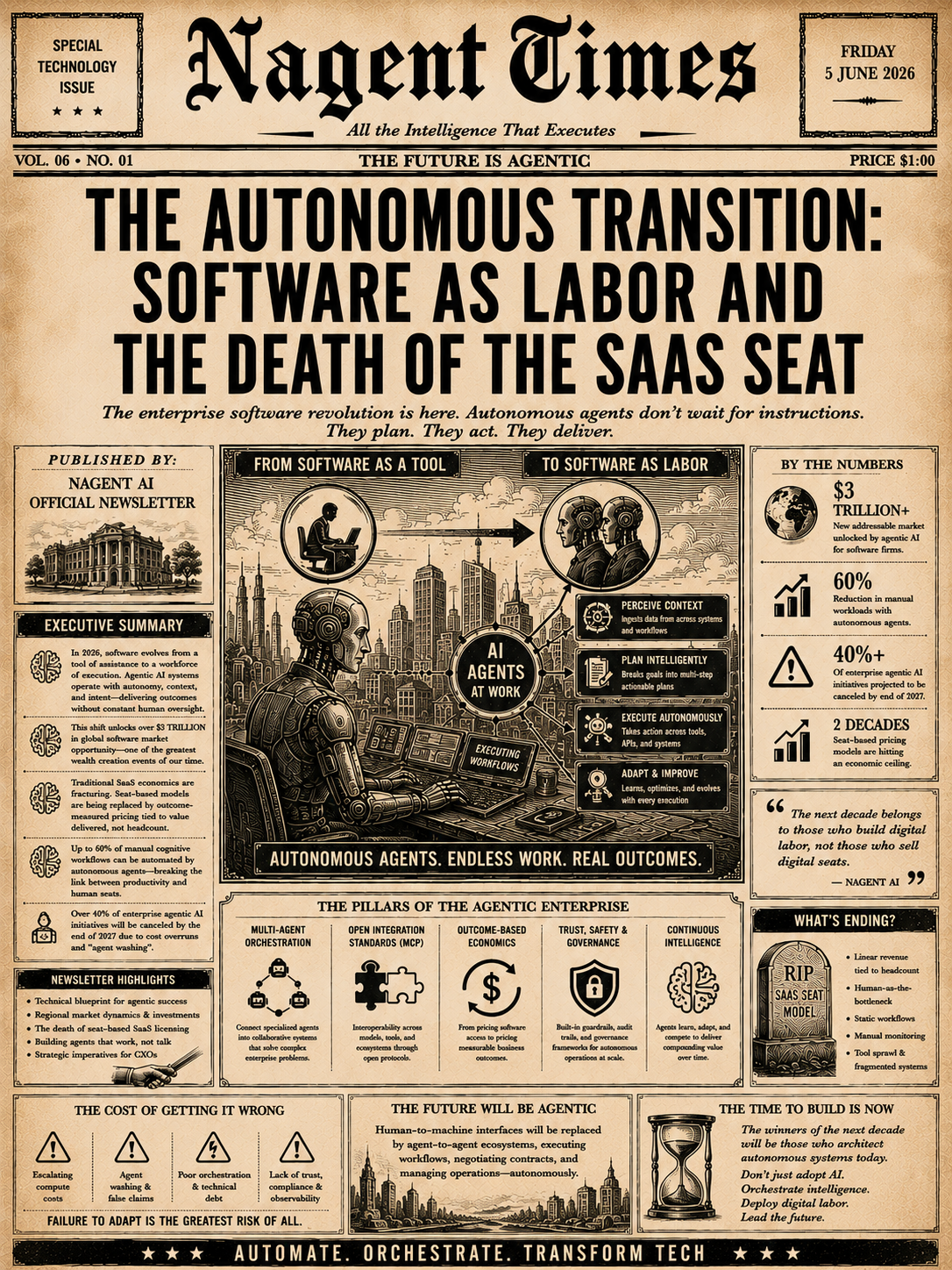
The global technology and software-as-a-service (SaaS) ecosystem has crossed a critical architectural threshold, transitioning definitively from conversational generative AI copilots toward the integration of autonomous, goal-oriented agentic AI systems. As of 2026, agentic AI represents a fundamental paradigm shift from "software as a tool" to "software as labor". Unlike early GenAI configurations that function as static reasoning engines requiring constant human prompting, autonomous agents possess the cross-workflow context necessary to perceive, plan, and execute multi-step enterprise workflows entirely on their own.
The commercial implications are staggering. This shift adds over $3 trillion to the global addressable market for software firms, presenting a generational wealth-creation event. Simultaneously, it fractures the foundational economics of the traditional SaaS industry. For two decades, enterprise software valuations were anchored by seat-based licensing models, in which revenue scaled linearly with headcount. As autonomous agents displace human operators in routine cognitive tasks, slashing manual workloads by up to 60%, the correlation between enterprise productivity and the number of human seats is breaking down. Consequently, leading providers are forced to pivot toward outcome-measured pricing models to monetize digital labor rather than human access.
Despite this profound promise, over 40% of enterprise agentic AI initiatives are projected to be canceled by the end of 2027. These failures are driven by escalating computational costs and the rampant industry practice of "agent washing", which is rebranding legacy RPA or static chatbots as autonomous agents. Enterprise success is no longer dictated by the raw capabilities of underlying models. Instead, it hinges on robust multi-agent orchestration fabrics, open integration standards such as the Model Context Protocol (MCP), and rigorous enterprise evaluation frameworks. This comprehensive newsletter highlights the technical blueprint, regional market dynamics, and strategic imperatives defining the autonomous enterprise in 2026.
The Ontological Shift: Re-Architecting for Cross-Workflow Context
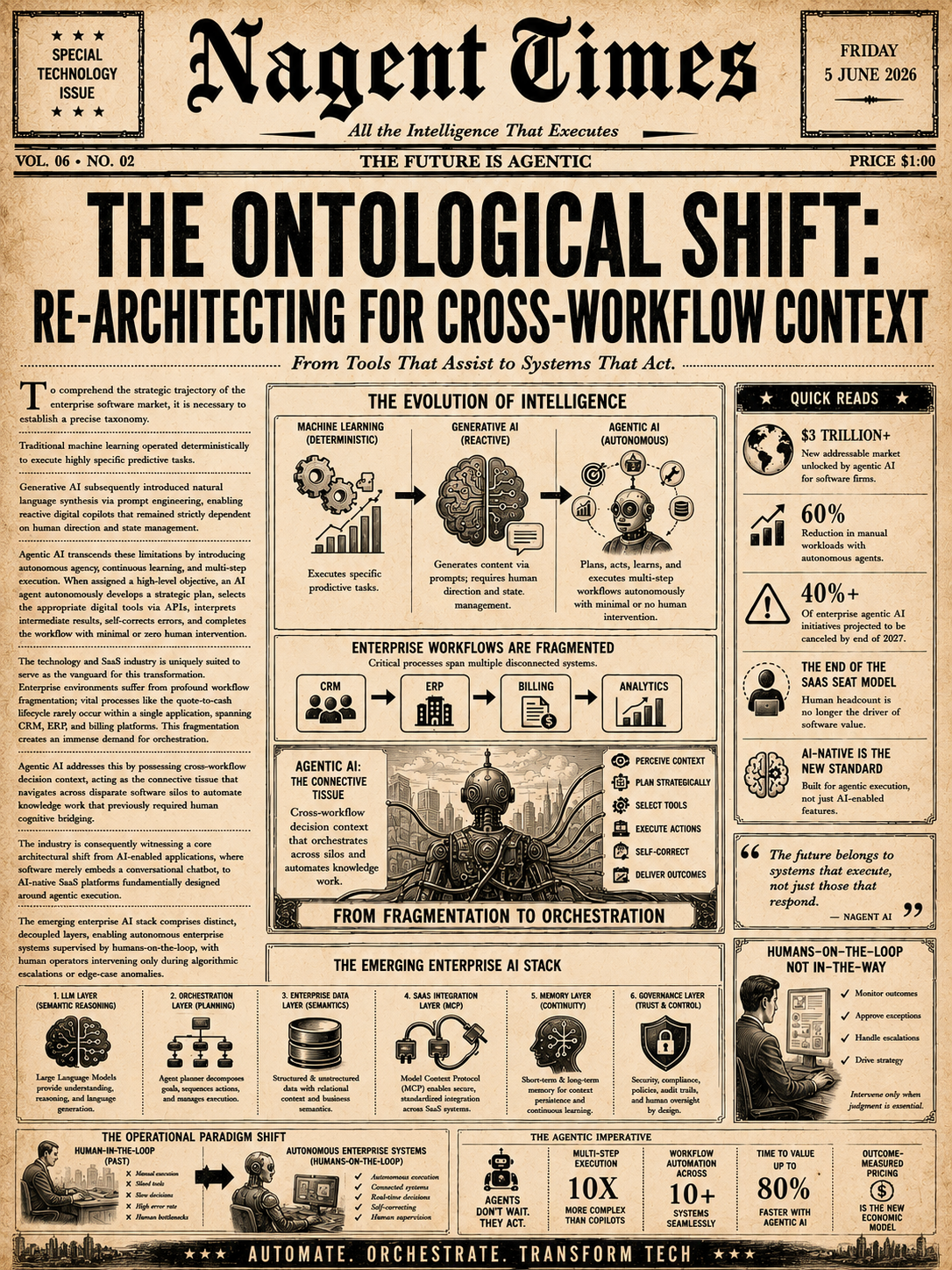
To comprehend the strategic trajectory of the enterprise software market, it is necessary to establish a precise taxonomy. Traditional machine learning operated deterministically to execute highly specific predictive tasks. Generative AI subsequently introduced natural language synthesis via prompt engineering, enabling reactive digital copilots that remained strictly dependent on human direction and state management. Agentic AI transcends these limitations by introducing autonomous agency, continuous learning, and multi-step execution. When assigned a high-level objective, an AI agent autonomously develops a strategic plan, selects the appropriate digital tools via APIs, interprets intermediate results, self-corrects errors, and completes the workflow with minimal or zero human intervention.
The technology and SaaS industry is uniquely suited to serve as the vanguard for this transformation. Enterprise environments suffer from profound workflow fragmentation; vital processes like the quote-to-cash lifecycle rarely occur within a single application, spanning CRM, ERP, and billing platforms. This fragmentation creates an immense demand for orchestration. Agentic AI addresses this by possessing cross-workflow decision context, acting as the connective tissue that navigates across disparate software silos to automate knowledge work that previously required human cognitive bridging.
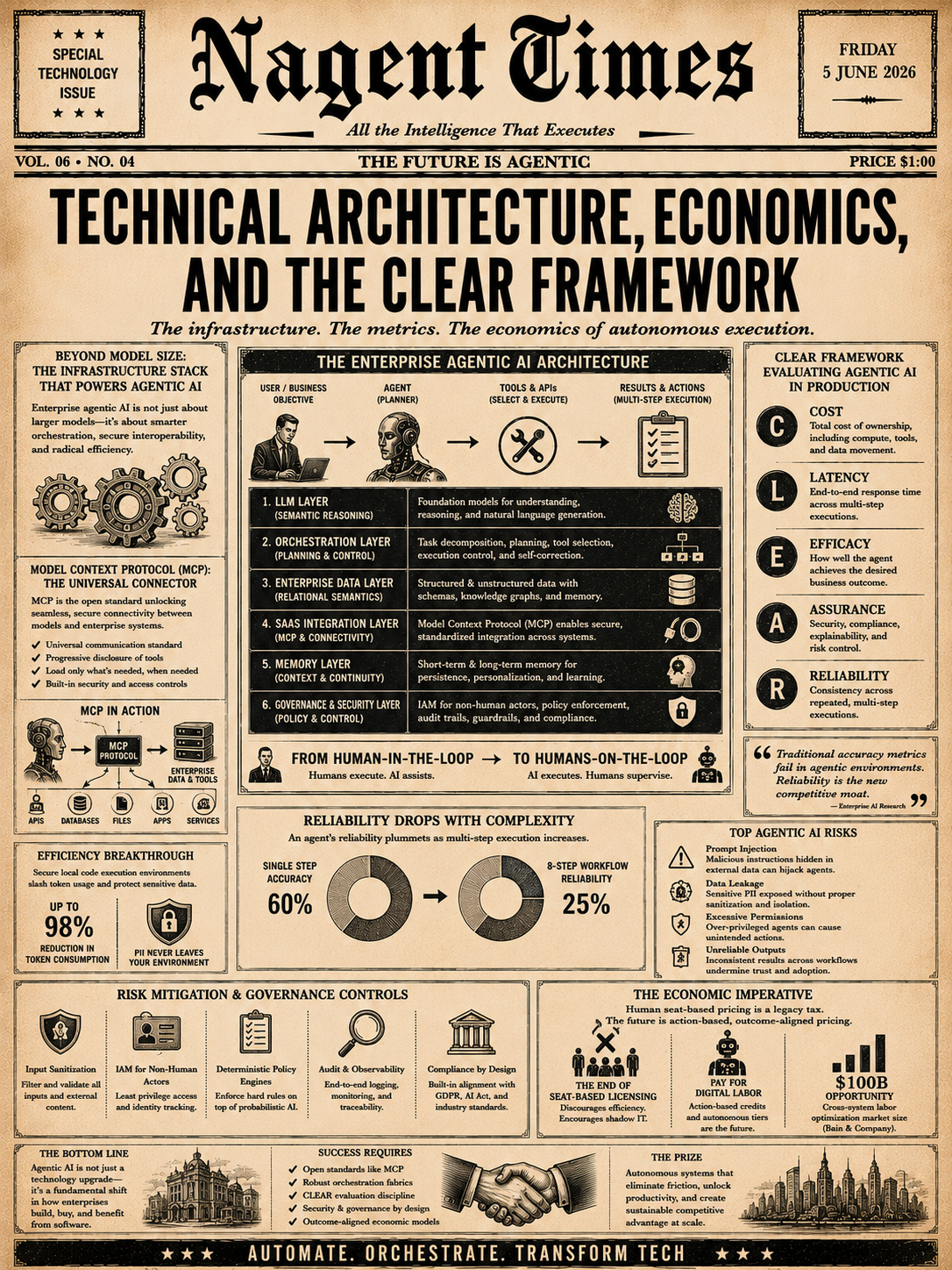
The industry is consequently witnessing a core architectural shift from AI-enabled applications, where software merely embeds a conversational chatbot, to AI-native SaaS platforms fundamentally designed around agentic execution. The emerging enterprise Al stack comprises distinct, decoupled layers: the LLM Layer for semantic reasoning, the Orchestration Layer for planning, the Enterprise Data Layer for relational semantics, the SaaS Integration Layer (facilitated by standards like MCP), and dedicated layers for Memory and Governance. In this paradigm, the operational structure transitions from human-in-the-loop to autonomous enterprise systems supervised by humans-on-the-loop, with human operators intervening only during algorithmic escalations or edge-case anomalies.
The Global Market Landscape and Sub-Industry Use Cases
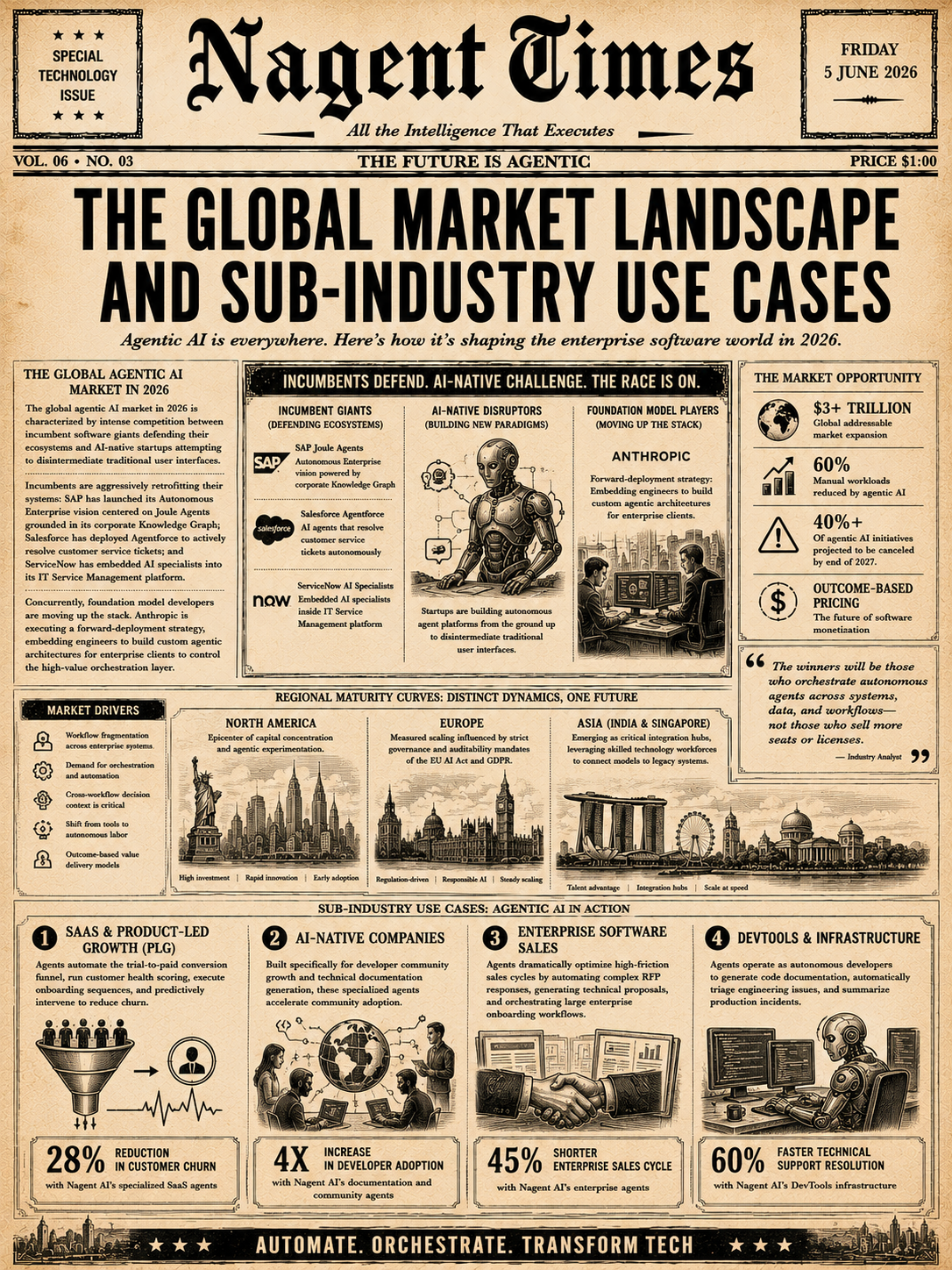
The global agentic AI market in 2026 is characterized by intense competition between incumbent software giants defending their ecosystems and AI-native startups attempting to disintermediate traditional user interfaces. Incumbents are aggressively retrofitting their systems: SAP has launched its Autonomous Enterprise vision centered on Joule Agents grounded in its corporate Knowledge Graph; Salesforce has deployed Agentforce to actively resolve customer service tickets; and ServiceNow has embedded AI specialists into its IT Service Management platform. Concurrently, foundation model developers are moving up the stack. Anthropic is executing a forward-deployment strategy, embedding engineers to build custom agentic architectures for enterprise clients to control the high-value orchestration layer.
The regional maturity curves reveal distinct dynamics. North America remains the epicenter of capital concentration and agentic experimentation. Europe exhibits a more measured scaling trajectory heavily influenced by the strict governance and auditability mandates of the EU AI Act and GDPR. Asian markets, particularly India and Singapore, are emerging as critical integration hubs, leveraging skilled technology workforces to connect foundational models to legacy enterprise architectures.
Across these regions, the commercial deployment of agentic AI is manifesting across four core technology sub-industries:
- SaaS & Product-Led Growth (PLG): Agents automate the trial-to-paid conversion funnel, run customer health scoring, execute onboarding sequences, and predictively intervene to reduce churn. Platforms utilizing Nagent AI's specialized SaaS agents are achieving a 28% reduction in customer churn.
- AI-Native Companies: Built specifically for developer community growth and technical documentation generation, these specialized agents accelerate community adoption. Deploying Nagent AI's documentation and community agents triggers a 4x increase in developer adoption rates.
- Enterprise Software Sales: Agents dramatically optimize high-friction sales cycles by automating complex RFP responses, generating technical proposals, and orchestrating large enterprise onboarding workflows. Nagent AI's enterprise agents drive a 45% shorter enterprise sales cycle.
- DevTools & Infrastructure: Agents operate as autonomous developers to generate code documentation, automatically triage engineering issues, and summarize production incidents. Nagent AI's DevTools infrastructure achieves a 60% faster time to technical support resolution.
The October industry guide
Technical Architecture, Economics, and the CLEAR Framework
The technical implementation of agentic AI within enterprise SaaS environments relies on a highly sophisticated infrastructure that extends well beyond the foundation model's parameter counts. Interoperability has historically been stymied by brittle, point-to-point API integrations. The widespread adoption of the Model Context Protocol (MCP) as an open-source standard has resolved this bottleneck, functioning as a universal communication standard between models and enterprise data sources. MCP facilitates progressive disclosure, allowing an agent to load only the specific tool definitions required for an immediate task. Combined with secure code execution environments where agents process data locally, this architectural breakthrough slashes token consumption by up to 98% and prevents sensitive PII from entering external context windows.
This efficiency is paramount because security and governance represent the primary barriers to enterprise-scale deployment. To address these risks, the enterprise market has adopted the CLEAR Framework (Cost, Latency, Efficacy, Assurance, Reliability) for production evaluation. Traditional model accuracy metrics fail in agentic environments; research under the CLEAR framework demonstrates that an agent achieving 60% accuracy on a single execution can see its reliability plummet to 25% when required to run eight consecutive, multi-step operations. Furthermore, agents are highly vulnerable to prompt injection, where malicious actors embed hidden instructions in external data sources to hijack goal-seeking behaviors. Mitigating this requires input sanitization, strict Identity and Access Management (IAM) for non-human actors, and deterministic policy engines that enforce hard logic overrides on probabilistic AI actions.
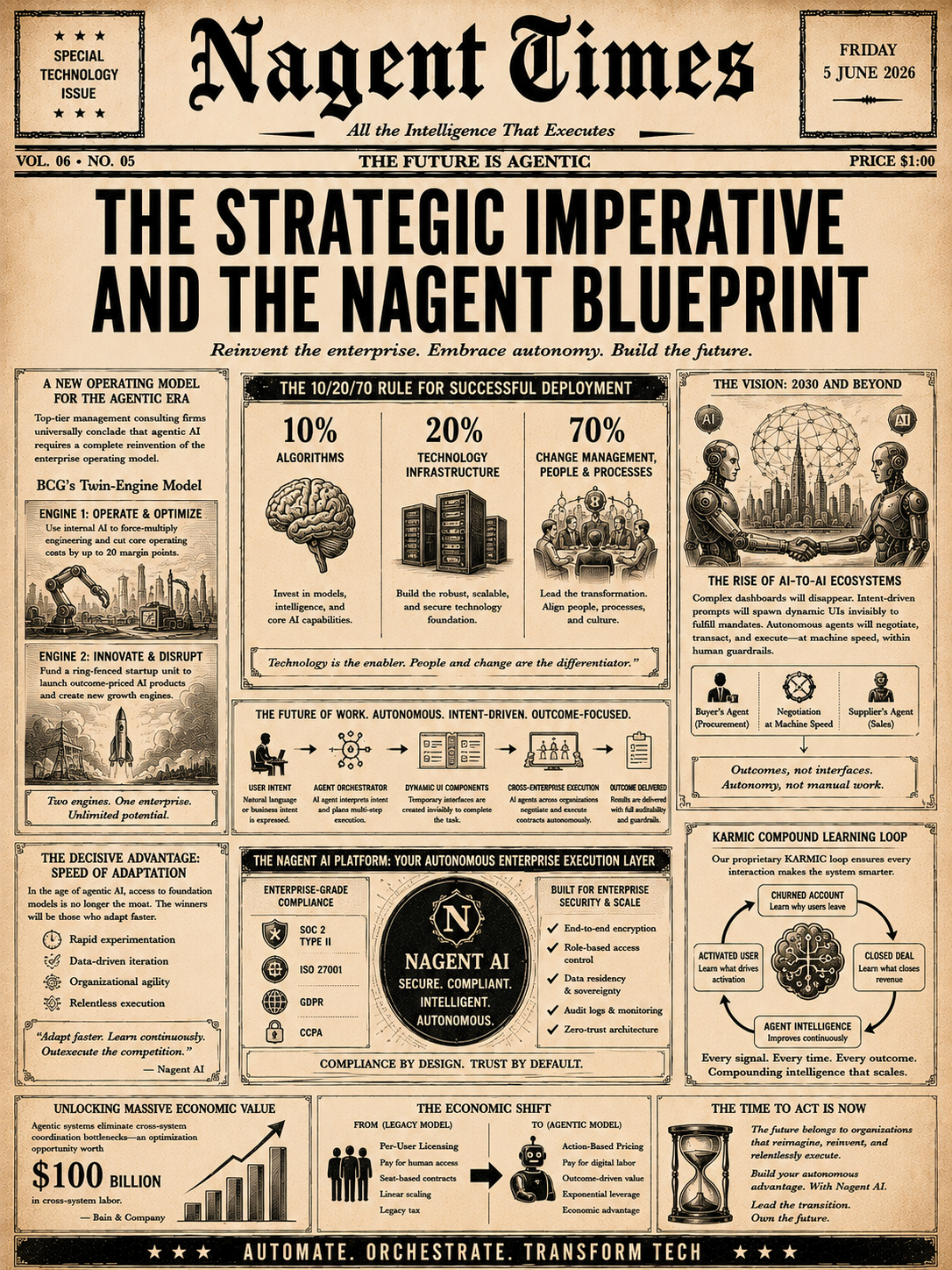
Economically, the contracting demand for human software seats means that enforcing per-user contracts is becoming a legacy tax that incentivizes enterprises to bypass vendor ecosystems entirely. To survive, the market is converging on action-based credit pricing and tiered autonomous packaging where organizations pay for digital labor rather than human access. True economic value is unlocked when agentic systems eliminate cross-system coordination bottlenecks, an optimization opportunity that Bain & Company quantifies as a $100 billion market in cross-system labor.
The Strategic Imperative and the Nagent Blueprint
Top-tier management consulting firms universally conclude that agentic AI requires a complete reinvention of the enterprise operating model. BCG advocates for a "Twin-Engine Model" where technology companies must use internal AI to force-multiply engineering and cut core operating costs by up to 20 margin points, while simultaneously funding a ring-fenced startup unit to launch outcome-priced AI products. Successful deployment requires strict adherence to the 10/20/70 rule: allocating 10% of corporate effort to algorithms, 20% to technology infrastructure, and 70% to change management, people, and process realignment.
By 2030, complex software dashboards will disappear. Traditional user interfaces will be replaced by intent-driven prompts that dynamically spawn temporary UI components invisibly to fulfill user mandates. We will witness the rise of Al-to-Al corporate ecosystems, where a buyer's autonomous procurement agent directly negotiates pricing, volume, and logistics with a supplier's autonomous sales agent, executing legally binding contracts at machine speed within human guardrails.
The decisive factor in this era is not access to foundation models; it is the speed of organizational adaptation. This is the infrastructure we are providing at Nagent AI. Built fully compliance-ready across SOC 2, ISO 27001, GDPR, and CCPA standards, Nagent AI serves as the secure execution layer for the autonomous enterprise.
Through our proprietary KARMIC feedback loop, every churned account, closed deal, and activated user trains the agent to improve, compounding conversion accuracy without manual data science retraining.