
Custom AI Agent for Churn Prediction: A Practical Guide
A custom AI agent for churn prediction watches the signals that come before a customer leaves, scores each account's risk, and turns that score into a retention play, such as a check-in, a fix or an offer, with a person approving any outreach. This guide covers the signals, the scoring, the data it needs, build versus buy and the mistakes to avoid, and how to build one on Nagent that works alongside MIRA and her marketing team.
What does a churn prediction agent actually do?
A churn model gives you a number in a dashboard. A churn prediction agent closes the loop around that number. It does three jobs:
Watch. It reads the signals in your product, CRM, billing and support data.
Score. It gives each account or customer a risk score, and says why.
Act. It proposes the retention play that fits the reason, and drafts it for a person to approve.
The third job is what makes it an agent. A score that nobody acts on is a report, and churn doesn't wait for the monthly review.
Which signals predict churn?
The strongest signals are changes in behaviour, not absolute levels. A customer who always logs in once a week isn't at risk. One who used to log in daily and now logs in once a week might be.
Usage. Fewer logins, fewer active seats, and key features used less or not at all.
Onboarding. Setup steps left unfinished weeks after signing up.
Support. More tickets, repeat tickets on the same problem, unresolved escalations and frustrated wording.
Commercial. Failed payments, downgrades, a contract renewal date coming up and requests for discounts.
Relationship. The champion who bought the product has left, or nobody senior has spoken to you in months.
Conversations. What customers say in chats, calls and emails: a mention of a competitor, a question about exporting data or a complaint that keeps coming back.
For e-commerce, the signals look different. Watch the gap since the last order against the customer's own usual cycle, a falling order value, rising returns and skipped subscription deliveries.
How should the agent score churn risk?
Start simple, then earn complexity.
Weighted rules first. Give each signal a weight, add them up and set bands such as watch, at risk and critical. This works from day one, and anyone can read why an account scored high.
A statistical model later. Once you have a clean history of who churned and when, train a model on it. Logistic regression and gradient-boosted trees are common choices, and survival analysis helps when you care about when a customer will leave, not only whether.
Always with reasons. Every score should come with the two or three signals that drove it. A retention play depends on the reason, so a score without one is hard to act on.
Check it against reality. Each month, compare the scores with who actually churned, and adjust the weights or retrain.
How does the agent turn a score into a retention play?
Match the play to the reason, not to the score alone:
Usage has dropped: a training session, or a guide to the feature they stopped using.
Support pain: escalate the open issue to an owner, and follow up when it's fixed.
Price or budget: an offer within limits the business has already approved.
Champion has left: introduce yourself to the new owner and walk them through the value.
Failed payment: a reminder with an easy way to update the card.
The agent drafts the play. A person approves any outreach before it reaches a customer, at least until the agent has a record of getting it right. Then log the outcome of every play, so you learn which ones work for which reasons.
What data does a churn agent need?
At a minimum:
Product usage events, or order history for e-commerce.
CRM records: owner, plan, renewal date and contacts.
Billing: plan changes, failed payments and discounts.
Support tickets and conversation transcripts.
A history of who churned, when and, where you know it, why.
Your own definition of churn: a cancelled contract, a lapsed subscription or a customer who hasn't ordered within their usual cycle.
The most common blocker isn't missing data but mismatched data. Make sure one customer has one ID across product, CRM, billing and support before you score anything.
Should you build or buy a churn prediction agent?
Option: A churn score inside a customer success platform, Good for: Teams already running on that platform, Watch out for: The score is a black box, and acting on it stays manual
Option: A model built in-house by data science, Good for: Large datasets and a team to maintain it, Watch out for: Months to build, and the model rarely drafts the play
Option: A custom agent built on an agent platform, Good for: Teams that want scoring and action in one place, on their own data, Watch out for: It needs your data connected and a clear definition of churn
Nagent doesn't ship a built-in churn model, and MIRA doesn't predict churn. What Nagent gives you is the third option: the place to build your own churn agent on your own data, with approvals and an autonomy level you set.
How do you build a custom churn agent on Nagent?
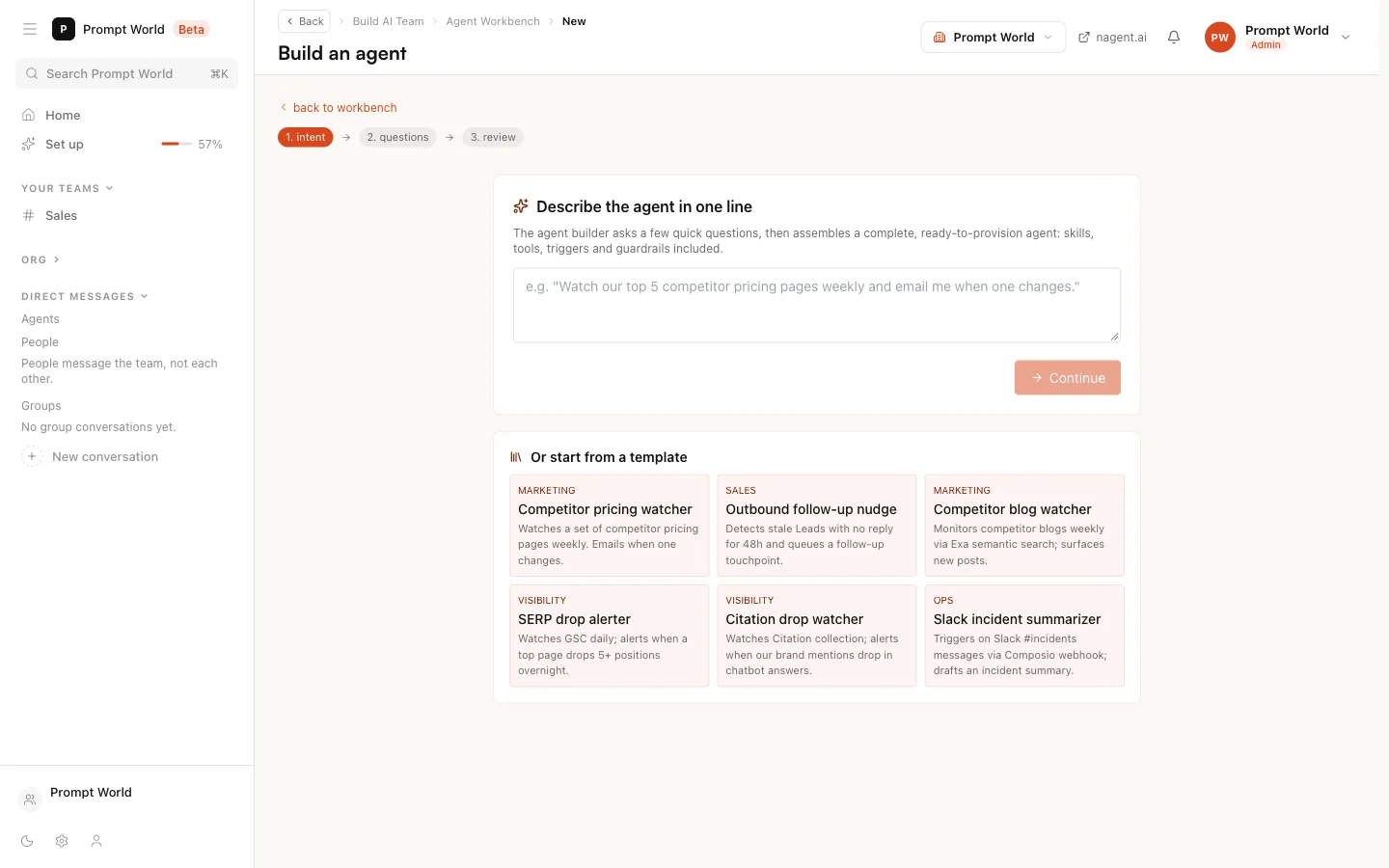
Describe it in one sentence. In Agent Workbench, press + New agent and write the job, for example: "Score every customer's churn risk from usage, billing and support data, explain the top reasons, and draft a retention play for each at-risk account." The builder asks a few questions, such as how it should run, how much it may do on its own and a daily spending cap, then drafts the agent's skills, tools, triggers, guardrails, model, autonomy and system prompt. Nothing exists until you've read the draft and pressed Provision agent. See creating an agent.
Give it your data. Add your churn definition, playbooks and past analysis to the Knowledge Hub by pasting text, giving a URL or uploading a file. Connect the systems that hold the signals: hundreds of tools via Composio, plus your own API. Start from integrations, and allow only the actions the agent needs.
Set its autonomy. A new agent starts at L2 Assist: it reads and drafts on its own, and changes to records other people rely on wait for a person. At L3 Operate it can change workspace records on its own, while anything reaching outside the workspace still waits. Keep a churn agent at L2 or L3, so every message to a customer waits for approval. See autonomy and governance.
Put it on a team and give it a rhythm. In the review, set its department and who it reports to, such as MIRA. A custom agent works when someone messages it in its team room. For a weekly scoring pass, give it a step in a workflow and put that workflow on a schedule, or start it from an event or a signed webhook. See triggers and webhooks.
How does the churn agent work with MIRA's marketing team?
Your churn agent finds the risk and explains it. The retention campaign that follows is marketing work, so it goes through MIRA, the AI Marketing Chief of Staff. In the Marketing team room, a person briefs her with the outcome, such as winning back the at-risk segment the churn agent flagged. She plans it and passes each piece to the teammate who owns it. NIA, for example, builds paid campaigns that arrive paused, with every live change waiting for a person.
The teammate who owns each piece keeps its approvals, its budget and its record, and a handoff runs under that teammate's own level. For a personal email to an at-risk account, LIPI, the CRM email writer on the Sales team (Beta), writes from the customer's CRM record and never sends on its own.
What mistakes should you avoid?
Predicting without acting. A score with no play attached changes nothing.
Scores without reasons. The team can't choose a play, and won't trust the number.
Leaky signals. A cancellation request predicts churn perfectly because it is churn. Score on what happens before the decision.
Discounts by default. Many at-risk customers need a fix or a conversation, not a lower price.
Full autonomy on day one. Let a person approve outreach until the agent has a record.
No control group. Hold back a small share of at-risk accounts from each play, or you won't know if the play worked.
Frequently Asked Questions
What is a custom AI agent for churn prediction?
It's an AI agent built for your business that reads your product, CRM, billing and support data, scores each customer's churn risk with the reasons, and drafts a retention play for a person to approve.
How do churn prediction AI agents differ from a churn model?
A model produces a score. An agent produces the score, the reasons and the next step, and on Nagent it works inside approvals and an autonomy level you set.
What tool lets me track churn risk in AI agent conversations?
A churn agent can read conversation transcripts from chat, email and support tools as one of its signals, flagging competitor mentions, data export questions and repeat complaints. On Nagent you connect those tools and build the agent in Agent Workbench.
What software uses agentic AI to predict churn and trigger retention actions in e-commerce?
A custom agent on an agent platform can score customers from order history, such as the gap since the last order and skipped subscriptions, then draft win-back plays. On Nagent, a person approves any outreach before it goes out.
Does Nagent have a built-in churn prediction model?
No. You build the churn agent on your own data and definition of churn, and retention campaigns run through MIRA's marketing team, with approvals.
Ready to plan a churn agent with MIRA and her marketing team? Book a demo.