
AEO Metrics for Executives: What to Include in Your Report
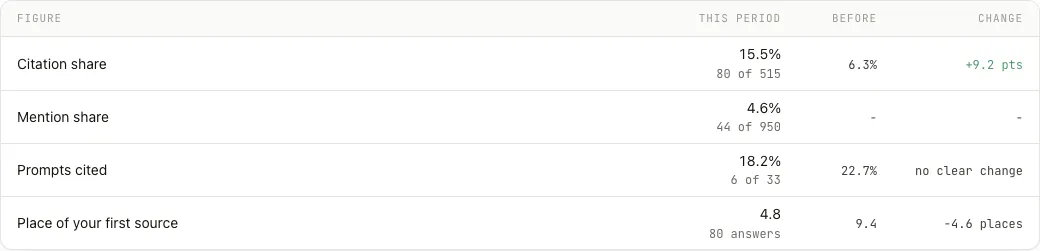
An AEO report for executives should lead with three metrics: AI answer presence (how often the engines cite you on your buyers' questions), citation share against named competitors, and visits from answer engines. Below those sit the diagnostics that explain movement, such as mention share, prompts cited, share by engine and answer accuracy, then the operating numbers that show the work is governed. This guide defines each metric, how to calculate it, and which numbers to leave out, with how DRIS measures them.
Why do AEO metrics need their own report?
Answer engine optimization (AEO) is about whether ChatGPT, Claude, Gemini, Perplexity and Google's AI answers name and cite you when a buyer asks about your category. Classic SEO metrics don't capture that. A page can rank first on Google and never appear in an AI answer, and an AI answer can recommend you without sending a click.
AI answers also vary from one run to the next. The same question asked twice can cite different sources. So AEO metrics are shares measured over many answers, not positions read off a single result, and an executive report has to say how many answers sit behind each number.
Which three AEO metrics should lead an executive report?
Executives remember three numbers. Make them these, and keep them for the whole year.
1. AI answer presence
What it is: the share of your fixed set of buyer questions where at least one engine's answer cites your site.
How to calculate it: prompts with at least one answer citing you, divided by prompts asked, on the same prompt set each period.
Why executives care: it answers "do we show up when buyers ask?" in one figure, and it's the natural number to set a target on.
2. Citation share against named competitors
What it is: your share of the answers that cite anyone in your competitive set.
How to calculate it: answers citing you, divided by answers citing you or any competitor on your list, counting each competitor once per answer.
Why executives care: it turns visibility into a competitive position. Presence can rise while a competitor rises faster; citation share shows that.
3. AI-search referrals
What it is: visits to your site that your analytics attributes to an answer engine's domain, such as chatgpt.com or perplexity.ai.
How to calculate it: sessions by source from your analytics, grouped by engine, plus conversions from those sessions if you track them by source.
Why executives care: it's the line that connects visibility to the funnel. Keep it honest: a citation often leads to a branded search later rather than a direct click, so referrals undercount the real effect.
What diagnostic AEO metrics explain the headline numbers?
Diagnostics belong one level down, on the page a curious executive turns to when a headline number moves.
Metric: Mention share, What it shows: How often answer text names you, linked or not, against every brand, When to bring it up: When presence is flat but brand recall is growing
Metric: Prompts cited, What it shows: How wide your coverage is across buyer questions, When to bring it up: When presence rises on a few questions only
Metric: Share by engine, What it shows: Presence or citation share split by ChatGPT, Claude, Gemini, Perplexity and others, When to bring it up: When one engine moves against the rest
Metric: Branded vs unbranded, What it shows: Share on questions that name you versus category questions that don't, When to bring it up: Always: unbranded share is the growth signal
Metric: Place of your first source, What it shows: Where your site sits among an answer's sources, 1 being first, When to bring it up: When you are cited but buried
Metric: Answer accuracy, What it shows: Whether what the engines say about you matches your confirmed facts, When to bring it up: When a launch, price or positioning changed
Metric: AI crawler activity, What it shows: Which answer-engine bots read your site, and how often, When to bring it up: When a key page isn't being cited at all
Two of these deserve more attention than they usually get.
Branded versus unbranded. Being cited when someone asks about you by name is expected. Being cited when they ask "what's the best tool for X" is what wins new buyers. Report the unbranded share separately, or a strong brand will hide a weak category position.
Answer accuracy. An engine that names you but describes an old price or a retired product is a risk, not a win. A short count of answers that contradict your facts, and whether it's falling, is one of the most useful lines a leadership team can see.
Which operating metrics show the AEO work is governed?
Leaders also want to know the program is under control, especially when AI agents do some of the work. Add a short operating block:
Fixes shipped: changes that went live on the site this period.
Approvals and reversals: how many fixes a person approved, and how many were rolled back.
Spend: what the measurement and the work cost this period.
Next period's top actions: the three or four queued fixes expected to move the headline numbers.
These are not outcomes, so they never lead. They answer the question that follows every result: "what did we do to get it, and can we keep doing it safely?"
Which AEO metrics should you leave out?
Raw citation counts. A bigger prompt set collects more citations without you being any more visible. Report citations per answer, with the prompt set's size, or leave them out.
Single-answer screenshots. One great answer on one day proves nothing about the next run.
Opaque composite scores. A "visibility score" with no stated method invites the question "how is that calculated?" and ends the conversation.
Keyword rankings on their own. They belong in an SEO report. In an AEO report they confuse which game you're scoring.
Changes inside the noise. If two periods' ranges overlap, the honest label is "no clear change", whatever the arrow says.
How do you keep AEO metrics comparable over time?
Every metric above only means something if the method holds still. Fix the prompt set, ask every engine the same way, keep the competitor list stable and note any change to it in the report. Set a minimum number of answers before you call a movement real. When the measurement itself changes, say the new figure doesn't compare directly with the old one. A footnote like that costs nothing and protects every number around it.
How does DRIS measure these AEO metrics?
DRIS leads organic visibility on Nagent's Marketing team and reports to MIRA, the AI Marketing Chief of Staff. He asks ChatGPT, Claude, Gemini, Perplexity and Grok what your buyers ask, records the exact prompt behind every citation and keeps the prompt set fixed per account. Here's where each metric lives:
Headline numbers. Today's tiles show AI answer presence, citations gained, organic clicks, site audit total, actions executed and spend over the last 28 days. You can set AI answer presence as the objective, with a target and a date, and Today grades it every month as ahead, on target or behind.
Citation share and mention share. Analytics (Beta) shows both for you and each competitor on your list, split by engine, question, persona, intent and branded or unbranded prompt, at 7, 28 and 90 days, with prompts cited and the place of your first source beside them.
Noise control. A change is shown only when both periods hold at least eight answers and their 95% ranges no longer overlap; otherwise it reads "no clear change". Citations are also shown per answer beside the panel size, and repeated samples and failed captures are left out.
AI-search referrals. With Google Analytics connected, Traffic splits out the visits answer engines send.
Answer accuracy. What AI says (Beta) checks recent answers that name you against the facts you confirmed and lists any that contradict them, quoting the engine's own words.
AI crawlers. With crawler logs connected, it separates live fetches made while someone is asking from indexing and training crawls.
Operating numbers. Every fix is a proposal with its reason, and publishing to a live page needs a person. The monthly report, a Word download, counts actions executed with their approvals and reversals, alongside objective progress, citation share against named competitors and next month's top queued actions.
The DRIS guide defines every number on each screen, and setting up DRIS covers the connections each one needs.
For the rest of the picture, read how to report AEO results to executives every quarter, how to build an AEO ROI report and the AEO dashboard metrics that matter to executives.
Frequently Asked Questions
What are the most important AEO metrics?
AI answer presence, citation share against named competitors and visits from answer engines. Together they say whether you show up, whether you beat the competition and whether it sends anyone to your site.
What is the difference between citation share and mention share?
Citation share counts answers whose sources link to your site. Mention share counts answers whose text names you, linked or not. A brand can be mentioned often and cited rarely, which usually means the engines know the name but rely on other sites for the detail.
How do you measure AEO success?
Set one objective, such as AI answer presence on a fixed prompt set, with a baseline, a target and a date. Measure the same prompts on the same engines every period, and only count a change when it is larger than the run-to-run noise.
Should AEO and SEO metrics be in the same report?
Keep them on separate pages. Organic clicks belong in an AEO report as context, but rankings and impressions answer a different question. Mixing them makes it hard for executives to see which program moved which number.
Measure the AEO metrics that matter
An executive AEO report needs fewer numbers than most teams send, measured more carefully than most teams manage. DRIS asks the answer engines the same questions every period, counts the shares that matter and tells you when a change is only noise.
Book a demo to see DRIS measure your own brand.