
How to Build an AEO ROI Report Your CFO Will Accept
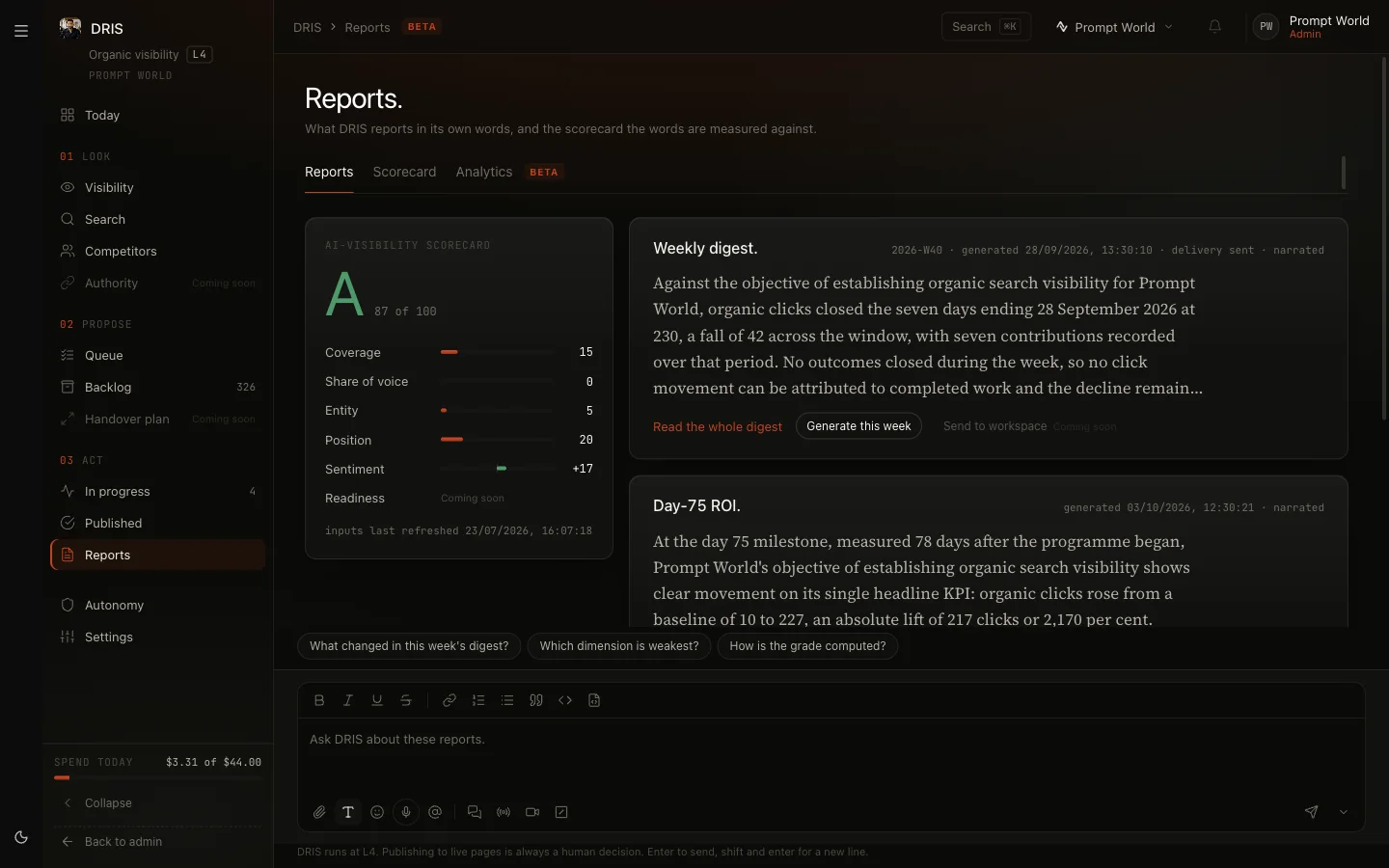
To build an AEO ROI report, total everything the program cost, then measure the return in three layers: visibility gained in AI answers, visits from answer engines, and conversions from those visits. Attribute each fix by comparing equal windows before and after it shipped, flag anything else that could explain the change, and report cost per outcome. Put a revenue figure only on what you can trace. This guide walks through each step, and how DRIS builds most of it for you.
What does an AEO ROI report need to prove?
Answer engine optimization (AEO) is the work of getting ChatGPT, Claude, Gemini, Perplexity and Google's AI answers to cite your brand when buyers ask about your category. An ROI report on that work has to answer three questions for finance:
What did it cost? All of it, not just the tool line.
What did it change? Movement you can measure, with a baseline it started from.
How sure are we that the work caused it? The part most AEO reports skip.
A report that answers the first two and skips the third is a correlation chart. Finance teams can tell the difference, and once they catch one inflated claim they discount everything after it.
What goes on the cost side of AEO ROI?
Count every cost the program carried in the period, so nobody can say the return was bought with hidden spend:
People time. Hours from content, SEO, web and product marketing, at a loaded rate.
Measurement. What it costs to ask the answer engines your prompt set, plus any visibility tools.
Content production. Writing, design, review and any agency or freelance fees.
Developer time. Schema, metadata, page speed and the other fixes that need an engineer.
AI spend. Any model or agent costs used to draft, audit or fix pages.
Present it as one total with the breakdown underneath. A complete cost line makes a modest return look credible; a partial one makes a large return look suspicious.
What goes on the return side of AEO ROI?
Measure the return in three layers, from the most certain to the least:
Layer: Visibility, What you measure: AI answer presence on a fixed prompt set, and citation share against named competitors, How certain it is: High, if the prompt set and engines stay fixed
Layer: Traffic, What you measure: Sessions your analytics attributes to answer engine domains, plus organic clicks on the pages you fixed, How certain it is: High for the sessions you can see; undercounts the rest
Layer: Commercial, What you measure: Sign-ups, demos or purchases from those sessions, times their value, How certain it is: Only as good as your conversion tracking by source
Report all three, in that order. Visibility is the leading indicator, traffic is the bridge, and commercial value is the number finance wants. If you can only fill the first two honestly, say so and stop there. That's a stronger report than one that guesses the third.
There is also an indirect effect: buyers read an AI answer, remember the name and come back later through a branded search or a direct visit. Mention it, and track branded search volume as a signal, but don't add it to the ROI total. You can't separate it from everything else that builds a brand.
How do you attribute AEO results to the work?
Attribution is what turns "the number went up" into "our work moved the number". Use these habits:
Measure each fix on its own. For every change that shipped, compare the metric it targets over an equal window before and after it went live. A metadata fix is judged on clicks to that page; a new answer page is judged on presence for the prompts it targets.
Wait for the data to settle. Search data arrives with a lag of a few days. Don't close a fix's window until the after period is fully reported.
Flag confounders. A search algorithm update, a product launch, a pricing change or a seasonal peak inside the window can move the numbers on its own. Note it beside the result instead of hiding it.
Keep a holdout where you can. Pages or prompts you deliberately left alone give you a baseline for what would have happened anyway.
Count each gain once. If two fixes touched the same page in the same window, credit the change to the pair, not to each.
Respect the noise. AI answers vary from run to run. Set a minimum number of answers before calling a change real, and label anything smaller "no clear change".
Then add up only the positive, attributed outcomes. That total, not the raw change in the headline metric, is the return you put on the page.
How do you calculate AEO ROI?
Use the formula your data can support.
When you can't value conversions yet, report efficiency:
Cost per attributed outcome: total program cost divided by the number of fixes that produced a measured gain.
Cost per attributed click: total program cost divided by the incremental clicks attributed to those fixes.
Visibility gained: the change in AI answer presence and citation share from the baseline, beside the cost that bought it.
When conversions from answer engine visits are tracked with a value, report return:
AEO ROI = (attributed conversion value minus total program cost) divided by total program cost.
Lay it out as a short table each period: cost, attributed outcomes, attributed clicks, presence and citation share against baseline, attributed conversion value where you have it, and the two cost-per figures. Keep the method notes underneath: the prompt set's size, the engines asked, the attribution window and any confounders flagged.
When should an AEO ROI report show results?
Not on day one. Capture the baseline before you change anything, because every later claim is measured from it. Individual fixes can be judged once their after window closes. A first ROI checkpoint for leadership works best after a couple of months of shipped and measured fixes, with monthly reports in between so nobody is surprised by the number.
What makes an AEO ROI report lose credibility?
Revenue nobody can trace. A figure built on assumed influence will be the first thing finance challenges.
A partial cost line. Leaving out people time makes any return look too good.
A moving baseline. Re-baselining mid-program resets every claim of progress.
Raw citation counts. A bigger prompt set collects more citations without you being more visible. Use shares and per-answer figures.
Ignoring confounders. If a launch landed the same week as your fixes, say so before someone else does.
How does DRIS build the AEO ROI report?
DRIS leads organic visibility on Nagent's Marketing team and reports to MIRA, the AI Marketing Chief of Staff. He asks ChatGPT, Claude, Gemini, Perplexity and Grok what your buyers ask, keeps the prompt set fixed per account, and measures every fix he ships. Here's how that maps to the report:
The baseline. You declare an objective, such as organic clicks or AI answer presence, with a target and a date. DRIS captures the baseline once, and it cannot be replaced.
Attribution per fix. Every fix is a proposal with its reason, and publishing to a live page needs a person. Once a fix is live, DRIS compares its metric over an equal window before and after it shipped, 28 days each by default, waits for Search Console to finish reporting, and notes any logged Google core update that fell inside the window.
The return. Analytics (Beta) shows citation share and mention share against each competitor on your list, and a change is shown only when it is larger than the run-to-run noise. With Google Analytics connected, Traffic splits out the visits answer engines send.
The ROI report itself. The Day-75 ROI report, a Word download from Reports, sets the lift in each objective metric from the baseline beside the attributed outcomes and what DRIS spent on the work, with cost per attributed outcome and cost per attributed click. Add your people and production costs to it for the full cost line. It doesn't invent revenue; where a figure is missing, the report says so. The monthly report covers objective progress, citation share, actions executed with approvals and reversals, and next month's top queued actions.
The DRIS guide covers the objective and the reports, and setting up DRIS covers connecting Search Console and Google Analytics so the return side has real data.
For the rest of the picture, read how to report AEO results to executives every quarter, the AEO metrics to include in an executive report and the AEO dashboard metrics that matter to executives.
Frequently Asked Questions
How do you prove the ROI of AEO?
Total the program's full cost, measure the gain in AI answer presence, citation share and answer engine visits from a fixed baseline, and attribute each fix by comparing equal windows before and after it shipped. Put a revenue figure only on conversions you can trace by source.
Can you attribute revenue to AEO?
Partly. Conversions from sessions that answer engines send are traceable if your analytics tracks conversions by source. The larger indirect effect, buyers who read an answer and come back later through a branded search, can be tracked as a signal but shouldn't be added to the ROI total.
What is a good attribution window for AEO fixes?
Use equal windows before and after each fix, long enough to hold several weeks of data, and close a window only after search data has fully reported. DRIS uses 28 days either side by default.
What should an AEO ROI report include?
The full cost, the baseline, visibility and traffic gains, attributed outcomes per fix, cost per attributed outcome and per attributed click, conversion value where it's tracked, and method notes covering the prompt set, the engines and any confounders.
Build an AEO ROI report that holds up
An AEO ROI report earns its budget by being careful: every cost counted, every gain measured from a fixed baseline, every fix attributed on its own and no revenue that can't be traced. DRIS measures the answer engines the same way every week and checks each fix before and after it ships, so the report is built from evidence.
Book a demo to see DRIS measure the return on your own AEO work.