
AI Video Ads for Fashion Brands Without a Production House
AI Video Ads for Fashion Brands Without a Production House
Fashion brands can produce platform-ready video ads, such as Instagram Reels, TikTok clips and YouTube pre-rolls, from a single brief without a production house. The old model (brief, agency, shoot, edit, revise, publish) takes days at minimum. An AI video teammate collapses most of that pipeline, and a person still approves the storyboard and the final ad. Here is how it works.
Why Is Traditional Video Ad Production Killing Fashion Brand Growth?
The production house model breaks paid social for fashion brands at scale.
You need 40+ creatives per month to stay competitive on TikTok and Meta. A traditional shoot gives you 4 to 6. The gap between what performance marketing demands and what production can supply is where fashion brands bleed budget and lose ground to faster-moving DTC competitors.
The math is brutal:
Average production cycle: 3 to 5 days per creative
Agency revision rounds: 6 to 8 per campaign
Monthly output: 4 to 6 ads per brand
What paid social actually needs: 30 to 100 variations per month
That last number is not hyperbole. Platform algorithms reward creative freshness. The brands winning on paid social in 2026 are the ones publishing new creatives weekly, not the ones with the most polished single hero video.
The question is not whether you need more video content. The question is how to create video ads for fashion brands at the volume paid social actually demands.
What Does an AI Video Agent Actually Do Differently?
An AI video agent runs the production workflow from brief to platform-ready asset, so nobody has to touch a timeline. On Nagent, a person still approves the storyboard before anything renders.
This is not a template tool or an editor with AI filters. An agent reads your brief, interprets creative intent, sequences scenes, writes copy variations and prepares each placement's version in one run.
On Nagent, Alpha is the AI video teammate built for this workflow. She plans video ads to a preset, quotes each one before anything renders and waits for storyboard approval, so one brief can become a batch of variations for testing rather than a single asset.
That is not a marginal improvement. That is a structural change in how fashion marketing teams operate.
How Does the Single-Brief-to-Multi-Platform Workflow Actually Run?
A single campaign brief flows through five sequential steps to produce Instagram Reels, TikTok clips, and YouTube pre-rolls simultaneously.
Here is the actual workflow, not the concept, the execution:
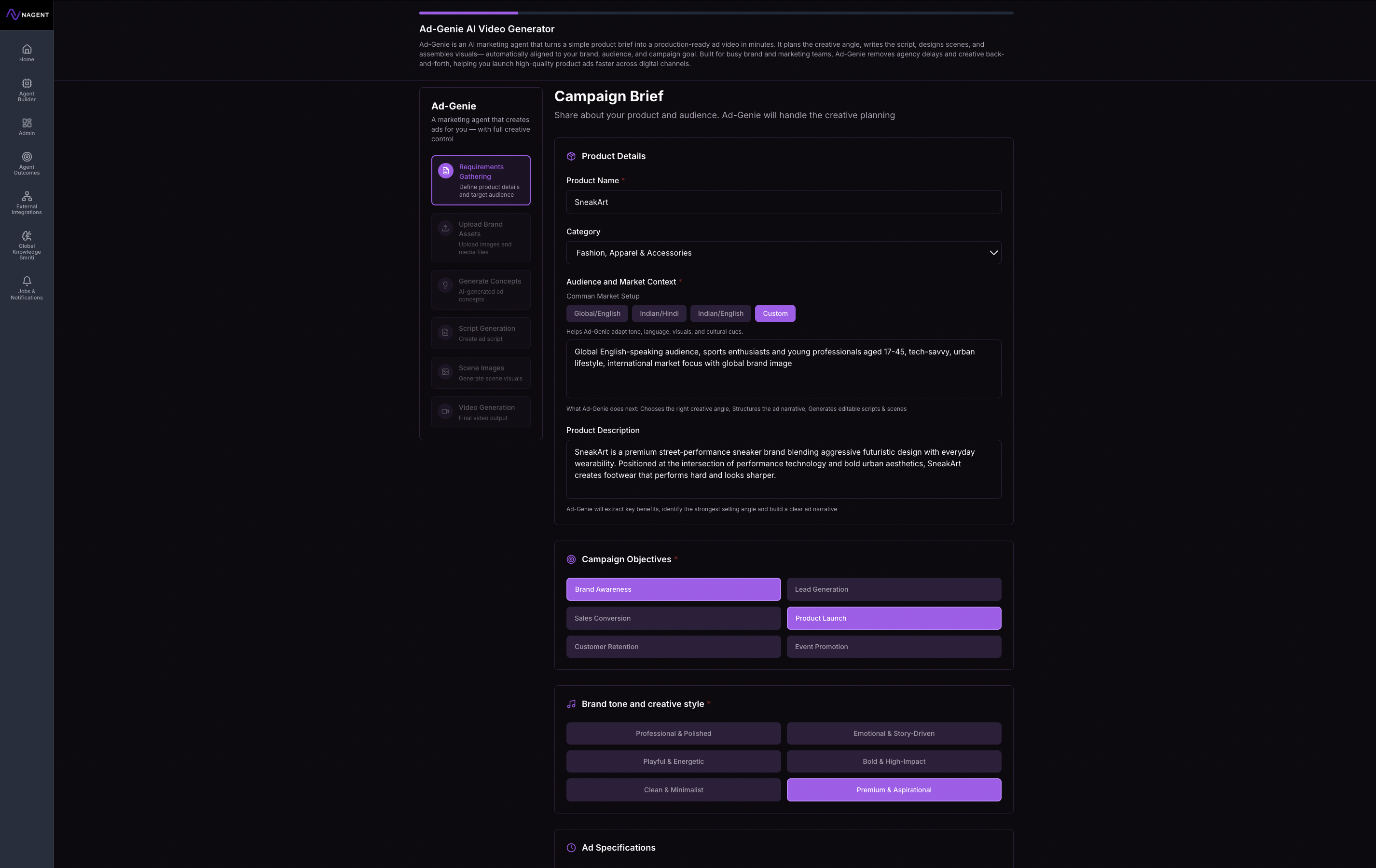
Step 1: Brief Input
You provide one structured brief. It covers:
Product or collection name
Target audience segment
Campaign objective (awareness, conversion, retargeting)
Brand tone and visual references
Key message or offer
No detailed prompting required. The brief carries the intent.
Step 2: Script and Scene Generation
The agent writes multiple scripts simultaneously, each optimized for a different platform's native behavior. A TikTok script front-loads the hook in the first 1.5 seconds. A YouTube pre-roll structures a skip-resistant opening. An Instagram Reel uses a mid-scroll pattern interrupt.
Same product. Same message. Three distinct creative structures.
Step 3: Visual Composition
The agent sequences scenes, selects visual treatments and applies motion logic for each format. For fashion brands, product stills can come from RUPA, the AI image teammate, rendered to a preset with your brand guidelines attached, without a physical shoot.
You get campaign-quality imagery without booking a location, a photographer, or a model.
Step 4: Format Adaptation
Output is automatically adapted to:
9:16: TikTok and Instagram Reels
1:1: Instagram feed and Facebook
16:9: YouTube pre-roll and connected TV
One creative direction. Three aspect ratios. No manual resizing.
Step 5: Variation Output
Ask for several variations per brief: different hooks, different CTAs, different visual pacing. Each is structured for A/B testing, and once a person approves it, it is ready for your Meta Ads Manager or TikTok Ads account.
Your paid social team gets a full creative batch, not a single asset.
How Does This Change the Creative Testing Cycle for Fashion Brands?
AI-generated variation eliminates the bottleneck between creative ideation and live testing.
Traditional paid social teams wait for production to finish before they can test. By the time results come back, the creative is already stale. The feedback loop is too slow to optimize.
With an AI video teammate, the loop can look like this:
Brief submitted Monday morning
Storyboards approved and the first variations live soon after
Performance data by Wednesday
New brief informed by winning signals submitted Thursday
Next batch live Friday
That is a weekly creative optimization cycle: something that was operationally impossible with a production house dependency.
HOOK (Beta), the creative strategy lead for paid social, compounds this further. It writes many distinct copy angles (headline, body and CTA variants) and checks every claim against your proof. Your paid social manager stops writing copy and starts making decisions based on data.
What About Visual Quality: Can AI Match Production House Output?
For performance creatives, AI output meets or exceeds production quality at the formats that actually drive conversions.
This is the objection most fashion brand marketers raise. And it is worth addressing directly.
Production houses produce beautiful content. But beauty is not the primary driver of paid social performance. Relevance, hook strength, and format-native behavior drive performance. An AI agent optimizes for those variables by design.
For hero brand content, runway films, brand manifestos, seasonal campaign videos, a production house still has a role. But hero content represents maybe 10% of the creative volume a paid social program needs. The other 90% is performance creative: product-focused, offer-driven, format-specific. That 90% is exactly where AI video agents win.
With RUPA, fashion brands can render model and product shots with the setting, lighting and styling they brief, on demand. No location fees. No talent scheduling. No weather delays.
For performance creative, the output holds up, and the timeline shrinks from weeks to far less.
How Do Fashion Brands Get Started With AI Video Ad Production?
The fastest path is a single campaign brief given to Alpha, with no migration and no overhaul of your existing stack.
You do not need to rebuild your marketing operations to start. Brief Alpha on one campaign in the Marketing team room, compare the output with your current production workflow, and make a data-based decision.
Here is the starting sequence:
Pick one active campaign with a clear brief and defined audience
Brief Alpha in the Marketing team room and approve the quote and the storyboard
Compare output against your last production-house batch, quality, volume, time
Put both live and let performance data decide
The creative volume difference alone, a batch of variations instead of one, changes how your paid social team thinks about testing.
For brands that want to go further, MIRA, the AI chief of staff for Marketing, routes the whole campaign: HOOK (Beta) for angles and scripts, RUPA for product stills, Alpha for video. One goal, handed to the teammates who own each piece, with a person approving what goes live.
That is how to create video ads for fashion brands at the scale paid social actually demands.
Related Reading
Frequently Asked Questions
How long does it take to produce a video ad with an AI video teammate?
Far less than a production cycle of several days, though it depends on the brief, the format and your review. On Nagent, Alpha quotes each video before anything renders and waits for your storyboard approval, so most of the remaining time is your own review.
Can AI-generated video ads match the visual quality of a production house?
For performance creatives (product-focused, offer-driven, format-specific ads), AI output holds up at the formats that drive paid social conversions. For hero brand content like seasonal campaign films, a production house still has a role. RUPA renders photorealistic product visuals to a preset with your brand guidelines attached, without a physical shoot.
How does an AI video agent handle different platform formats simultaneously?
You set the placements in the brief: 9:16 for TikTok and Instagram Reels, 1:1 for feed placements, 16:9 for YouTube pre-roll. Each format should get a platform-native script structure, not just a resized crop: the hook, pacing and CTA follow how people watch on that platform.
Do fashion brands need technical expertise to use AI video agents?
No. Alpha works from a structured campaign brief: product, audience, objective, tone and key message. No prompting expertise, no video editing skills and no developers are needed. A person approves the quote, the storyboard and the final ad.
What is the ROI case for replacing a production house with AI video agents?
The ROI case has two components: cost reduction and volume increase. Traditional production costs run $800 to $2,000+ per creative asset, and AI-generated variations cost a fraction of that. More importantly, the volume increase enables the creative testing velocity that drives paid social performance. Measure the payback on your own account rather than trusting a typical figure.
What's Next
Your next campaign brief should produce a batch of platform-ready video ads, not one. Book a demo and see Alpha plan one from your actual brief.
Sources
AI ranking optimisation _(pdf)_
The Agentic FMCG Playbook _(pdf)_
RUPA (product page)