
Top 10 AI Content Agents That Research, Draft and Cite (2026)
An AI content agent takes a topic, researches it against your own material, drafts the piece, reviews it against your house style and hands it to a person to publish. The best ones in 2026 differ on one question: where the facts come from. A general-purpose writer fills the gaps with confident generalities; an agent grounded in your own documents writes what your company can stand behind.
Disclosure: Nagent makes CREA, first on this list. The other nine are described from their own published claims and prices.
Every content lead has read the same AI draft: fluent, confident, and about nobody in particular. By the time it has been rewritten with the company's real products and voice, it might as well have been written by hand. The tools below approach that problem from different directions. Some ground every draft in your Knowledge Hub and refuse to invent. Some optimize a draft against what already ranks. Some are workflow builders you assemble yourself. We have sorted them by what each does best.
How did we pick these tools?
Grounding: does the draft come from your own documents, products and voice, or from the model's general knowledge with your brand name pasted in?
Citations: whether sources are gathered, shown and checked, and what happens to a claim with no source behind it.
Review: who reads the draft before it goes live, what they can edit, and whether a check runs at publish.
Operations: a board, a budget, a cost per piece, and a way to brief the agent alongside the people on the team.
Value: what the entry price buys, and whether it is public.
Prices are the vendor's published figure where there is one, checked October 2026, and marked approximate otherwise.
What are the 10 best AI content agents in 2026?
1. Nagent CREA
CREA is the AI chief of staff for Nagent's Content team. Give the team a topic and it researches, drafts, edits, reviews, illustrates and links a blog post, then waits. Nothing goes live until a person approves it. CREA leads RUPA for images and FOLIO for long-form publications, and takes content gaps from DRIS, Nagent's AI visibility lead, as tasks on the Content board.
Try it: Hire CREA · See plans · Talk to the team
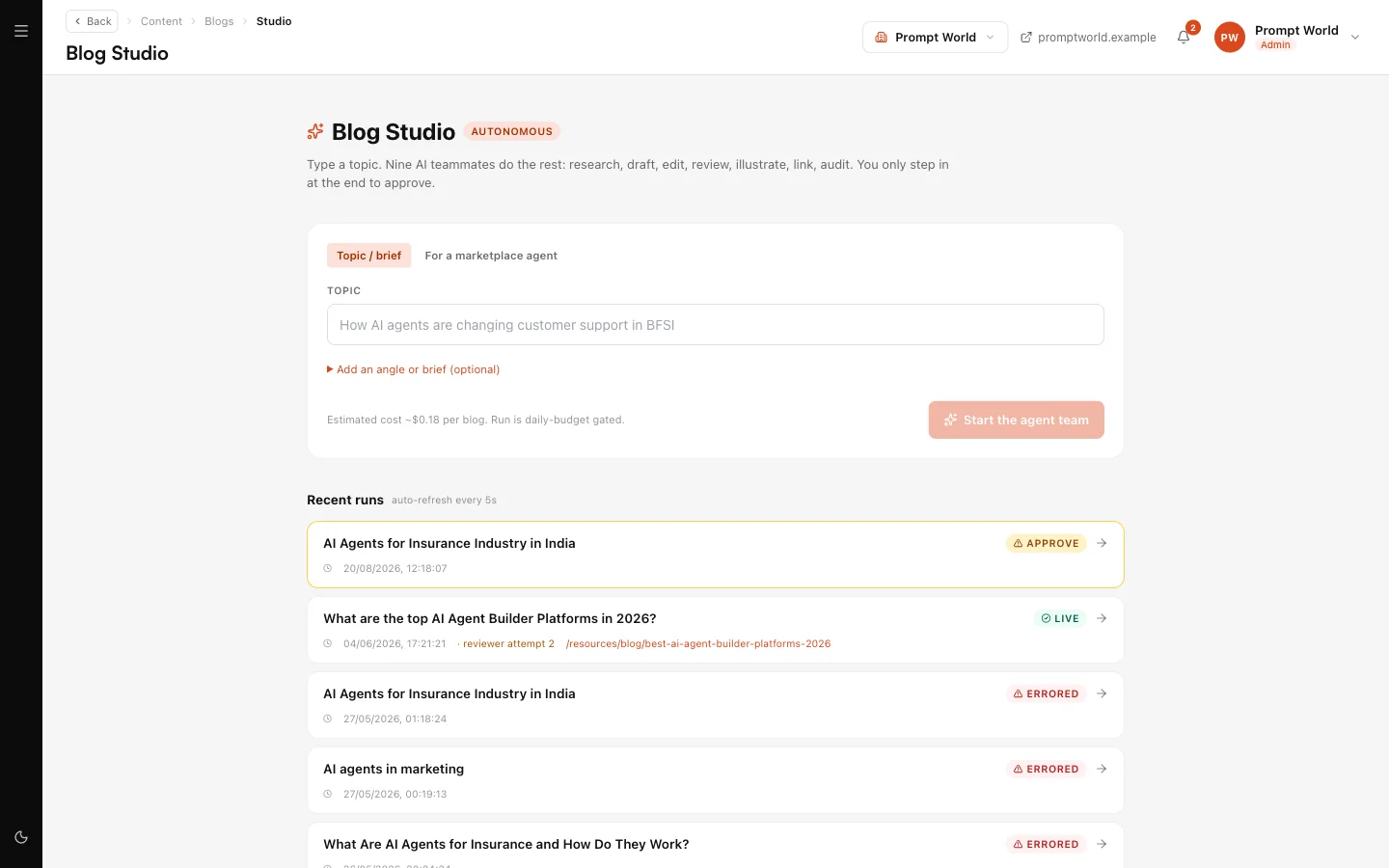
Blog Studio: a topic, an optional angle, the cost estimate, and the recent runs with their status. Shown from a Nagent workspace.
How CREA researches, drafts and cites
Ground it. The team reads the company name from the brand profile, what is sold from Products and services, up to six Knowledge Hub passages that match the topic, the voice from the brand book, and the booking link.
Start a run and watch it. In Blog Studio, type a topic and optionally an angle. The run page shows a live agent feed, the draft so far, the citations gathered and the visuals generated.
Draft, polish, review. The writer drafts the body in the brand voice from the citations and a tone preset. A polish pass tightens flow and voice without adding claims. A reviewer passes or fails the draft with reasoning and fix suggestions, applying the same house style the writer was given.
Illustrate and link. A cover and inline visuals are generated for the post. Internal links go only to entities and posts the site already has, and a Sources section is appended.
Review and decide. At Approve, the title, meta description, slug and body open for editing. "Send back with feedback" starts a new run with your note as the brief. "Approve & Publish" publishes, and an independent editorial check at publish holds the post if it finds a blocker.
Brief in the room. In the Content team room a brief becomes a task on the team's board, and DRIS can hand content gaps over as tasks, at most ten a day.
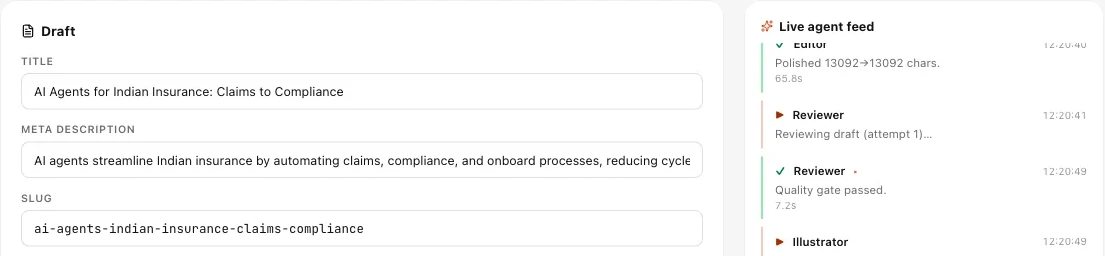
A run in progress. The draft's title, meta description and slug on the left, the live agent feed on the right.
Why CREA stands out
Every claim from a source. In Blog Studio, the writer may assert only what the retrieved passages support. In the room, CREA holds every factual claim to the knowledge, offerings or documents the workspace has shared; with no source to cite, the sentence comes out, and CREA says what source would let it back in.
The draft that refuses to invent. Where the Knowledge Hub has nothing on a topic, the draft is written without invented detail, in a neutral voice until a brand book exists. Product names are never invented, because the writer reads them from Products and services.
One house style for writer and reviewer. The same rules go to both, so a rule the gate enforces is a rule the writer was told. Fewer re-drafts follow from that.
An editorial check that fails closed. An independent check of facts and compliance runs apart from the reviewer. A live block, a required check that never ran or an unreadable record holds the post.
A person publishes. Nothing is published, scheduled or sent by CREA. Under the stricter governance profile, content always asks. Each night Nagent nominates an agent for the next level once it has spent 30 days at its level with at least 25 decided approvals and few dismissed, and a person approves or declines it.
More than blog posts. PAIGE drafts decks, documents and case studies, LANDON builds landing pages that can be served on your own domain, and NOVA writes newsletters, each from the same knowledge and brand book, and any of them can be named from a team room. A case study that names a customer is marked Needs customer sign-off until a person clears it.
A cost per post and a daily budget. The studio estimates about $0.18 per blog. Each run is checked against a daily blog budget before it starts; when the budget is spent, a new run stops until the next day.
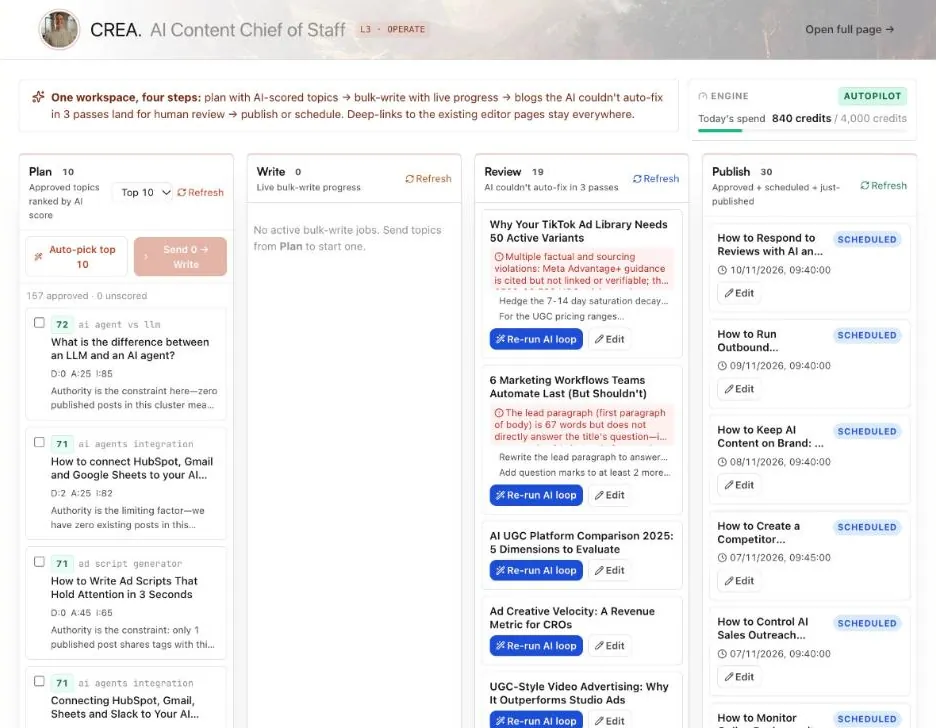
The Studio board. Topics in Plan, drafts in Write, posts waiting in Review, and today's spend against the cap.
Limits to know
Scheduled publishing, the blog engine modes and automatic topic discovery run only for Nagent's own workspace today. Customers publish by hand.
The site connection that serves posts to a customer's site is Beta, and publishing straight into a customer's own CMS is not built.
Room replies retrieve by word overlap over the team's record, not by meaning, so a question phrased differently from the source can miss.
Overriding a reviewer's rejection needs a permission outside the workspace admin role.
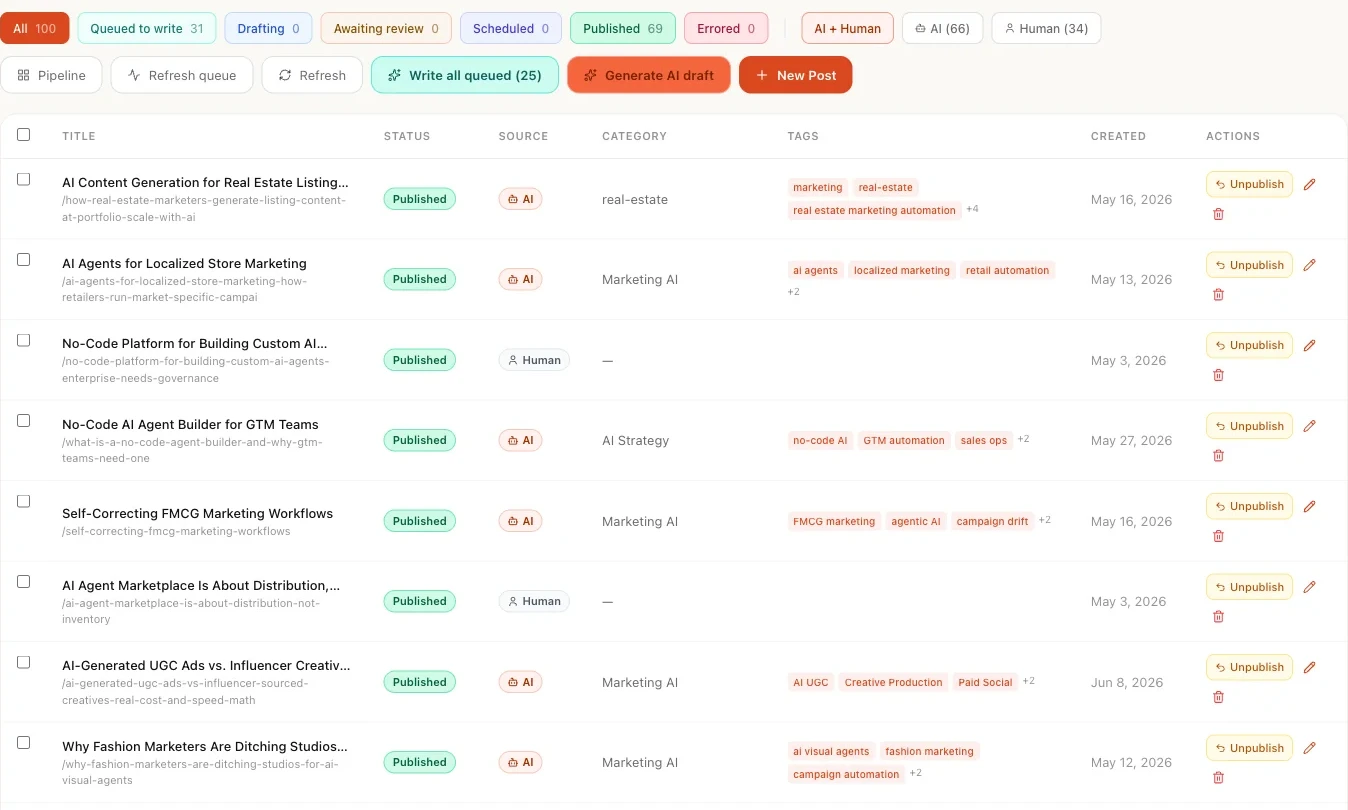
Posts. Every post, AI and human, filtered by status, with its source, category and tags.
Pricing
CREA works on the Content team. Nagent plans: Solo $29.99/mo ($19.99/mo billed annually), Team $299/mo ($199/mo annually), Business $1,499/mo ($999/mo annually), and Enterprise by quote. See pricing for which plans include the Content team.
Best for: heads of content who need articles that sound like the company, drafted from the company's own material, with a person holding the publish button.
2. AirOps
A content operations platform built around workflows for organic and AI discovery. AirOps's claim is that teams can run strategies that win across traditional and AI search, with editorial review and quality controls applied at scale.
Standout: the workflow builder. Research-to-publication pipelines you design yourself, with review steps inside them.
Watch for: the published pricing page mixes new package labels with older references, so the binding tier needs confirmation. Base price not verified; Solo lists 35,000 content tasks and Pro 100,000.
Best for: content operations teams with someone to own the workflows, producing at volume.
3. Writesonic
An AI visibility, content and action platform for both traditional and answer-engine discovery. Writesonic's claim is that teams can move from AI-search visibility gaps to prioritized content, citation and technical actions.
Standout: the article writer sits next to the visibility tracker, so a gap in AI answers can become a draft in the same tool.
Watch for: prompt, answer, article and action allowances differ by plan, and the entry plan does not include unlimited agent execution.
Best for: small content teams that want to see a gap and write the article in one place. Published entry price $79 a month on annual billing.
4. Jasper
A marketing-focused AI platform for brand-governed content, campaigns and agents. Jasper positions its marketing agents as specialized teammates that accelerate outcomes, with brand, knowledge and audience configuration behind them.
Standout: brand voice and audience settings applied across campaigns, with a Canvas for collaborating on the work.
Watch for: the published Pro plan is one seat with bounded brand and knowledge configuration; the broader brand context and admin controls are on the custom Business tier.
Best for: marketing teams producing campaign copy in volume who want one brand voice enforced across channels. Published entry price $69 a month.
An enterprise agent studio and control plane for governed, interoperable automation. WRITER positions governed autonomy as a way for business teams to delegate complex work while IT retains control, with content creation as one of the uses.
Standout: governance first. Approval, knowledge connections and routines are built for an IT owner, not only a content lead.
Watch for: the published Starter offer covers up to five users, five playbooks and one team personality, and no reliable numeric Starter rate is published. Plan price needs confirmation.
Best for: enterprises that want governed content inside a wider agent platform and have the procurement process to match.
6. Copy.ai
A GTM AI platform for codifying and running reusable marketing and sales workflows. Copy.ai positions AI workflows as a way to remove fragmented go-to-market work and system sprawl, with content generation and repurposing among them.
Standout: content is one output of a wider workflow engine that also covers account research and sales assets.
Watch for: chat access and the workflow packages are different scopes. Chat is from $29 a month; GTM Growth is $1,000 a month billed annually with 20,000 monthly workflow credits.
Best for: revenue teams that want content generation inside the same workflows as their sales and marketing operations.
7. Surfer
A content optimization platform that scores a draft against the pages already ranking for a keyword, with an AI writer that drafts to that target.
Standout: the content score. It tells a writer which terms, headings and length the ranking pages share, and the AI draft is built to hit them.
Watch for: optimization is to what already ranks, not to your own documents, so the facts in a draft still need a person who knows the product.
Best for: SEO-led content teams whose first measure of a draft is whether it can rank. Approximately $99 a month at entry; prices are approximate.
8. Frase
A research and writing tool that builds a brief from the top results for a query, then drafts and optimizes against it.
Standout: fast briefs. The research of what competitors cover for a query is done in minutes, with an outline to write from.
Watch for: the research is of the search results, not of your company, and feature claims about its AI writer vary by plan.
Best for: freelance writers and small teams that want a brief and a first draft without a separate SEO suite. Approximately $45 a month at entry; prices are approximate.
9. Byword
A bulk AI article generator that produces long-form posts from keywords or titles and can publish them to a connected site.
Standout: volume. Hundreds of articles can be generated and pushed to a CMS with little hands-on work per piece.
Watch for: the trade is depth and grounding. Generated at that volume, drafts are written from general knowledge, and the review burden moves to whoever reads them after.
Best for: programmatic content projects where breadth matters more than a company-specific voice. Approximately $99 a month at entry; prices are approximate.
10. Clearscope
A content optimization tool used by editorial teams to grade drafts against the competition for a keyword and keep published content current.
Standout: the editor's workflow. Grades, term recommendations and content monitoring that flags published posts losing ground.
Watch for: it is an optimization layer, not a writer. Drafting and citing stay with your team, and the entry price is high for a tool that does not draft.
Best for: established editorial teams that write in-house and want a reliable grade before publishing. Approximately $189 a month at entry; prices are approximate.
How do they compare at a glance?
Tool: Nagent CREA, What it is: Chief of staff for an AI Content team, Where the facts come from: Your brand profile, products, Knowledge Hub and brand book; uncited claims come out, Who publishes: A person, after an editorial check at publish, Entry price: Nagent plans from $29.99/mo (check which include Content)
Tool: AirOps, What it is: Content operations workflows, Where the facts come from: Whatever your workflow retrieves, Who publishes: Your workflow's review step, Entry price: Base price not verified
Tool: Writesonic, What it is: Visibility, content and action platform, Where the facts come from: AI-search gaps and the model, Who publishes: Your team, Entry price: $79/mo, annual billing
Tool: Jasper, What it is: Brand-governed marketing content, Where the facts come from: Brand and knowledge configuration, Who publishes: Your team, Entry price: $69/mo
Tool: WRITER AI Studio, What it is: Enterprise agent studio, Where the facts come from: Connected knowledge, governed by IT, Who publishes: Governed by approval settings, Entry price: Plan price needs confirmation
Tool: Copy.ai, What it is: GTM workflow platform, Where the facts come from: Workflow inputs, Who publishes: Your team, Entry price: Chat from $29/mo
Tool: Surfer, What it is: Content optimization with AI writer, Where the facts come from: The pages already ranking, Who publishes: Your team, Entry price: ~$99/mo
Tool: Frase, What it is: Research briefs and drafting, Where the facts come from: The top search results, Who publishes: Your team, Entry price: ~$45/mo
Tool: Byword, What it is: Bulk article generation, Where the facts come from: General model knowledge, Who publishes: Can push to a CMS, Entry price: ~$99/mo
Tool: Clearscope, What it is: Content optimization and monitoring, Where the facts come from: The competition for a keyword, Who publishes: Your team, Entry price: ~$189/mo
Prices change often; check each vendor's pricing page before buying. Entries 2 to 6 paraphrase the vendor's own published claims as recorded in Nagent's comparison research.
How do you choose the right one?
Start from where the facts should come from. If the answer is "our own documents, and nothing the agent cannot cite", you want CREA. If you want to build the pipeline yourself, with your own retrieval and review steps, AirOps is the builder's tool and WRITER the governed enterprise version. If your first measure of a draft is whether it can rank, Surfer, Frase or Clearscope grade it against the competition, and your team supplies the facts. If you need volume above all, Byword produces it, and you budget the review time.
Then check three things on a trial:
Ask where one sentence came from. Pick a factual claim in a draft and ask the tool for its source. A grounded agent shows the passage. A general writer shows nothing, and the claim is yours to verify.
Give it a topic your material does not cover. Watch whether it invents detail or says so. The honest miss is the behavior you want on a post that carries your name.
Find the publish button. Know who can press it, what is checked when they do, and whether anything can go live on a schedule you did not set.
Frequently Asked Questions
What is an AI content agent?
Software that takes a topic and does the work of a content team: research, drafting, editing, review, visuals and internal links, then hands the result to a person. The agents differ on where they get their facts and on who publishes.
Will the posts actually be about our company?
Only if the agent reads your material. CREA grounds each draft on the workspace's brand profile, products, up to six Knowledge Hub passages that match the topic and the brand book, so the more a team puts in, the better every draft gets. Optimization tools such as Surfer and Clearscope read the competition instead, and the company-specific facts come from your writer.
Do AI content agents cite their sources?
Some do. CREA gathers citations during the run, appends a Sources section, and in the room removes any sentence it cannot cite. Many tools generate text with no source trail at all, which moves fact-checking to the editor.
How much does an AI-written blog post cost?
On Nagent, the studio estimates about $0.18 per blog, within a daily budget shown on the Content Studio. Elsewhere the cost is a subscription, from approximately $45 a month for a brief-and-draft tool to $1,000 a month and up for workflow platforms. Nagent plans start at $29.99 a month; see the pricing page for which plans include the Content team.
Can an AI content agent publish on its own?
Some tools push straight to a CMS. CREA does not: a person approves and publishes, an independent editorial check runs at publish, and scheduled publishing is not available for customer workspaces today.
What should you do next?
Ready for drafts that sound like your company? CREA researches, drafts, reviews and links a post from your own Knowledge Hub, then waits for you to publish. Hire CREA → · How AI Is Restructuring Marketing Content Operations · 23 Agents That Automated a Full Content Pipeline
See an AI team at work
Book a 15-minute demo and watch a Nagent team plan, do and hand back real work in its room.