
AI vs. Agencies for Travel Campaigns: Build Your Framework
Meet MIRA, our marketing agent
Campaign planning, content generation, and performance analytics in one continuous loop.
See MIRA in action →AI vs. Agencies for Travel Campaigns: Build Your Framework
For most travel brands running seasonal campaigns, the agency model is no longer the default smart choice, it's the default familiar one. AI-native creative production now matches agency output on visual quality, beats it on speed, and scales without retainer friction. The decision isn't "AI or agency." It's "which jobs belong to each, and how do you evaluate that honestly?"
Why are travel brands still defaulting to agencies?
Habit is the honest answer. Agencies won the last 30 years because they owned three scarce resources: creative talent, production infrastructure, and media relationships. Two of those three are no longer scarce.
AI production tools now generate photorealistic destination imagery, platform-ready video ads, and campaign copy in minutes. What agencies still own, genuinely, is strategic narrative, local cultural nuance, and media buying relationships.
The mistake most travel marketing leaders make: they evaluate AI on the jobs agencies do best, instead of the jobs agencies do worst.
What does a travel campaign actually need?
A typical mid-scale travel campaign requires five distinct workstreams.
Creative strategy: positioning, narrative, audience segmentation
Visual asset production: hero shots, destination imagery, lifestyle content
Copy and messaging: headlines, CTAs, email sequences, social captions
Format adaptation: resizing, reformatting across platforms and ratios
Performance iteration: A/B variants, creative refreshes based on data
Agencies bundle all five. That bundling is convenient. It is also expensive, slow, and structurally misaligned with how modern paid social actually works.
Performance marketing on Meta, TikTok, and Google Demand Gen requires volume. The brands winning in travel paid social today aren't publishing 4 ads a month, they're testing 40.
Where does AI genuinely outperform agencies?
AI wins decisively on asset volume, iteration speed, and cost-per-creative.
Visual production at scale
On Nagent, RUPA, the AI image teammate, renders hero shots and lifestyle stills to a preset with the brand guidelines attached, without a photoshoot. For a resort brand needing destination images across several property types, that is a week of production compressed into far less.
The same applies to scene and setting: beach, mountain and city treatments for seasonal campaigns can come from one session, each image checked against the brand kit before a person approves it.
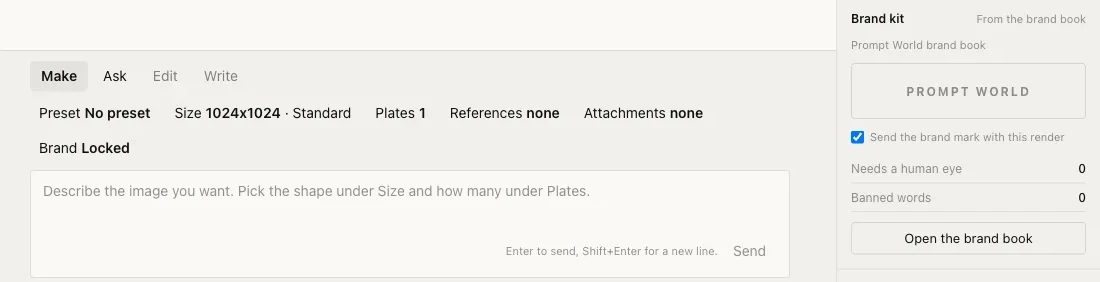
RUPA's composer: a preset, references and Brand Locked, with the brand kit alongside.
Ad creative and copy variation
On Nagent, Alpha, the AI video teammate, plans platform-ready video ads from a single brief to a preset, quotes each one before anything renders and waits for storyboard approval. Teams that used to produce a handful of ads a month can test far more. That is a structural change in how creative testing works.
HOOK (Beta), the creative strategy lead for paid social, turns one offer into many angles, hooks and headlines and checks every claim against your proof. For a travel brand running multi-destination promotions, every destination gets its own tested headline stack, not a recycled template.
Format adaptation
Resizing for 16:9, 9:16 and 1:1 becomes part of the same production step: you set the sizes in the brief, and composition and text are checked at each size before a person approves. What used to be a two-day design task becomes a routine step.
Where do agencies still win?
Agencies earn their fee in three specific situations.
1. Brand-defining creative strategy. When a travel brand is repositioning, moving upmarket, entering a new geography, reframing its audience, that strategic narrative work requires human judgment, cultural intelligence, and stakeholder management. AI doesn't replace a senior strategist with 15 years of destination marketing experience.
2. High-stakes editorial production. A luxury resort's brand film, a destination tourism board's flagship campaign, a hero TV spot, these require directors, cinematographers, and human creative direction. The output is a cultural artifact, not a performance asset.
3. Media relationships and buying. Programmatic is increasingly automated, but premium placements, co-op partnerships with airlines and OTAs, and destination marketing organization (DMO) relationships still run on human trust.
The honest summary: agencies are worth the investment when the output is irreplaceable. For repeatable, volume-dependent, performance-oriented creative, they are structurally over-engineered for the job.
How should you build an evaluation framework?
Score each creative workstream on three dimensions before you assign it.
| Workstream | Repeatability | Volume Demand | Strategic Sensitivity |
|---|---|---|---|
| Hero destination imagery | High | High | Low |
| Brand narrative / positioning | Low | Low | High |
| Social ad variants | High | Very High | Low |
| Flagship brand film | Low | Low | High |
| Email copy sequences | High | High | Medium |
| Format adaptation | High | Very High | Low |
Rule: High repeatability + high volume = AI. Low repeatability + high strategic sensitivity = agency. The middle column is where hybrid models live.
Apply this grid to your last campaign brief. Most travel brands discover that 60 to 70% of their agency spend is sitting in the top row, high repeatability, high volume, low strategic sensitivity. That's the budget AI frees up.
What does a hybrid model actually look like in practice?
A mid-size tour operator running a peak-season campaign might structure it this way:
Agency: 6-week engagement to define seasonal positioning, audience segmentation, and one hero brand film
AI teammates on Nagent: social video ads from Alpha, destination and lifestyle imagery from RUPA, copy stacks and hooks from HOOK (Beta), with MIRA routing the work and a person approving each asset
Internal team: Performance analysis, creative iteration decisions, media buying
The agency does 6 weeks of high-value strategic work. AI handles the 3-month production runway. The internal team owns optimization.
This isn't a theoretical model. It's the direction every performance-forward travel brand is moving, because the alternative is paying agency production rates for work that AI does in minutes.
Related reading
Frequently Asked Questions
Can AI-generated travel visuals match the quality of professional photography?
For performance marketing assets such as social ads, email headers and paid display, AI-generated visuals from an image teammate like RUPA are photorealistic enough to test against photography in your own click-through tests. For flagship brand films or editorial print, human-directed photography still leads on craft and emotional resonance.
How many creative variants should a travel brand test per campaign?
Performance marketing benchmarks suggest testing at least 10 to 20 creative variants per audience segment to get a meaningful signal. Most agency-produced campaigns deliver 4 to 8 in total. With AI teammates producing the variants and a person approving them, testing dozens per campaign becomes practical for a mid-size team.
What's the biggest mistake travel brands make when evaluating AI creative tools?
They test AI against the agency's best work, a brand film or a strategic repositioning deck, instead of the agency's most common work: resizing assets, producing copy variants, generating destination imagery for secondary markets. AI wins overwhelmingly on the latter category, which represents the majority of campaign production hours.
Does using AI for creative production reduce brand consistency?
Not if the workflow is structured correctly. On Nagent, your brand voice and guidelines live in the Knowledge Hub, and AI teammates write and render from them: CREA's Content team for copy, RUPA with Brand Locked for images. A person approves each asset before it goes live.
When should a travel brand keep its agency relationship intact?
Keep the agency when the work is strategically irreplaceable: brand repositioning, flagship campaign narrative, cultural market entry, or any output that defines how the brand is perceived for the next 2 to 3 years. Reduce agency scope on everything that is repeatable, volume-dependent, and performance-oriented, that's where AI delivers the clearest return.
What's next
Map your last campaign brief against the evaluation framework above. Most teams find a large share of their production spend sits in repeatable, volume-driven workstreams. Book a demo to see which AI teammates fit your campaign workflow.