
Where to Get Guidance on AI-Curated Interest Media
Where should you get guidance on AI-curated interest media for entertainment marketing? Start with the platforms' own explainers of how their recommendation systems pick content, then the advertising industry's standards for describing content and disclosing AI, then the rules on synthetic media, endorsements and copyright in your markets. Together they tell you what signals matter, what you must label and what you may use. This guide lists verified sources and shows how Nagent works for media and entertainment teams.
What is AI-curated interest media?
AI-curated interest media is content selected or assembled around what a person is interested in, by a recommendation system or by a marketer using AI. In entertainment marketing it shows up as:
Personalised feeds, where a platform's system chooses which trailer, clip or post a viewer sees next.
Interest-based recommendations, such as rows of titles, playlists or episodes ranked for each person.
Interest-cut assets, where a marketer makes several versions of a trailer, clip or artwork, each aimed at a different interest: the romance in a drama for one audience, the action for another.
AI-assisted curation, where AI helps a team pick moments, write copy or generate variants for each interest group.
The first two are run by platforms. The last two are yours. Good guidance covers both: how the platforms decide, and how to make and label what you feed them.
Where can you find guidance from the platforms themselves?
The most reliable guidance on how recommendation systems pick content comes from the platforms that run them. Each explains its own signals:
YouTube. Its engineering team's post on YouTube's recommendation system says the system learns from signals such as clicks, watch time, survey responses, shares, likes and dislikes, rather than following a fixed formula.
Netflix. The Help Center article on how Netflix's recommendations system works says it estimates how likely you are to enjoy a title from your viewing history, the tastes of similar members and details about the title, and that it does not use demographic data such as age or gender.
Meta. Meta's system cards on ranking explain how AI ranks content in Facebook and Instagram surfaces such as Feed, Reels and Stories, which signals feed those predictions and which controls people have.
Spotify. Spotify's page on understanding recommendations says its recommendations mix editorial curation with personalisation driven mainly by listening behaviour, and lists the controls listeners can use.
The common thread: these systems respond to what people actually do with content, such as watching, finishing, sharing or skipping. Make content that earns those actions from the interest group it targets, rather than trying to game a single signal.
Where can you find industry standards and rules?
Source: IAB AI Transparency and Disclosure Framework, What it gives you: Released in January 2026; targeted disclosure where AI could mislead consumers, rather than labelling every use
Source: IAB Tech Lab Content Taxonomy, What it gives you: A common language for describing content, used for contextual targeting and brand safety
Source: YouTube's altered or synthetic content disclosure, in the YouTube Help Center, What it gives you: Creators must disclose realistic AI-generated or altered content at upload
Source: European Commission on the AI Act, What it gives you: Transparency rules from August 2026, including labelling deep fakes, plus a code of practice on marking AI-generated content
Source: US Copyright Office on AI, What it gives you: Reports on digital replicas, whether AI outputs can be copyrighted, and training on copyrighted works
In the US, the Federal Trade Commission's endorsement guidance also applies when creators or talent promote a title: a material connection to the brand, such as payment or free products, must be made obvious. Check the equivalent rules in every market you run in.
How should entertainment marketers approach AI-curated interest media?
Define interests in a shared language. Use a taxonomy such as the IAB Tech Lab Content Taxonomy, or your own, so creative, media and analytics teams mean the same thing by "true crime fans" or "anime viewers".
Map each title to its interest hooks. For each interest group, name the moment, character or theme that would earn a watch, a save or a share.
Make modular assets. Cut trailers, clips, artwork and copy per interest, so platforms and your own channels have the right version to serve.
Clear rights before you cut. Confirm what your licences allow for clips, music, talent likeness and territories before AI touches the footage.
Label what needs labelling. Apply platform disclosure settings and your market's rules on synthetic media and endorsements.
Measure behaviour, not impressions. Track completion, follows, saves and conversions to watch or listen, by interest group.
Keep people on the final call. A person should approve every asset that goes out under your brand.
What are the risks of AI-curated interest media?
Rights. A licence for a trailer may not cover new cuts, AI-altered footage, music sync in a new edit or a performer's likeness in a synthetic version. Read the contracts before you generate.
Brand safety. An interest-cut clip can appear next to content you would never choose. Use the platforms' brand safety controls and a content taxonomy to set limits.
Disclosure. Realistic synthetic footage, AI presenters and paid creator posts carry labelling duties that differ by platform and market.
Privacy and consent. Personalising with viewing or listening data you hold needs a lawful basis and a privacy notice that covers it.
Age ratings and audiences. A clip cut for one interest group must still respect the title's rating and the platform's rules on who may see it.
Spoilers and accuracy. Interest-cut assets can reveal too much or misrepresent the title. Creative and legal review still apply.
Where does Nagent fit for entertainment marketing?
Nagent is multiplayer AI for growth: people and AI agents in one shared context, delivering the number. It does not run recommendation systems, build personalised feeds, curate playlists or manage rights. What it does is help a marketing team make, check and plan the assets those systems serve, with a person approving each one:
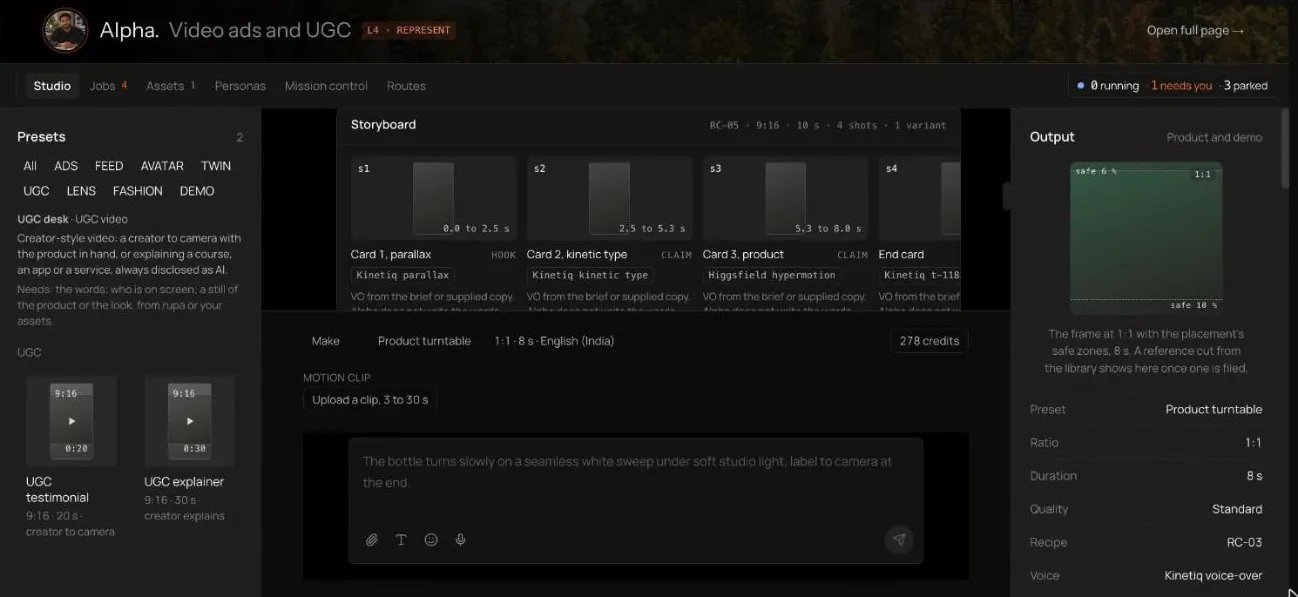
Video. Alpha, the AI video studio, plans a video shot by shot from a brief or preset and quotes it in credits. Nothing renders until a person approves the storyboard and its quote. A real customer appears only in their own consented footage, a digital twin renders only with a written release on file, and every synthetic presenter carries a disclosure layer. Each rendition is signed with Content Credentials.
Images. RUPA, the AI image studio, renders to presets with your brand guidelines attached by default, and shows the exact text sent with every render.
Creative strategy. HOOK (Beta), the ad creative strategy lead, studies competitor and category ads, turns patterns into testable angles and writes hooks and scripts. Its GATE checks every claim against your brand pack before anything ships.
Written content. CREA's Content team drafts from your Knowledge Hub and brand book, and nothing goes live until a person approves it.
Answer engines. DRIS checks how ChatGPT, Claude, Gemini, Perplexity and Grok answer the questions your audience asks, and proposes fixes to your pages.
If you need an agent for a job no teammate covers, you can build one from a sentence in Agent Workbench. See creating an agent. The media and publishing page shows how the rest of the growth org works for media teams.
Frequently Asked Questions
What is AI-curated interest media?
It is content chosen or assembled around a person's interests, either by a platform's recommendation system or by a marketer using AI to make interest-specific versions of trailers, clips, artwork or copy.
Where can I learn how streaming and social recommendation algorithms work?
From the platforms' own explainers: YouTube's post on its recommendation system, Netflix's Help Center article on recommendations, Meta's ranking system cards and Spotify's page on understanding recommendations.
Do I need to disclose AI-generated content in entertainment marketing?
Often, yes. YouTube asks creators to disclose realistic AI-generated or altered content, the EU AI Act's transparency rules require deep fakes to be labelled, and the IAB framework recommends disclosure where AI could mislead. Check every market you run in.
Does Nagent build recommendation engines for entertainment brands?
No. Nagent does not run recommendation systems or personalised feeds. Its teammates help you make and check the assets those systems serve, such as videos, images, ad creative and written content, with a person approving each one.
Get the guidance, then build the assets
The most reliable guidance on AI-curated interest media comes from the platforms that run the recommendations, the industry bodies that set standards and the rules in your markets. Use it to plan interest-cut assets, clear rights and label what needs it. See how Nagent works for media and entertainment teams.
Book a demo to see Alpha and the Content team make assets for your next release.