
AI Blog Writers vs. Copywriters vs. Agencies: CRO Cost Breakdown

AI Blog Writers vs. Copywriters vs. Agencies: CRO Cost Breakdown
AI blog writer agents outpace human copywriters on speed and cost — but the real question for CROs isn't "which is faster?" It's "which model produces revenue-generating content at a defensible cost per pipeline dollar?" Across output speed, per-asset cost, brand consistency, and outbound activation time, the three models perform very differently. This breakdown gives you the numbers to make that call.
What does each content production model actually cost per asset?
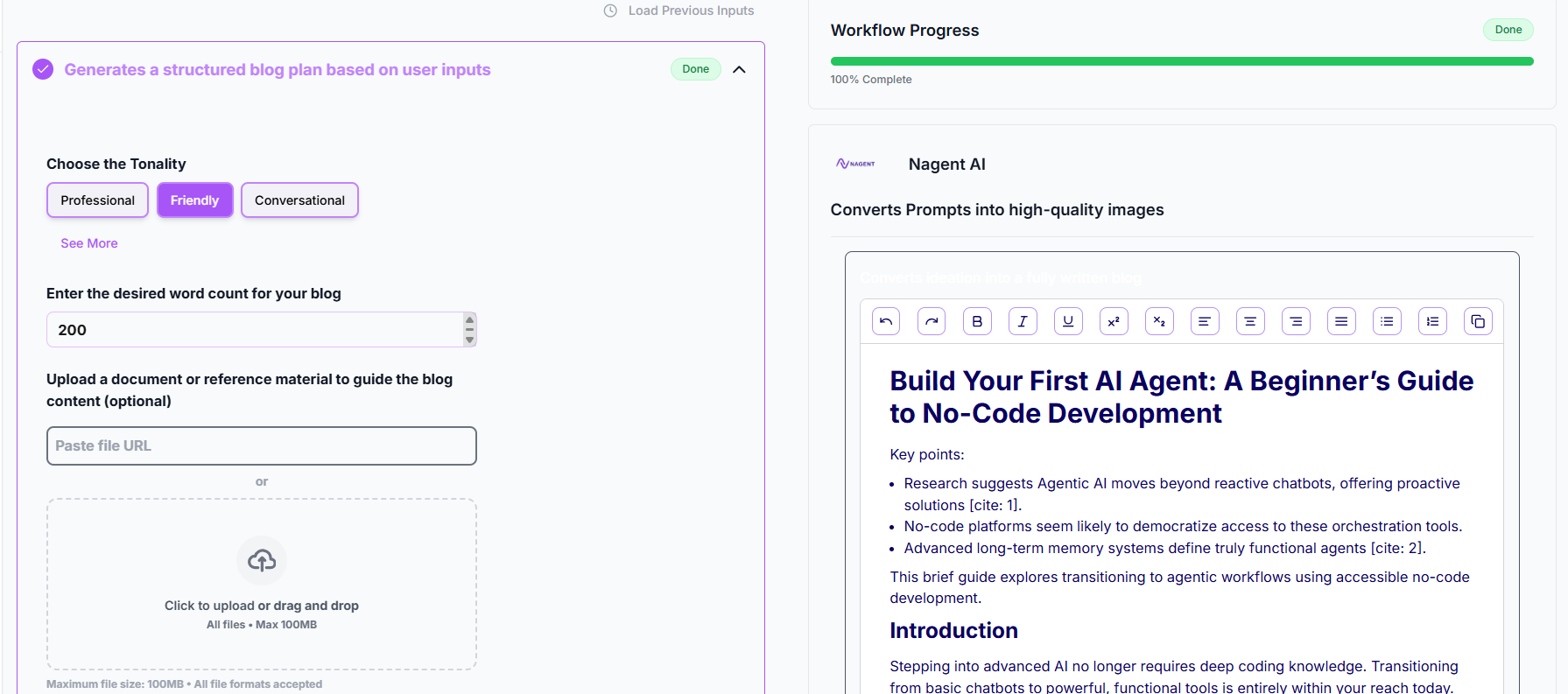
The per-asset cost gap between an AI blog writer, a freelance copywriter, and a content agency is not marginal — it's structural.
Here's what the math looks like in practice:
| Model | Avg. cost per blog post | Time to first draft | Brand consistency |
|---|---|---|---|
| AI Blog Writer Agent | ~$3–$15 per post (platform cost amortized) | 3–10 minutes | High — enforced by prompt layer |
| Freelance Copywriter | $150–$600 per post | 2–5 business days | Variable — brief-dependent |
| Content Agency | $500–$2,500 per post | 5–15 business days | High — but slow to update |
These aren't hypothetical ranges. The AI Blog Writer on Nagent's marketplace moves a brief to a structured, publish-ready draft in under 10 minutes — a compression from the 4-hour industry average for a human writer producing the same word count.[^1]
The cost-per-asset difference compounds fast at volume. A CRO running 20 blog posts a month pays roughly $3,000–$12,000 to a content agency for that output. The same volume through an AI blog writer agent costs a fraction of that — and scales linearly without adding headcount.
How does output speed affect pipeline activation time?
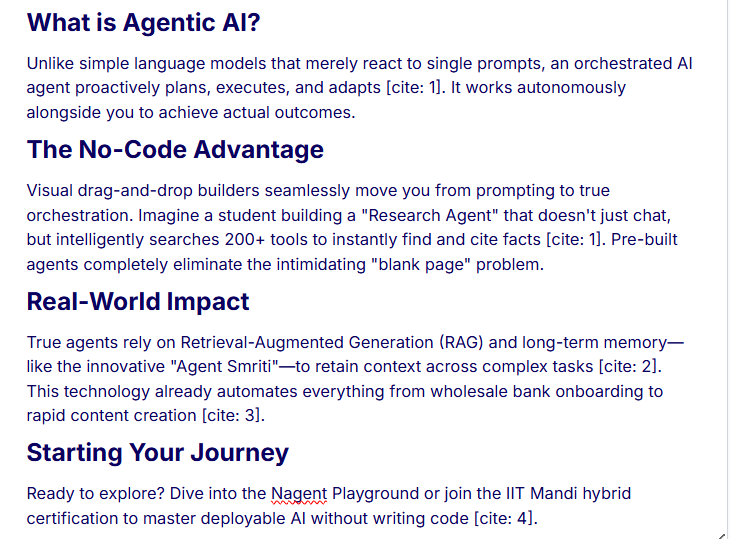
Speed-to-publish directly affects when content starts generating inbound pipeline.
A blog post sitting in a content agency's queue for 10 business days isn't generating organic traffic, isn't feeding your SDR team's outbound sequences, and isn't building topical authority. Every day in the queue is a day of zero return on that content investment.
Consider the activation chain:
- Brief created → content produced → SEO indexed → organic traffic arrives → lead captured → SDR sequence triggered
With a freelance copywriter or agency, steps 1 and 2 alone take 2–15 business days. With an AI blog writer agent, that gap collapses to minutes.
SERA, Nagent's Sales Execution & Research Agent, helps sales teams connect published content directly to outbound sequences.[^2] When content publishes in minutes instead of weeks, SERA can activate that asset in the same day's outbound motion — turning a blog post into a live sales tool before the agency model has even assigned a writer.
That's not a marginal efficiency gain. That's a structural change in how fast revenue-generating content reaches buyers.
Where do human copywriters still win?

Human writers outperform AI agents on three specific content types: high-stakes narrative, novel research synthesis, and relationship-driven thought leadership.
A ghostwritten op-ed for your CEO in Harvard Business Review needs a human. A 3,000-word original research report synthesizing proprietary customer data needs a human. A case study that requires 90 minutes of customer interviews needs a human.
These are high-value, low-frequency assets. They're not the bottleneck in most CROs' content stacks.
The bottleneck is the volume layer — SEO blog posts, product update articles, email nurture sequences, social copy, and landing page variants. That's where the ai blog writer vs copywriter vs content agency comparison matters most for revenue operations.
A smart CRO uses human writers for the 10% of content that requires genuine creative judgment. AI agents handle the 90% that requires consistency, speed, and scale.
What's the brand consistency risk with AI-generated content?
Brand consistency is the most common objection to AI blog writer agents — and it's the easiest one to solve.
The risk is real with generic AI tools. Paste a prompt into a general-purpose chatbot and you'll get generic output. But purpose-built agents like the AI Blog Writer enforce brand voice at the prompt layer — tone presets, vocabulary rules, banned phrases, and structural templates are all baked into the agent's configuration.
Compare that to a content agency managing 15 clients. Writer turnover, brief misinterpretation, and account manager churn all introduce brand drift. Most agencies compensate with revision rounds — which add days and cost.
Nagent's Agent Smriti takes this further. It's a cross-session memory layer that lets agents remember what worked for your brand six months ago — which angles converted, which CTAs underperformed, which topic clusters drove the most qualified traffic. A human writer starting a new engagement has none of that institutional memory. Agent Smriti does.
How do content agencies justify their premium?
Content agencies earn their fee on strategy, relationships, and integrated execution — not on per-post production.
A good agency brings:
- Editorial strategy and topic cluster planning
- SEO keyword research and competitive analysis
- Distribution partnerships and media relationships
- Multi-format repurposing (blog → social → email → webinar)
- Senior editorial oversight
The problem is that most CROs aren't buying all of that. They're buying 8 blog posts a month and getting a project manager, two junior writers, and a Slack channel. The strategic value is bundled into a production contract.
That's a misalignment of cost and value.
The smarter model: use MIRA, Nagent's Marketing Intelligence & Research Agent, to handle the research and topic discovery layer.[^1] Use the AI Blog Writer agent for production. Hire one senior content strategist (internal or fractional) for editorial oversight and distribution strategy. You get agency-quality strategic thinking at a fraction of agency cost — and you retain the speed advantage.
Which model wins on outbound activation time?
For CROs running integrated GTM motions, outbound activation time is the metric that ties content directly to revenue.
Outbound activation time = the hours between "content published" and "SDR team has a live asset to reference in outreach."
| Model | Outbound activation time |
|---|---|
| AI Blog Writer Agent | Same day — often same hour |
| Freelance Copywriter | 3–7 business days (draft + revisions + publish) |
| Content Agency | 7–20 business days (brief + production + approval + publish) |
When SERA is connected to your content pipeline, it can pull freshly published posts into outbound sequences automatically.[^2] That means a blog post published at 9 AM can be referenced in a personalized SDR email by 10 AM. No manual handoff. No content calendar lag.
For high-velocity GTM teams running account-based plays, this is the difference between content that supports revenue and content that sits in a library.
How should a CRO decide which model to use?
The decision isn't binary. The right answer is a tiered content stack.
Use AI blog writer agents for:
- High-volume SEO content (10–50 posts/month)
- Product update and feature announcement posts
- Email nurture sequences and social copy
- Landing page variants for A/B testing
Use freelance copywriters for:
- Executive thought leadership
- Customer success stories (post-interview)
- High-stakes campaign copy where conversion rate variance matters
Use content agencies for:
- Integrated content strategy and editorial planning
- Distribution partnerships and media placements
- Quarterly research reports with original data
OPRA, Nagent's Operations & Process Automation Agent, can map your current content workflow to identify where manual bottlenecks are costing you activation time and per-asset cost.[^3] Most teams find that 60–70% of their content volume sits in the AI-automatable tier — and that's where the cost stack breaks in their favor.
The AI Content Marketing & Visual Storytelling Suite on Nagent's marketplace pairs the AI Blog Writer with a carousel-maker agent — so a single brief produces a long-form post and a LinkedIn carousel in the same workflow. That's the kind of multi-format output that used to require a three-person agency team.
Related reading
- What is a Foundation Model and Why It Powers Every AI Agent
- Why GTM Agents Are Collapsing the SDR Org
- AI Restructuring Marketing Content Operations
- AI Content Marketing & Visual Storytelling Suite
Frequently Asked Questions
Is an AI blog writer agent as good as a human copywriter?
For high-volume, SEO-driven content, AI blog writer agents produce publish-ready drafts faster and at lower cost per asset than human copywriters. Human writers outperform on high-stakes narrative, original research synthesis, and relationship-driven thought leadership — content types that represent a small fraction of most CROs' monthly output volume.
How does an AI blog writer agent maintain brand consistency?
Purpose-built agents like Nagent's AI Blog Writer enforce brand voice through configured tone presets, vocabulary rules, and structural templates baked into the agent layer. Nagent's Agent Smriti adds cross-session memory, so the agent recalls which angles and formats have performed for your brand over time — a capability no freelance writer or agency retainer can match out of the box.
What's the real cost difference between an AI blog writer vs. a content agency?
At 20 posts per month, a content agency typically charges $10,000–$50,000 depending on scope. An AI blog writer agent running on Nagent's platform produces the same volume at a fraction of that cost, with same-day turnaround. The agency premium is justified only when you're buying integrated strategy, distribution, and senior editorial oversight — not production volume alone.
How do CROs connect AI-generated content to outbound sales motions?
SERA, Nagent's Sales Execution & Research Agent, connects published content directly to SDR outreach sequences. When content publishes in minutes rather than weeks, sales teams can reference live assets in personalized outbound emails the same day — compressing the gap between content production and pipeline activation.
Where should a CRO start when evaluating AI content agents?
Start with your highest-volume, lowest-differentiation content tier — typically SEO blog posts, email nurture copy, and product update articles. Run a 30-day pilot using the AI Blog Writer and track per-asset cost, time-to-publish, and organic traffic lift against your current model. Most teams see the cost case close within the first month.
What's next
See exactly how Nagent's AI Blog Writer agent fits into your content stack — and what a tiered content model looks like for your GTM motion. Book a free 30-minute demo at nagent.ai and we'll map your current content workflow to the right agent stack.
Sources
- MIRA — Marketing Intelligence & Research Agent _(product doc)_
- SERA — Sales Execution & Research Agent _(product doc)_
- OPRA — Operations & Process Automation Agent _(product doc)_