
What Is a Hook in Advertising? Types, Examples, Testing
A hook in advertising is the opening of an ad that stops someone from scrolling or skipping: the first line, the first frame and, in video, the first few seconds. Its only job is to earn the next few seconds, where the ad can make its case. Hooks come in a handful of types, they are cheap to write, and they are the easiest part of an ad to test. This guide covers each, with example lines, and where HOOK, Nagent's AI Ad Creative Strategy Lead, helps.
What is a hook in advertising?
The hook is the part of an ad a viewer meets before they have decided to pay attention. In a feed, it is the first frame and the first line of text or speech. In a skippable video ad, it is everything before the skip button appears; Google's help page for YouTube video ad formats says viewers can skip a skippable in-stream ad after 5 seconds. In a print ad or a search ad, it is the headline.
A hook is not a slogan and not the whole idea. It is the door. The body of the ad still has to deliver what the hook promised, or the viewer leaves and the platform learns that your ad disappoints people.
Why does the hook matter so much?
Because almost everyone who sees an ad sees only the hook. Feeds autoplay, the scroll is always available, and a viewer decides in a moment whether this is for them. Every later part of the ad, the proof, the offer and the call to action, reaches only the people the hook kept.
That makes the hook the highest-leverage line in the ad. A better body helps the few who stayed. A better hook changes how many stay.
What are the main types of advertising hooks?
Most hooks fall into a few families. The lines below are illustrative examples written for this guide, not quotes from real ads.
Hook type: Problem, How it works: Names the pain in the buyer's own words, Example line (illustrative): "Your skincare routine has eleven steps and your skin still hates you."
Hook type: Outcome first, How it works: Shows the finished result, then explains, Example line (illustrative): "This is the kitchen after one Saturday and one tin of paint."
Hook type: Contradiction, How it works: Challenges something the viewer believes, Example line (illustrative): "You don't need more protein. You need to sleep."
Hook type: Specific detail, How it works: Leads with one concrete, provable fact, Example line (illustrative): "It folds to the size of a paperback."
Hook type: Question, How it works: Asks something the viewer wants answered, Example line (illustrative): "Why does your coffee taste burnt even at home?"
Hook type: Call out, How it works: Names the audience directly, Example line (illustrative): "If you run a two-person bakery, watch this."
Hook type: Visual interrupt, How it works: Opens on something that doesn't look like an ad, Example line (illustrative): A frame of a laptop sinking slowly into a bathtub
Hook type: Story, How it works: Opens mid-scene with tension, Example line (illustrative): "Three days before launch, the printer sent the wrong boxes."
No type wins everywhere. A call out works when the audience is narrow; an outcome first hook works when the result is visible; a specific detail works when the detail is true and checkable.
How do you write a strong ad hook?
Start from the angle, not the line. A hook is the first sentence of an argument: which pain, which promise, for which buyer. If you can't say the angle in one sentence, the hook will be clever and empty.
Then work through these habits:
Write in the buyer's words. Reviews, support tickets and sales calls are full of the phrases people actually use. Borrow them.
Make it work with the sound off. Put the hook on screen as text as well as in speech, because many people watch silently.
Show something in the first frame. A hook is visual as well as verbal. Decide what is on screen at the very start, not only what is said.
Promise only what the body delivers. A hook that overclaims buys a click and loses trust. Every claim needs a source the brand can stand behind.
Keep it short. Cut every word that isn't doing work. If the line needs a breath in the middle, it's too long.
Write many. Hooks are cheap. Write several for every body and let the results choose, rather than a meeting.
Here's how one angle turns into several hooks. Angle: a meal kit for parents who are tired of deciding what to cook.
Problem: "It's six o'clock and nobody knows what's for dinner. Again."
Outcome first: Open on a finished family dinner, then cut to the box arriving.
Call out: "Parents who hate the 'what's for dinner' question, this one's for you."
Contradiction: "The hard part of cooking isn't cooking."
Each tests the same angle with a different door into it.
How do you test ad hooks?
Test hooks on their own, before you test anything else. Keep the body, the offer and the call to action the same, and swap only the opening. If you change two things at once, you won't know which one moved the result.
A simple structure:
One body, several hooks. The body stays fixed; each variant opens differently.
Judge the hook on attention first. Look at how many viewers stayed past the opening seconds and how many watched through, not only at clicks.
Then check it carries through. A hook that holds attention but brings the wrong buyer will show up later as weak conversions.
Set the stop rule before launch. Decide the result at which a hook is dropped, so a bad week doesn't turn into an argument.
Read results against your own ads. Compare a new hook with what normally works for your brand in that placement, not with an industry average.
Once a hook wins, try it on another angle, or carry it to another placement. Keep a record of what won and why, so the next brief starts from evidence.
Where does HOOK, the Nagent teammate, help with hooks?
HOOK is Nagent's AI Ad Creative Strategy Lead for paid social. It's in Beta, sits on the Marketing team and reports to MIRA, the AI Marketing Chief of Staff. Eight sub-agents do the work. For hooks specifically:
Hooks start from an angle. ANGLE writes a brief as a set of bets, each with a kill condition set before launch, and each bet opens a concept. Hooks are written for a concept, so every hook belongs to an argument.
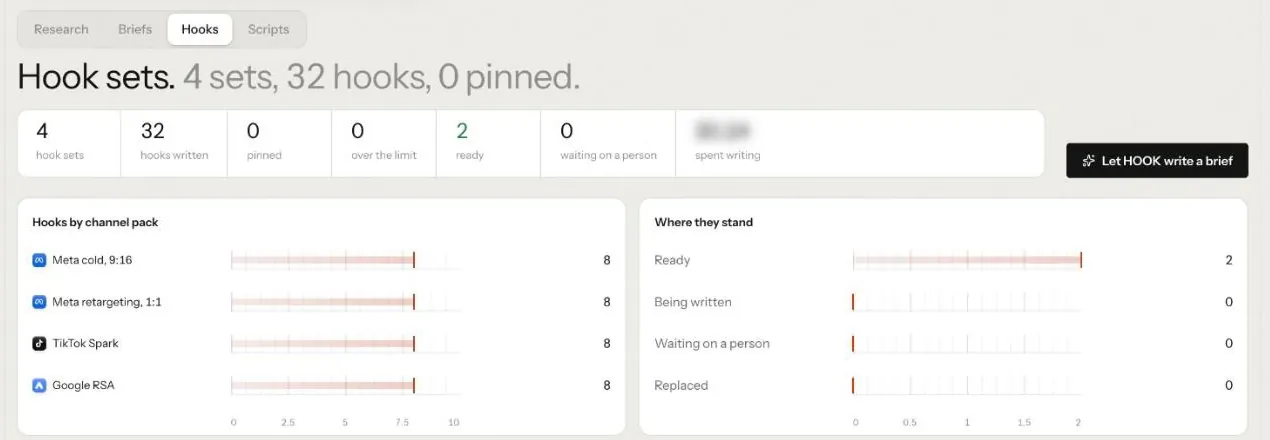
SCRIPT writes hook sets. When you write a brief you choose the channel packs and the hooks per pack, from 3 to 10. SCRIPT writes a hook set per concept and channel pack, with lengths measured in code. A person pins the sets they like and clicks "Hand to SCRIPT" for full scripts, or asks for another round with Iterate.
Claims are checked. HOOK won't make anything until its brand pack is complete, with the claims the brand may make and their proof. GATE checks every claim against the pack and holds what the pack doesn't support.
Results come back by ad. PULSE reads ad level performance from a connected Meta account or from an uploaded .csv or .xlsx export, says where an ad loses its audience and suggests one change to make. VAULT keeps what won as a playbook for the next brief.
Other teammates can ask for hooks. A person working with DRIS or NIA can ask HOOK for hooks from that lead's own page, and the request lands in HOOK's Requests.
What HOOK doesn't do: it makes read calls only on an ad account, so it can't launch, pause, or change a budget or a bid. A person runs the test in the ad platform. Its channel packs today are Meta cold 9:16, Meta retargeting 1:1, TikTok Spark and Google RSA.
Frequently Asked Questions
What is a hook in an ad?
The opening line, frame or seconds that stop a viewer from scrolling or skipping. It earns the attention the rest of the ad needs to make its case.
How long should an ad hook be?
As short as it can be while still making sense: one line, a few seconds of video. On skippable YouTube ads, land the hook and the brand before the skip appears at 5 seconds.
What is a good hook for a video ad?
One that names the viewer's problem in their own words, shows the result first, or opens on a frame that doesn't look like an ad, and that the body of the ad then delivers on. Test several rather than picking one.
How many hooks should you test per ad?
Several for every body, swapped one at a time with the rest of the ad fixed. HOOK lets you choose from 3 to 10 hooks per channel pack when you write a brief.
Can AI write ad hooks?
Yes, and volume is where it helps most. It works best from a clear angle, a buyer and a list of claims the brand can prove, with a person choosing which hooks go to test.
Write hooks that earn the rest of the ad
A good hook in advertising is a promise the ad keeps: specific, in the buyer's words, visible in the first frame and tested against other openings rather than chosen by taste. See how HOOK writes hook sets from your angles and checks every claim before anything ships.
Book a demo to see HOOK write hooks from your own brand pack.