
AI Creative Strategist: What It Does and Where It Stops
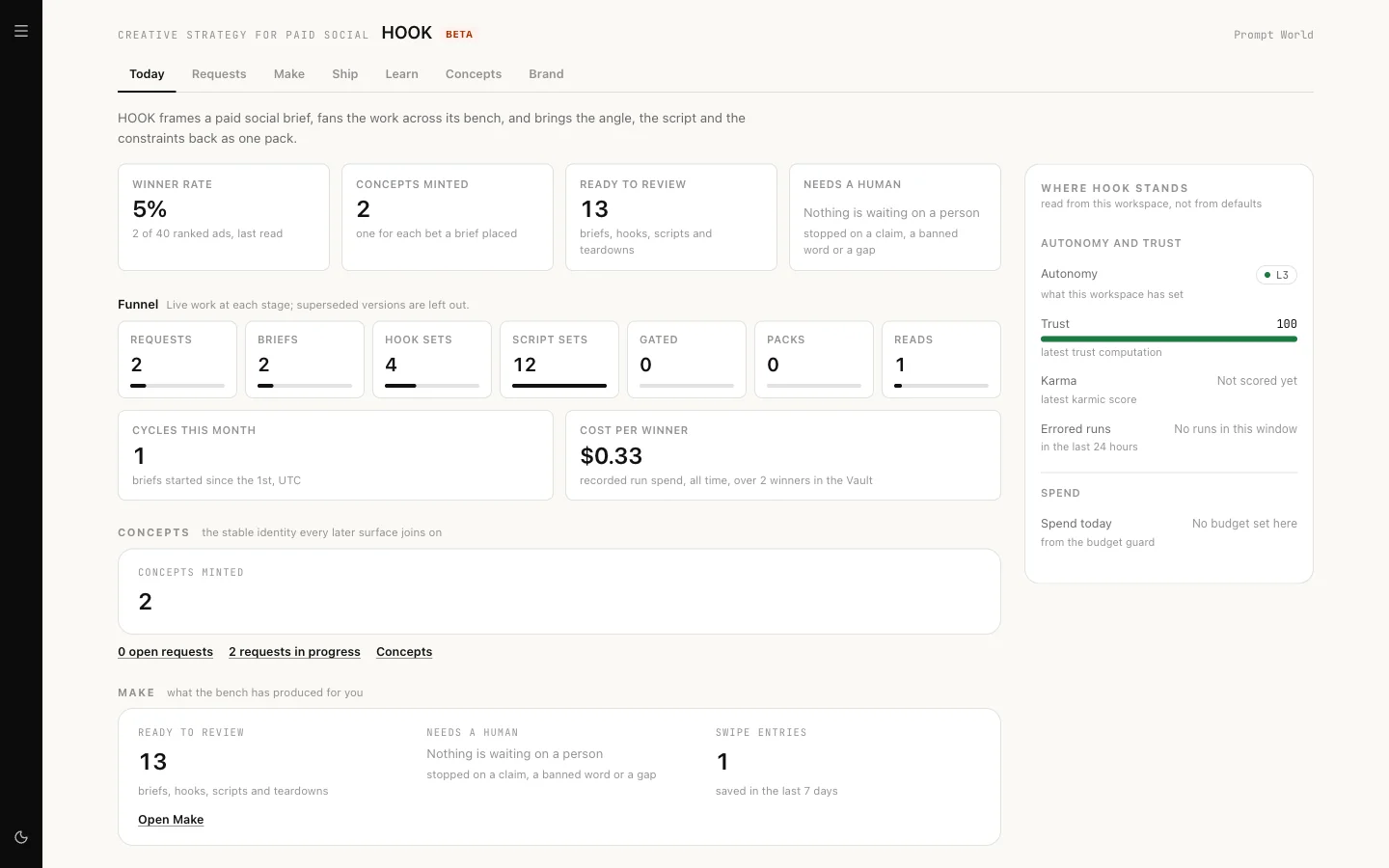
An AI creative strategist does the research and reasoning behind ad creative: it studies the ads in your category, finds the patterns that seem to work, turns them into angles you can test, briefs production, then reads results and says what to kill, what to iterate and what to carry forward. It speeds up a creative strategist's loop; it doesn't replace their judgment. This guide covers each step, and how HOOK, Nagent's AI Ad Creative Strategy Lead, handles it.
What does a creative strategist actually do?
A creative strategist sits between the media buyer and the people who make the ads. Their job is to decide what to make next, and why, so the creative budget goes into ideas with a reason behind them. In practice the work is a loop with five parts:
Research. Study competitor and category ads, customer reviews and your own past winners.
Patterns. Work out what the ads that last have in common, stated as a reason rather than a look.
Angles. Turn a pattern into an argument for your brand: which pain, which promise, for which buyer, resting on which claim.
Briefs. Hand production something they can make without a meeting.
Reading results. Decide what to kill, what to iterate and what the test taught.
The loop is slow by hand because the first and last steps take hours of watching, tagging and spreadsheet work. That's where AI helps most.
Which parts of creative strategy can AI do well?
AI is good at the volume work and at keeping the loop honest. It is weaker at taste and at knowing your market from the inside.
Step: Research, What AI does well: Collecting and transcribing many ads, breaking each into its beats, What still needs a person: Choosing which competitors and categories matter
Step: Patterns, What AI does well: Tagging hooks, formats and claims across a library, so a pattern shows up, What still needs a person: Judging whether a pattern fits your brand
Step: Angles, What AI does well: Drafting many angles from one pattern, each with the claim it rests on, What still needs a person: Picking the bets worth money
Step: Briefs, What AI does well: Writing a consistent brief with constraints and a kill condition, What still needs a person: Approving what gets made
Step: Results, What AI does well: Ranking ads against your own baseline and spotting a weak hook, What still needs a person: Deciding what runs and what it costs
A useful rule: let the AI produce options and evidence, and let a person make the calls that spend money or speak for the brand.
How does an AI creative strategist research ads?
Good research starts with a swipe library: a saved set of ads worth learning from, each with a note on why it was kept. Public sources help here. Meta describes its Ad Library as "a comprehensive, searchable database for ads transparency", which makes it a common starting point for seeing what a category is running.
What separates research from scrolling is the teardown. A teardown breaks a video ad into its beats: the opening, the problem, the proof, the offer and the call to action, with what is said and shown at each point. Once ads are torn down the same way, you can compare them.
On Nagent, this is the work of two of HOOK's eight sub-agents. SCOUT finds the competitor and category ads worth studying and says why each one earned a place in the swipe library. A teardown transcribes the audio, cuts keyframes and reads both into beats. Searching a paid ad source and tearing down an ad cost money, so both wait for a person's approval, and a search needs an ad source connection set up first.
How do you turn ad patterns into testable angles?
A pattern is only useful when it is stated as a mechanism. "Lots of winners use a person talking to camera" is an observation. "Winners in this category open on the buyer's frustration in their own words, then show the fix within seconds" is a mechanism you can test.
From a mechanism, write angles. Each angle should name:
The buyer it is for.
The pain or desire it leads with.
The claim it rests on, and the proof for that claim.
The kill condition: the result at which you stop spending on it, set before launch.
HOOK splits this between MINE, which mines the swipe library for what is working and why, and ANGLE, which turns a mined pattern into a testable angle for your brand with the claim it rests on made explicit. ANGLE writes the brief as a set of bets, each with a structured kill condition, and each bet opens a concept that HOOK tracks to whether it won.
What should a creative brief from an AI strategist include?
A brief should let a producer make the ad without a briefing call. That means the angle, the hooks, the script or shot list, the format for the placement, and the constraints: what the ad may claim, what it must never say, and the offer.
The constraints matter most. An ad that claims what the brand can't prove costs more than a weak ad. HOOK won't make anything until its brand pack is complete: voice, buyer profile, the claims the brand may make with their proof, banned language, the offer and channel packs. GATE, the only one of HOOK's sub-agents that stops work rather than producing it, checks every claim against that pack and holds what the pack doesn't support. Overriding a GATE block always needs a second person.
From there, SCRIPT writes hook sets per concept and channel pack. A person pins the sets they like and hands them to SCRIPT for full scripts. A production brief for statics goes to RUPA, Nagent's image studio, when a person sends it, and a video brief goes to Alpha, the video studio.
How should an AI creative strategist read performance?
Reading results is where most creative tests lose their value. A dashboard shows which ad won; a strategist needs to know why, and what to do next.
Three habits help:
Compare against your own ads. A new ad is judged against what normally works in that placement for your brand, not against an industry average.
Separate the angle from the execution. A good angle with a weak hook is worth iterating. A weak angle isn't, however well it was shot.
Keep what you learned. A test that taught something should change the next brief, even after the people who ran it move on.
In HOOK, PULSE reads ad level performance from a connected Meta account or from a .csv or .xlsx export uploaded from any ad platform. Each ad is ranked against the account's own ads in its channel pack, and a diagnosis says where an ad loses its audience and one change to make. PULSE writes a refresh plan in three columns, kill, iterate and next, and flags when a kill condition is met. VAULT keeps what each campaign taught as a playbook for the next brief.
What can't HOOK do?
HOOK is in Beta, and it's worth knowing its edges before you plan around it.
It never touches a live ad. HOOK makes read calls only on an ad account. It can't launch, pause, or change a budget or a bid, and none of its sub-agents can. A person pauses the ad, even when PULSE says a kill condition is met.
Meta is read only. HOOK can't place Meta campaigns; you download the package and upload it to Meta Ads Manager yourself. For Google, a pack can go to NIA, who builds the campaign paused and asks for her own approval first.
Four channel packs today. Meta cold 9:16, Meta retargeting 1:1, TikTok Spark and Google RSA. YouTube and LinkedIn aren't HOOK channel packs.
Some loops aren't closed yet. TikTok packs can't be placed, no TikTok video is gated yet, and Google Ads results aren't read back. A gated video can't go into a pack yet: packs hold statics, carousels and Google RSA sets.
Chat isn't the full workflow. Talking to HOOK in chat uses a general prompt; the full workflow runs on HOOK's own pages.
HOOK reports to MIRA, the AI Marketing Chief of Staff. If you need a creative step HOOK doesn't cover, a team can build its own agent from one sentence in Agent Workbench; see creating an agent.
Frequently Asked Questions
What is an AI creative strategist?
An AI system that does the research, pattern finding, angle writing, briefing and performance reading behind ad creative. It produces options and evidence quickly; a person still decides what runs and what it may claim.
Can AI replace a creative strategist?
No. It removes the hours of watching, tagging and spreadsheet work, so a strategist can test more ideas with clearer reasons. Taste, market knowledge and the decision to spend stay with people. HOOK is built for the creative strategist and the paid social manager, not instead of them.
How does an AI creative strategist decide what to kill?
Against a kill condition set before launch, and against your own ads in the same placement. A good one separates a weak angle from a weak execution, so you iterate the hook rather than drop an angle that works.
Does HOOK pause losing ads?
No. HOOK makes read calls only on an ad account. PULSE says when a kill condition is met and lists the ads to kill, and a person pauses them in the ad platform.
Put an AI creative strategist on your team
An AI creative strategist earns its place by making the loop faster without making it looser: research you can trace, angles with their claims named, briefs with a kill condition, and results read against your own baseline. Read how HOOK, the AI Ad Creative Strategy Lead, runs that loop from brand pack to playbook.
Book a demo to see HOOK work from your own brand pack.
Continue learning
Agents that match this read.
Kinetiq: AI Motion Design Studio
Kinetiq turns briefs, scripts, website URLs, and brand assets into editable After Effects-style motion videos, including explainers, SaaS videos, product launches, ads, kinetic typography, and social videos, without manual motion-design work.
View agent VVirtual Photoshoot Agent
A comprehensive virtual production tool that orchestrates full-scale photoshoots with total control over models, weather, location and other styling preferences via AI.
View agent