
Best AI Video Ad Generators for Ecommerce 2026
Best AI Video Ad Generators for Ecommerce 2026
About this comparison: this post reflects Nagent's analysis of the AI video ad market based on product documentation and publicly available information. Alpha (video), HOOK (Beta, creative strategy) and RUPA (images) are Nagent's own AI teammates; where we reference third-party tools, we say so. Descriptions of Nagent's teammates come from our own product pages, and real-world results vary by brand, brief quality and campaign set-up.
The best AI video ad generators for ecommerce in 2026 are not the ones with the most cinematic output, they are the ones that scale across SKUs, adapt to platform formats automatically, and cut production time from days to minutes. For CMOs running multi-product paid social, three criteria matter above all else: volume, variation, and platform fit. Generic quality rankings miss this completely.
Most comparison lists rank AI video tools on visual polish. That is the wrong question for ecommerce.
If you are running 50 SKUs across TikTok, Reels, and YouTube Shorts, and your performance team needs weekly creative refreshes, visual quality is table stakes. What kills you is production bottleneck. Slow iteration cycles. Agencies that take six rounds to approve a 15-second ad. Format rework every time a platform changes its aspect ratio.
This guide ranks the best AI video ad generators on the metrics that actually drive ecommerce growth.
What criteria actually matter when choosing an AI video ad generator for ecommerce?
Four criteria separate useful tools from expensive distractions for ecommerce teams.
Most tools get reviewed on output aesthetics. But a D2C brand running flash sales every two weeks needs something different from an agency building brand films. Here is what to actually evaluate:
SKU scalability: Can the tool generate distinct creatives per product without manual re-briefing for each one?
Multi-platform format output: Does it auto-adapt to 9:16, 1:1, and 16:9 without a separate export workflow?
UGC-style rendering: Can it produce raw, native-feeling content that doesn't look like a produced ad?
Iteration speed: How many rounds does it take to get to a shippable asset?
Tools that score well on all four are rare. Most excel at one and force workarounds on the rest. The best AI video ad generators solve the whole workflow, not just the render.
How does Alpha perform on ecommerce-critical criteria?
Alpha is Nagent's AI video teammate, built for teams running paid social video, and we think she is a strong all-round option for ecommerce teams.
To be clear upfront: Alpha is a Nagent product. We are not a neutral observer here. The workflow is worth explaining because it works differently from generic video generators: Alpha plans to a preset, quotes each video before anything renders and waits for storyboard approval.
Alpha turns a single brief into platform-ready video ads planned to a preset: product ad videos, UGC-style ads with a disclosed AI host, and presenter videos with your spokesperson or a digital twin. One brief can become several variations covering different hooks, scenes and angles. We do not quote a typical monthly volume; it depends on your briefs and review cycles.
On the four criteria:
SKU scalability: each product can be its own brief, and the brand kit and approved claims live in the Knowledge Hub, so there is no manual re-setup per SKU.
Multi-platform format output: you set the placements in the brief, such as 9:16 for TikTok, square for feed and horizontal for YouTube pre-roll.
UGC-style rendering: UGC-style video ads use a disclosed AI host, native in feel and honest about what they are.
Iteration speed: hooks and scripts come from HOOK (Beta), and approval happens at the quote and the storyboard, before render, so fewer rounds are spent on finished video.
What does HOOK bring to a video production stack?
HOOK (Beta) is Nagent's AI creative strategy lead for paid social. It is a pre-production teammate, not a finished ad generator.
This distinction matters. HOOK does not render video. It turns a brief into angles, hooks and scripts, checks every claim against your proof, and reads results from the ad data you upload to say which concepts won. HOOK never changes live ads.
For ecommerce teams, the use case is creative strategy and learning. You see a format working in your category, HOOK turns it into angles and scripts for your product, and the output is a production-ready brief, not the final video.
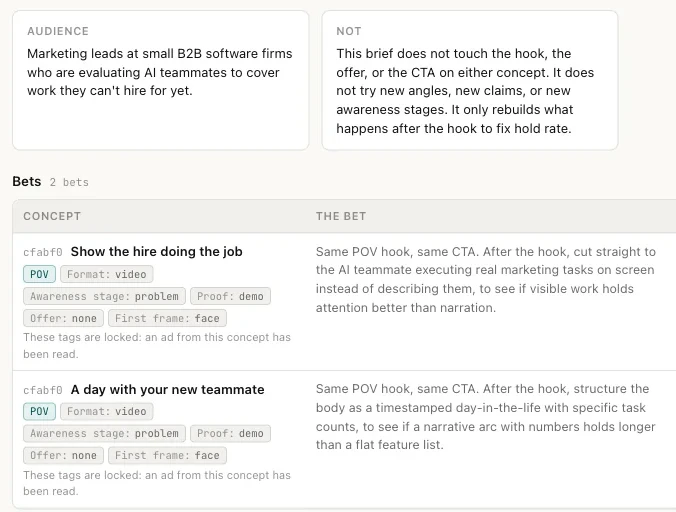
A HOOK creative brief: the audience, what it will not touch, and the bets it opens.
Used with Alpha, the workflow becomes:
HOOK writes the angles and scripts from your brief and proof
The approved script becomes Alpha's brief
Alpha plans several variations to a preset, quoted before anything renders
This is a Nagent workflow, not a standalone comparison: HOOK raises the quality of the brief that feeds Alpha's output.
How does RUPA fit into a D2C content operation?
RUPA is Nagent's AI image teammate: product shots, ad stills and social images rendered to a preset with your brand guidelines attached.
RUPA covers a different part of the brief than Alpha. Where Alpha makes video ads, RUPA makes the still creative that runs alongside them.
For D2C brands running both video and static creative, these teammates complement rather than overlap:
Alpha handles video ads, including UGC-style and presenter formats
RUPA handles product shots, ad stills and social images
Both are Nagent AI teammates working in the same Marketing team room, with MIRA, the AI chief of staff for Marketing, routing the work. That matters for teams deciding whether to consolidate their creative production on one platform.
How do third-party AI video tools compare on ecommerce criteria?
Several external tools appear frequently in market comparisons, tools like Runway, Pika, and Synthesia among others. Here is an honest read of where external tools currently fit for ecommerce teams.
| Criterion | Nagent Alpha | Market alternatives (e.g., Runway, Pika, Synthesia) |
|---|---|---|
| SKU scalability | One brief per product, several variations per brief | Typically single-output; batch requires manual re-prompting |
| Multi-platform format output | Placements set in the brief | Format adaptation often manual or post-export |
| UGC-style rendering | UGC-style ads with a disclosed AI host | Varies; some strong (Runway), some primarily polished output |
| Iteration speed | Approval at the quote and storyboard, before render | 3 to 6 rounds typical without integrated review workflow |
| Ecommerce brief integration | Works from product briefs and the Knowledge Hub | Most require separate prompt engineering per product |
Note: Third-party tool capabilities evolve rapidly. This table reflects publicly available product information as of mid-2026. Verify current capability with each vendor.
External tools are not wrong choices for every use case. Runway's cinematic quality is well-documented. Synthesia excels at spokesperson-style video. But for an ecommerce team whose bottleneck is volume and iteration, not visual sophistication, the best AI video ad generators are those built with a performance marketing workflow in mind.
What does a full ecommerce video production stack look like in 2026?
The most efficient ecommerce video stack in 2026 combines brief intelligence, ad generation, and supporting creative agents, not a single tool.
A practical Nagent-first stack for a D2C brand running paid and organic:
HOOK (Beta): turns what works in your category into angles, hooks and scripts, each claim checked against your proof
Alpha: plans platform-ready video ads from the approved script, quoted before anything renders
RUPA: renders product shots, ad stills and social images with your brand guidelines attached
MIRA: the AI chief of staff for Marketing, routes the campaign and keeps the approved assets together
A person: approves every asset before it goes live
This is a Nagent-first recommendation. We are transparent about that. If your team has existing tools for specific parts of this stack, the right call is to evaluate fit per workflow step, not to replace everything at once.
For multilingual generation specifically, this remains an active development area across all tools including Nagent's. Verify current multilingual capability directly with any vendor before making it a purchase criterion.
Related reading
Frequently Asked Questions
What are the best AI video ad generators for ecommerce in 2026?
The best AI video ad generators for ecommerce prioritise SKU scalability, multi-platform format output and fast iteration, not just visual quality. Nagent's Alpha is built for this use case: video ads planned to a preset from each brief, quoted before anything renders and approved at the storyboard. Third-party tools like Runway and Synthesia serve different use cases (cinematic quality and spokesperson video, respectively) but need more manual workflow management for multi-SKU campaigns.
How is Alpha different from general-purpose AI video tools?
Alpha is a performance marketing teammate, not a general video generator. She works from product briefs and your Knowledge Hub, plans each video to a preset, quotes it before anything renders and waits for storyboard approval, so feedback happens before render rather than on finished video. General-purpose tools produce strong output but usually need manual re-prompting per product and separate exports per format.
Can I use several Nagent AI teammates together?
Yes. HOOK (Beta), Alpha and RUPA have complementary roles: HOOK handles creative strategy, angles and scripts; Alpha makes the video ads; RUPA makes the stills. MIRA, the AI chief of staff for Marketing, routes the work between them in the Marketing team room, so video and static production run on one platform.
Does Alpha support multilingual video ad generation?
Multilingual generation is an active development area across the AI video category, including Nagent's platform. Before making multilingual capability a key purchase criterion, verify current feature support directly with Nagent or any vendor you are evaluating. Requirements vary significantly by market and language pair.
How do I evaluate AI video tools if I'm not ready to switch platforms?
Start with the bottleneck, not the tool. Identify whether your biggest constraint is brief creation, raw video output, format adaptation or iteration speed. Map one Nagent AI teammate to that step: for example, use HOOK (Beta) for angles and scripts without replacing your existing video production workflow. A modular evaluation reduces risk and gives you measurable before and after data within 30 days.
What's next
See Alpha, HOOK and RUPA work on a live ecommerce brief. Book a demo and we will walk through a set-up matched to your SKU volume and platform mix, with a person approving every asset.