
What E-Commerce Marketers Get Wrong About AI Brand Governance

What E-Commerce Marketers Get Wrong About AI Brand Governance
Most e-commerce marketing teams think AI brand governance means uploading a style guide to Google Drive and hoping agents read it. That assumption is expensive. Real AI brand governance enforces tone, visual rules, and approval logic inside the agent workflow, not beside it. Teams that get this right produce more content at higher quality. Teams that don't ship off-brand assets at AI speed, which is a reputational risk most brands can't afford.
Static brand documents still matter. The argument here isn't against style guides, it's that style guides alone can't govern agents operating at scale.
Why Do Most E-Commerce Teams Treat Brand Governance as a Document Problem?
Brand governance fails at scale because documents don't execute, agents do.
Most governance frameworks were built for human-paced workflows. A copywriter reads the style guide. A designer checks the brand deck. A manager approves before publish. That sequence worked when you produced 20 assets a month.
Now, with AI agents producing 100 ad variations a week, pulling product data, writing copy, generating visuals, and scheduling posts, there's no human checkpoint at every step. The style guide sits in a shared drive. The agents run. Nobody notices the tone drift until a customer does.
This is the core failure mode: governance designed for humans, applied to agents.
What Does Real AI Brand Governance Look Like in Practice?
Real governance is embedded in the agent's execution logic, not layered on top after the fact.
Think of it in three enforcement layers:
Layer 1: Tone Enforcement at the Copy Level
Tone isn't just "friendly" or "professional." For a high-performing e-commerce brand, tone encodes specific things:
- Which words you never use (e.g., "cheap" for a premium brand)
- How urgency is expressed without feeling pushy
- Whether you address the reader as "you" or "they"
- How product claims are framed, direct claim vs. social proof
An agent writing product descriptions or ad copy needs these rules built into its working inputs, not referenced from an external document. On Nagent, your brand voice and rules live in the Knowledge Hub, and CREA's Content team writes from them. Those rules become the operating rules for every downstream content teammate.
When rules exist as structured logic rather than prose in a PDF, agents can check every output against them. Tone governance stops being aspirational. It becomes functional.
Layer 2: Visual Consistency Rules for Image-Generating Agents
Visual agents are the fastest source of brand drift in e-commerce workflows.
An image-generating agent doesn't "understand" that your brand uses warm, natural lighting or that your product shots always include a lifestyle context. Without explicit visual rules, background constraints, colour palette restrictions, composition requirements, the agent optimises for aesthetics, not brand alignment.
This matters at volume. Without explicit visual constraints, more outputs need revision before they meet brand standards; add the constraints and revision falls. The fix isn't a better prompt. It's governance built into the agent's configuration.
On Nagent, RUPA, the AI image teammate, renders to a preset with your brand guidelines attached (Brand Locked), so lighting, setting and styling follow rules you set rather than the model's taste.
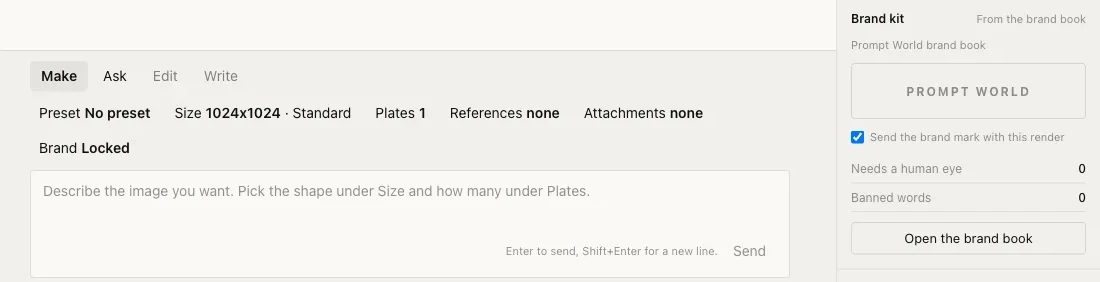
RUPA's composer: a preset and Brand Locked, with the brand kit read from the brand book alongside.
Layer 3: Approval Routing as a Governance Mechanism
Approval workflows are governance infrastructure. Most teams don't think of them that way.
When a content agent produces a high-stakes asset, a homepage hero, a brand campaign video, a promotional email, that output should route to a human reviewer before publish. Not because the agent can't produce good work. Because high-stakes decisions warrant human accountability.
The key design principle: approval routing should be conditional, not universal.
Routing everything to a manager creates the bottleneck most teams are trying to escape. Routing nothing creates the risk they're trying to avoid. The right design routes by asset type, channel, risk level, and audience size.
Conditional routing shrinks the approval burden because reviewers see grouped, pre-checked work instead of raw drafts. On Nagent, a person still approves anything that goes live; what changes is how much of the checking arrives already done.
How Does AI Brand Governance Apply to FMCG and E-Commerce Specifically?
The e-commerce context amplifies both the opportunity and the risk of AI-generated content.
E-commerce brands face a specific pressure: they publish across more channels, with more SKUs, at higher frequency than most brand categories. A fashion retailer running 50 SKUs across Instagram, Meta, Google, and email, with weekly promotions, is producing thousands of assets per month. A food brand doing seasonal campaigns produces variations across product lines, regions, and audiences simultaneously.
At that volume, human-only governance doesn't scale. But uncontrolled AI governance creates a different problem: speed without consistency.
Consider a scenario most e-commerce marketers recognise. An agent produces 80 ad variations for a seasonal sale. Forty of them nail tone and visual style. Thirty are acceptable with minor edits. Ten are off, wrong tone, wrong aesthetic, one with a price claim that doesn't match the current promotion. Without governance infrastructure, all 80 go into a review queue. The manager reviews all 80. The speed advantage of AI evaporates.
With governance embedded, the ten problematic outputs are flagged with the reason, the thirty acceptable ones go to a lighter-touch review, and the forty clean ones reach the approver ready to sign off in one pass. The marketing team gets speed and brand safety, and a person still approves what goes live.
On Nagent, AI teammates work this way: Alpha quotes each video and waits for storyboard approval before rendering, HOOK (Beta) checks every ad claim against your proof, and each output reaches its reviewer as its own item rather than a blanket queue.
What's the Governance Risk Nobody Talks About: Compounding Drift?
Brand drift compounds. A small tone deviation in week one becomes a recognisable pattern by week eight.
This is the risk that doesn't show up in a single asset review. It shows up when a customer says "your brand feels different lately", and you can't pinpoint when it changed.
AI agents operating without continuous governance feedback don't self-correct. They reproduce whatever patterns their instructions encode. If those instructions are slightly off, or if the brand has evolved and the agent's parameters haven't, every subsequent output drifts in the same direction.
The fix is continuous governance monitoring: tracking outputs over time for pattern deviations, not just reviewing individual assets in isolation.
On Nagent, this is what the control plane is for: every action is proposed, approved, run and audited, so the record shows how outputs change over time. MIRA, the AI chief of staff for Marketing, reports what the AI teammates did and what is waiting. It's not about reviewing every asset. It's about auditing trends.
How Should Marketing Ops Lead the Governance Design?
Marketing Ops owns governance infrastructure, not just tools.
Brand Marketing Managers define what "on-brand" means. Marketing Ops builds the systems that enforce it. That division of responsibility is critical for AI brand governance to work.
Practically, this means Marketing Ops leads:
1. Defining the structured rules that agents use (not just prose guidelines)
2. Configuring approval routing logic, which assets route to whom
3. Setting visual parameter constraints in image agents
4. Building the audit workflow that catches drift before it compounds
On Nagent, these rules live in the Knowledge Hub and in each AI teammate's approvals and level: what a teammate may do on its own and what waits for whom. AI teammates start supervised and earn autonomy level by level on their track record.
MIRA illustrates this in practice: she turns a basic brief into work for CREA's team, HOOK and RUPA, and every output follows the brand rules Marketing Ops set and waits for the approval they configured. The output isn't generic AI content; it's governed content.
Related Reading
Frequently Asked Questions
What is AI brand governance in e-commerce marketing?
AI brand governance is the practice of embedding brand rules, tone, visual standards, approval logic, directly into AI agent workflows, rather than relying on external documents for compliance. In e-commerce, it ensures that agents producing ad copy, product descriptions, and visual assets output brand-consistent content at scale. Without it, AI speed becomes a source of reputational risk rather than competitive advantage.
How is AI brand governance different from a brand style guide?
A style guide documents brand rules for human readers. AI brand governance encodes those rules as structured logic that agents execute against in real time. A style guide can't flag a tone violation in a generated ad, an governed agent workflow can. Both have a role, but style guides alone cannot enforce consistency when agents are producing hundreds of assets a week.
How do you set up governed content on Nagent?
There is no agent to build. You put your brand rules and approved claims in the Knowledge Hub and decide who approves what. Simple cases, like governed ad copy, are quick to set up; workflows with several approval layers take longer to design but give proportionally more brand safety.
What causes brand drift in AI-generated content?
Brand drift happens when an agent's operating parameters don't match the current brand standard, either because instructions were loosely defined initially, or because the brand evolved and the agent wasn't updated. Drift compounds over time: small deviations in early outputs become recognisable patterns across hundreds of assets. Continuous output monitoring across the audit trail is the most reliable way to catch and correct drift before it becomes visible to customers.
Which Nagent AI teammates are most relevant for e-commerce brand governance?
CREA's Content team writes from the brand voice and rules in your Knowledge Hub. MIRA turns a brief into routed work and reports what is waiting. HOOK (Beta) checks every ad claim against your proof. RUPA renders images with your brand guidelines attached, and Alpha waits for storyboard approval before any video renders. Across all of them, a person approves what goes live.
What's Next
If your team is producing AI content at scale without embedded governance, the gap between your style guide and your agent outputs grows every week. Book a demo to see governed AI teammates work in a live e-commerce context.