
How to Delegate Marketing Work to AI Agents
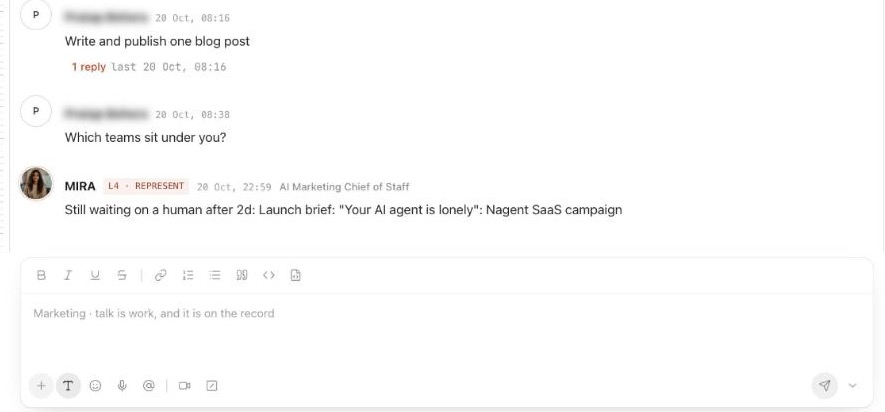
To delegate marketing work to AI agents, hand over the outcome, not the steps: state the target, say what done looks like, name what must wait for you, and let one coordinator split the work among the agents who own each part. On Nagent you write one ask in the room of MIRA, the AI Marketing Chief of Staff. She routes it to the right team lead, the lead briefs its sub-agents, writing and visuals go to CREA's Content team, and the work comes back for your approval.
Why does delegating to AI agents usually go wrong?
Most teams delegate to AI the way they use a tool: one prompt, one agent, one output, and a person stitching the pieces together. That breaks down on anything bigger than a single task. A campaign needs creative, a paid plan, a landing page and copy, and each piece depends on the others. When every handover goes through you, you are the bottleneck and the context lives only in your head.
Good delegation has the same shape whether the team is human or not:
A goal with a number. "More sign-ups" is a wish. "Forty demo requests from the workshop launch by the end of the month" is a goal.
One owner of the plan. Someone splits the work and names who does each part.
Clear owners for each part. The person or agent who does a piece keeps its approvals and its record.
A checkpoint before anything irreversible. Spending, publishing and emailing a contact wait for a person until the agent has earned more room.
Nagent's Marketing department is set up so that a single ask can follow that shape.
Where does MIRA sit in the team?
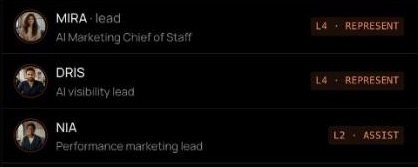
Every Nagent department has the same three layers: an AI chief of staff who owns the outcome, team leads who each run one part of it, and sub-agents who do the specialist work. The team page explains the model. For Marketing:
MIRA, AI Marketing Chief of Staff. Owns reach and pipeline cost, and reports to you.
DRIS, organic visibility (SEO and AEO), with sub-agents such as an SEO auditor, an AEO runner, technical SEO and a content producer.
NIA, paid marketing, with one sub-agent per ad channel.
HOOK, creative strategy (Beta), with SCOUT, MINE, ANGLE, SCRIPT, GATE, PACK, PULSE and VAULT.
Echo, reputation (Beta), with a seat for each kind of place you are reviewed.
MOXA, social media, coming soon.
A request travels down that line and back up:
Step: 1, Who: You, What happens: Ask the department in one line, in MIRA's room
Step: 2, Who: MIRA, What happens: Decides who owns each part and hands it to that lead
Step: 3, Who: Team lead, What happens: Breaks it down, puts tasks on the board and briefs its sub-agents
Step: 4, Who: Sub-agents, What happens: Each does its part and hands the result back to the lead
Step: 5, Who: Team lead, What happens: Brings one answer back, with anything that needs a person waiting on a card
Step: 6, Who: You, What happens: Approve, edit or decline, in the room where the work is
The rules that keep it safe: a sub-agent hands work back to its lead or up to the chief of staff, never sideways to another seat. One message can pull in at most three more teammates, and every hop is checked against the receiving agent's own budget. Work MIRA hands over runs under the receiving teammate's own level, so a handoff never lends her trust to anyone else. A person's instruction becomes a task only when they press Confirm. And asking another department is a written handoff to that room's lead, not a free-for-all.
That last rule matters for campaigns. MIRA does not run the writers or the image studio. Writing, images and video are made by CREA's Content team in its own room, so MIRA passes the writing and visuals to CREA's Content team and the result comes back to her thread.
How do you delegate a marketing campaign, step by step?
Here is one campaign from ask to approval. The example: a company launching a paid workshop that wants demo requests from it.
Step 1: Set the target before you ask
MIRA plans against the target the team has set. If none is set, she says so and plans in counts, never in percentages against a number nobody chose.
The workspace's growth number is one of the things N asks for during set-up, in N · Setup, with MIRA in the chat. If you skipped it, open Set up in the sidebar, go back to the set-up chat and give it there: the number, the target and the date you want it by.
She also states a number only when a teammate's report, a connected account or the team record gave it, and says where it came from. If you want her plan to reference your ad spend or your search traffic, connect Google Ads, Search Console and Google Analytics before you ask.
Step 2: Write one ask in MIRA's room
Open the Marketing room from Your teams in the sidebar. The composer at the bottom reads "Marketing · talk is work, and it is on the record". Because MIRA leads the room, a message addressed to nobody reaches her, but addressing her with @ makes it explicit. Describe the outcome and the constraints, and use the words "who should do it" so she assigns owners:
@MIRA We launch the AI workshop on 3 November and want 40 demo requests from it this month. Plan the launch and decide who should do it: ad angles and scripts, a Google Search campaign, a landing page and a launch blog post. Nothing goes live or spends money without my approval.
As soon as you send, the room shows what it is doing, from "Reading what you sent" to "Writing back". Replies collect under your message, so each ask keeps its own thread.
MIRA also chases on her own. When something in the room has waited two days on a person, she posts it once in the thread, "Still waiting on a human after 2d", with what it is, so delegated work cannot stall quietly on your desk.
Step 3: MIRA plans and routes the work
MIRA answers with a plan. For each item it names the owner, what done looks like and what it is waiting on. Because you asked who should do it, she writes one task per owner on the team's board, up to six, and starts each owner's run on it.
Two things can pause this step, and both are deliberate:
An instruction card. If your message reads as an instruction nothing can run right now, the lead proposes it as a task on a card headed Instruction read, waiting on you, with Confirm, Edit and Not a task. Only a person can confirm.
MIRA's own level. Writing tasks to the board is an internal action, which runs on its own from L3 Operate. MIRA sits at L4 Represent on the roster above, so it runs at once; if you ever lower her below L3, that step waits on a card for you before the leads start.
Step 4: Each lead works its part
Each lead now works its part under its own level and budget, never MIRA's.
HOOK frames the creative brief and spreads it across its bench: SCOUT for ads worth learning from, ANGLE for the bets and when to kill each one, SCRIPT for hooks and scripts, and GATE to check every claim against your brand pack, which can block a line. It brings the result back as one pack: the angle, the hooks, the script and the rules the ad must keep.
NIA builds the Google Search campaign from the brief. Campaigns arrive paused on every channel, and because NIA starts at L2 Assist, each live change she proposes waits for a person. For a leads objective she will not build without an enabled conversion action on the account, so check your conversion tracking first.
DRIS, if you add it to the ask, can draft an answer page for one buyer question about the workshop, so AI answers have something to cite.
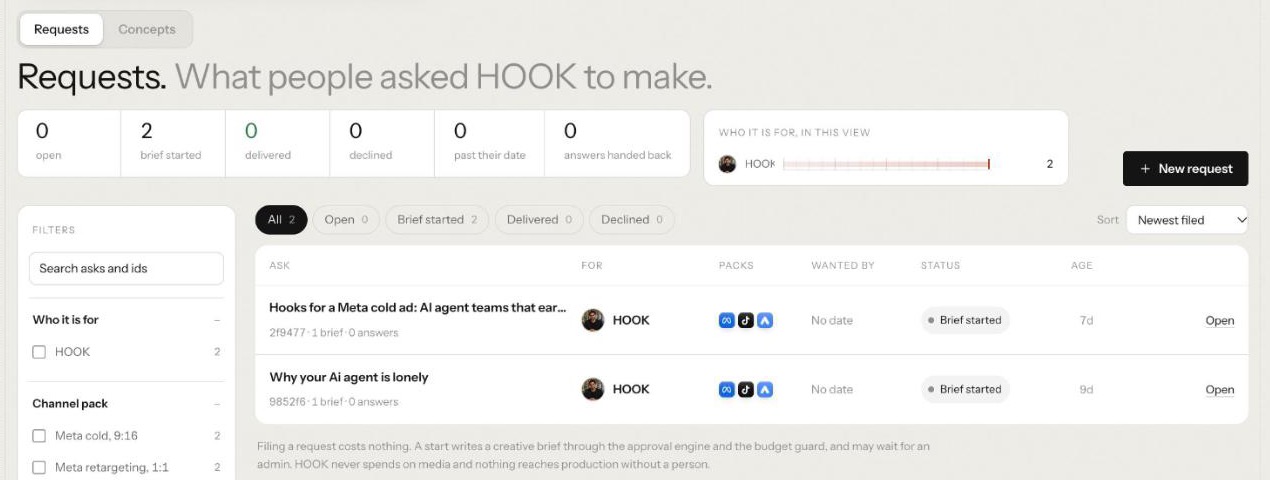
Each lead also keeps its own queue. On HOOK's Review tab, Requests is headed "What people asked HOOK to make.", with what is open, started and delivered, and New request to file one yourself. Nothing reaches production without a person.
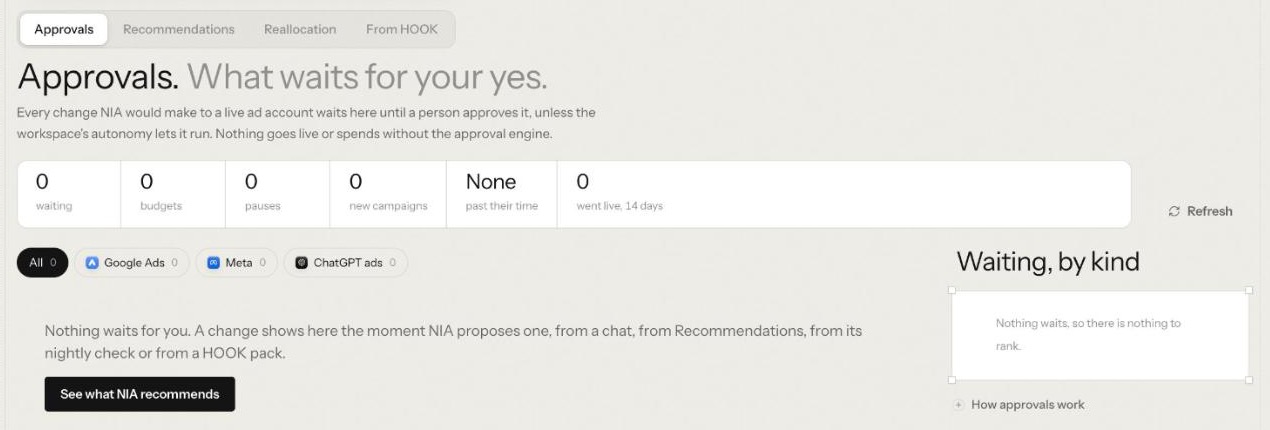
NIA's is her Review tab, on Approvals: "What waits for your yes." Every change she would make to a live ad account waits there for a person, unless the workspace's autonomy lets it run, whether it came from a chat, her recommendations, her nightly check or a HOOK pack.
If you only want one specialist, address it by name. In the HOOK team room, @SCRIPT reaches that seat directly.
Step 5: Writing and visuals go to CREA's Content team
The landing page and the blog post are content, so they leave the Marketing room. MIRA asks the Content team for each piece with her tool for that, and the request becomes a task on the Content room's board. Her thread shows a Content request card and the line "Asked CREA in the Content room. Progress shows below." The Content room gets a matching note saying who asked and from which room.
In the Content room, CREA writes the blog post and hands the rest to the seat that makes it: RUPA for images, LANDON for landing pages, Alpha for video. Every claim about your business must come from your own sources, and nothing is published, scheduled or sent by CREA. A landing page is left as a draft until a person presses Publish.
When the work is done, MIRA's thread reads "CREA's team finished this", with the title. If CREA's team is waiting for an approval, the card names who can give it. If your workspace has no Content team, the thread says so and offers Install the Content team; an admin can add it from Teams.
When HOOK's pack is ready for production, the HOOK team room has a workflow for the next step, Creative brief for RUPA, in which HOOK writes a brief the design team can make ads from.
Step 6: Approve the work that comes back
Each lead's output is a file, not a chat message. The thread gets a short note with a Review the work chip that opens it, and Take it as to download it as Markdown, Word or another format that suits. Then it is your call:
Approve accepts the work and closes its review. Request changes asks "What should change?" and sends it back with your answer.
A held action, such as starting a campaign or asking another team, shows a card headed Confirm before it runs. It names the agent, the action, its cost, risk and side effects, and who can approve. Approve lets it run; Decline stops it.
Typing "approve" does not approve anything. Only the buttons do.
Everything waiting on a person also lands in Approvals, in the Control plane, headed "What needs a person's decision." Pick a row, press Approve or Reject, and add a reason if you like. It is written to the record with your name on it, and agents read it before their next run, so one sentence on why teaches the team. Approvals and the Inbox covers who may decide what.
Step 7: Teach the team as you go
On any agent message, Good answer and Not what I wanted feed that agent's track record, which is how its level moves over time. If one piece of work should always follow another, say it in one sentence in the room, for example "when DRIS finishes, have HOOK draft the ads". The lead replies with a card to switch that chain on (Beta), and setting one up needs the permission to set up the team, which a workspace admin holds. A chain runs at most three steps.
What should you not delegate to AI agents yet?
Delegation works when you know where the edges are. On Nagent today:
Publishing waits for a person. Below L5 Lead, every public post and reply waits for a named person.
Social posting is not available. MOXA is coming soon, so don't route a social calendar through the Marketing room yet.
Meta campaigns start empty. NIA can create an empty Meta campaign (Beta); ad sets, audiences, ads and creative are made in Ads Manager.
Review replies are copied by hand. Echo (Beta) drafts replies for a person to approve and never posts them.
MIRA routes; she does not do the specialist work. She hands work only to teammates on her roster, and when something blocks the work she names what is missing and who can clear it.
Frequently Asked Questions
How do I delegate marketing work to AI agents?
State the outcome with a number, the constraints and what must wait for you, then give it to one coordinator who splits it among the agents who own each part. On Nagent, write one ask in MIRA's room; she routes it to the right team lead and the work comes back for approval.
Can AI agents run a whole marketing campaign?
They can plan it, draft the creative, build the paid campaign and draft the content, with each lead working its own part. On Nagent, anything that spends money, goes live or reaches someone outside the workspace waits for a person until that agent has earned a higher level.
How do AI agents hand work to each other?
Down a line: the chief of staff hands to a team lead, the lead briefs its sub-agents, and results come back up. Another department is asked through a written handoff to that room's lead. On Nagent, MIRA's request to CREA's Content team becomes a task on the Content board, and the result returns to MIRA's thread.
What should I check before I delegate a campaign?
That a target is set, the tools the leads need are connected, conversion tracking is on for paid work, the Content team is installed if you need writing or visuals, and at least one other person can approve.
Delegate the outcome, keep the decisions
The point of delegating to AI agents is to stop being the router. Give MIRA the outcome and the constraints, let the leads and their sub-agents do their parts, and spend your time on the few decisions that need a person. Sending a brief and the team room cover each control in more detail.
Book a demo to see MIRA take one campaign ask and route it across your marketing team.