
Agent Workbench
How to read the Agent Workbench, its level ladder and org chart, and each agent's own page, where its instructions, tools, triggers, guardrails, budget and status are set.
Browse documentation
Every agent in your workspace, on one screen
The Agent Workbench lists every agent your workspace can see: the agents your teams seated, the agents you built, and the agents Nagent maintains for every workspace. Open any of them to read and change how it works.
Find it in Build AI Team, or go straight to nagent.ai/admin/ai-team/agent-workbench.
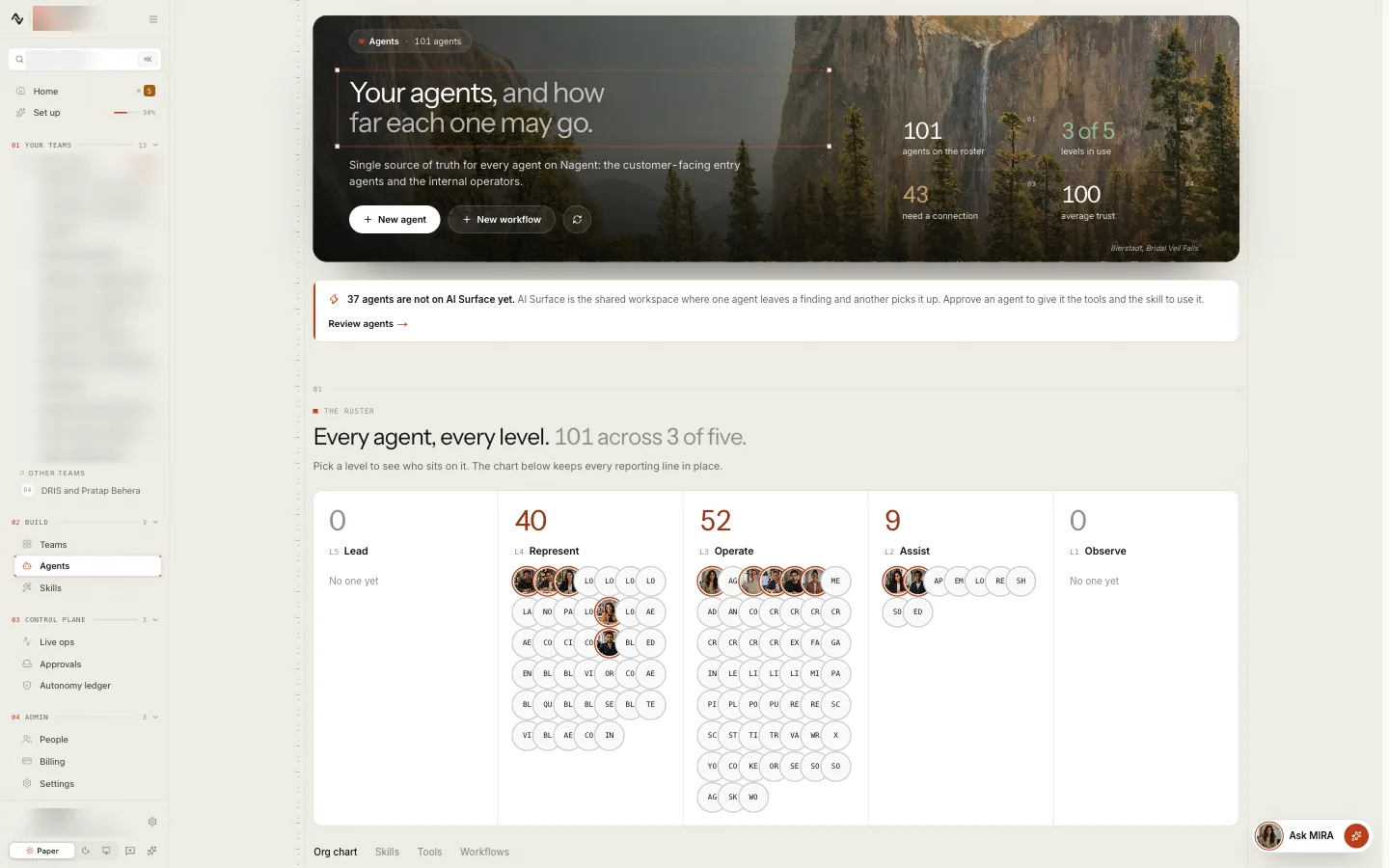
Reading the top of the screen
+ New agent opens the agent builder, and New workflow starts a workflow. See creating an agent.
A notice may say that some agents are not on AI Surface yet. AI Surface is the shared space where one agent leaves a finding and another picks it up. Press Review agents, then Approve beside an agent to give it the tools and the skill to use it. What an agent writes there shows on its team's board, in the room's Team surface tab, and the team chooses whether each type shows as a list, a calendar, a checklist or KPI cards. See boards and surface views.
The ladder counts your agents at each level, from L1 Observe to L5 Lead. Press a level in the row of chips under it to pick out the agents at that level. The other rows stay in place, dimmed, so every lead is still visible. Press All to clear it. For what each level means, see autonomy and governance.
Under the ladder are four tabs.
| Tab | What it holds |
|---|---|
| Org chart | Every agent, in the department and under the lead it works for |
| Skills | Your skill library, and which agents use each skill. See skills |
| Tools | Your tool library. See tools and integrations |
| Workflows | Multi-step runs that hand work from one agent to the next |
Reading the org chart
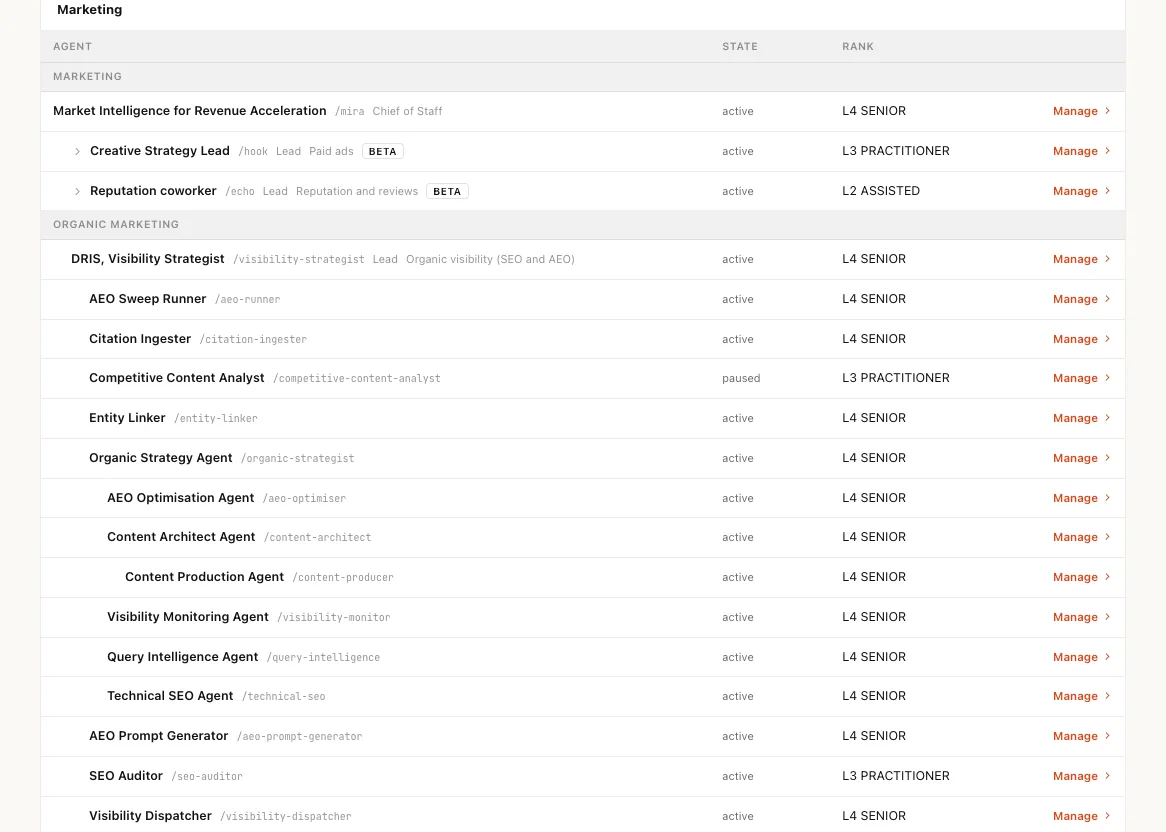
The chart is grouped the way your company is: Platform agents, Marketing, Sales, Content, Custom agents, and Other for an agent on the roster that is not yet seated in a department. Inside a department, the chief of staff comes first and each lead follows, with the agents that work for that lead under it. A lead with agents under it has a chevron to show or hide them.
Each row shows:
| Column | What it shows |
|---|---|
| Agent | Its name and its key, for example /nora |
| State | Its operational state, such as active, paused or unprovisioned |
| Rank | Its level, such as L4 Represent |
| Manage or View | Opens the agent's own page |
Manage means you can change the agent. View means you can read it but not change it, which is the case for platform agents and for a custom agent someone else built.
A seat marked Coming soon is one Nagent has not built yet, and a seat marked Beta is new. A seat reading not on this roster belongs to the department but is not installed in your workspace.
A team lead's row says Lead and what its team does, the same words its room carries: Paid ads for HOOK, Reputation and reviews for Echo, Organic visibility (SEO and AEO) for DRIS. DRIS and the agents that work for it sit in their own group inside Marketing, Organic marketing, each nested under the agent it reports to.
The kinds of agent you will see
- Your teams' agents. The agents a prebuilt team seated when you installed it, such as NORA, DEXA and RIVA on Sales. See the Sales team.
- Platform agents. Agents Nagent maintains, such as the builders and the industry strategists. The chart says it plainly: every workspace runs the same copy at L3 and nobody but Nagent edits it. You can still pause one.
- Custom agents. Agents built in your workspace. With permission to manage agents, you can remove one with the bin icon, Delete custom agent.
Below the chart, Available to install lists teams published by Nagent that your workspace does not have yet, each with its agents and an Install button.
An agent's own page
Press Manage or View on any row. The top of the page shows the agent's name and description, and these controls:
- Pause switches the agent off at once, and Activate switches it back on. A paused agent takes no action with a side effect.
- Sandbox opens a test where you give it a sample input and read what it would do.
- The tiles: Status, Autonomy, Trust, Runs · 24h, Risk and Cost per run.
- Promotion review moves the agent one level up and Change level moves it one level down, each with a reason that goes on its permanent history. A button is hidden at the top or bottom of the ladder, on platform agents, and when your role cannot change levels. See autonomy and governance.
- Stop agent, under the header, is a recorded stop: you give a reason, which goes on the agent's permanent history, and new runs are refused. The agent keeps its level, skills and memory. If your role does not carry the permission it needs, the dialog says so; Pause still works.
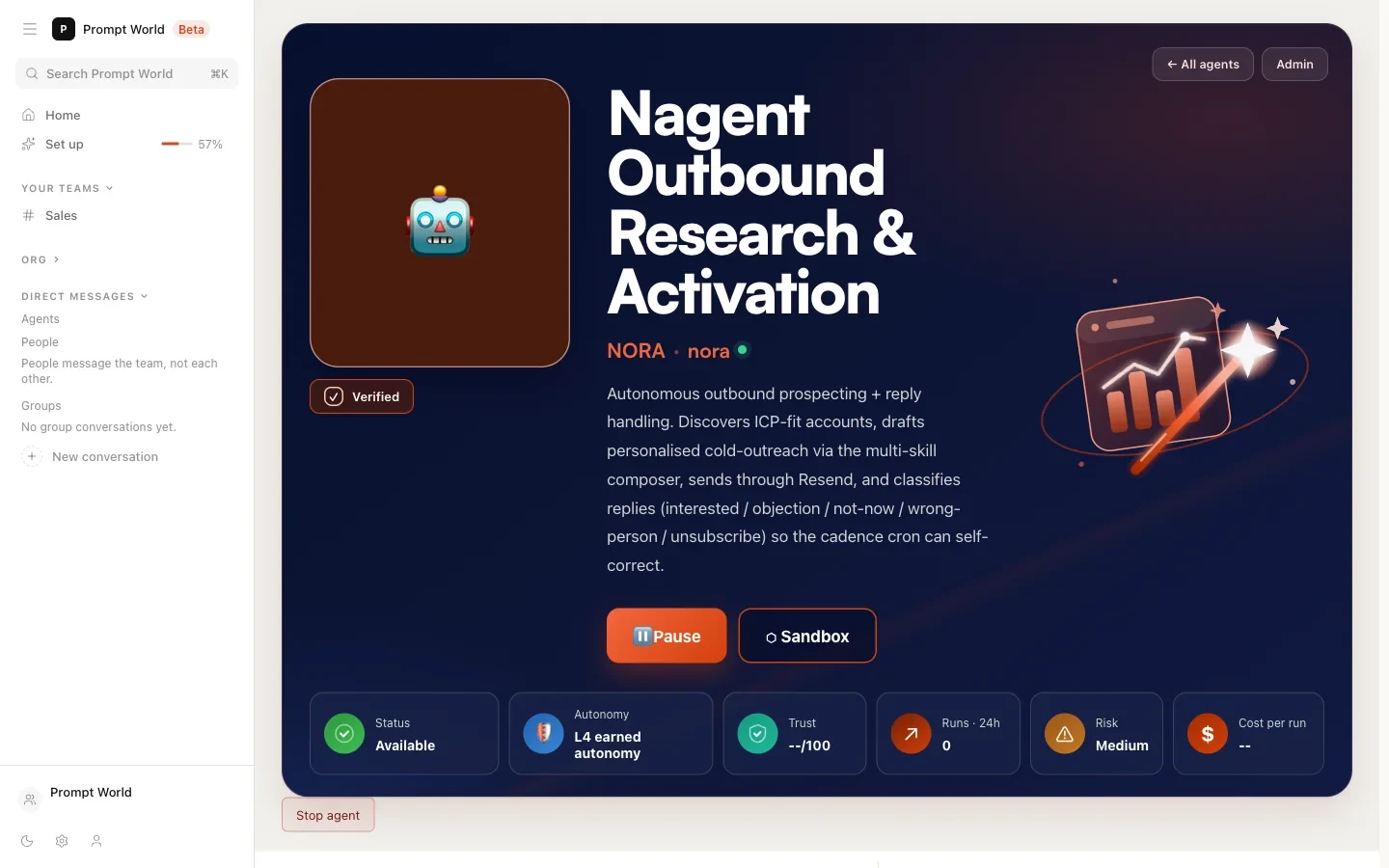
A platform agent's page carries the line Maintained by the platform, and its set-up cannot be changed there.
The tabs on an agent's page
| Tab | What it holds |
|---|---|
| Profile | What the agent is for, its capabilities, its parts, and a read-only Surfaces card listing the artifact types it may write and how many it has written |
| Configuration | Its instructions and how it is governed (see below) |
| Sandbox | A one-off test with a sample input |
| Live feed | Its recent activity, with links to past outputs |
| Advanced | Further pages for this agent, including Autonomy & state, Trust detail, and an actions table whose Auto floor column gives each action's class and the level that runs it on its own |
| Settings | Switch it on or pause it, and its display name |
| Skills | The skills it may use |
| Tools & Integration | The tools it may use |
| Guardrails | The rules it checks before acting |
| Policies | Which of its actions need approval, and its hard limits |
| Budget | Its daily and monthly caps |
Configuration is where most of an agent is set. It is grouped into cards:
- System prompt and Identity: its instructions, tagline and description, and Published, which lets other people in your workspace run the agent without being able to edit it.
- Governance: its model, autonomy level, risk level and allowed tools.
- Hierarchy & Handoff: who it reports to, who it hands work to, and the rules for handing off.
- When this agent starts working: its schedule, the events that start it, and any start condition.
- Approval authority: the people who can overrule its verdicts.
- Learning mode: whether it learns continuously, or only inside a training window in which a person decides every case.
- Surfaces: which AI Surface artifact types the agent may write: finding, analysis, plan, draft and result. Each type shows how often the agent has written one. Remove a type and, once saved, the agent's write tool for it is withheld and its next attempt is refused; + Add artifact type… puts one back. How a type renders on the team's board is set on the board, not here. See boards and surface views.
Changes are held in a save bar at the bottom of the screen until you save them. The bar counts them and names the parts they sit in, for example "1 unsaved change, in surfaces", and Save writes them together. The Surfaces card has no save of its own.
Budget shows spend today and this month against the caps, and Edit caps sets them and what happens when one is reached. See credits and budgets.
An agent's triggers
Triggers on an agent's page lists what starts that agent on its own: a schedule, an event, or a delivery from a connected tool or an outside service. Press New trigger, pick a Kind, give it a Label, an Action key and a Rate limit (per hour), and press Create.
Each fire of an agent's trigger starts a room job: one piece of background work for that agent in its team room, which the room's lead reviews before posting the result in the thread. The action key is still asked for, but the job does the work, so what it does is the text you give it. See long-running work for how a job runs and the limits it runs under.
Runs as a room job
Every trigger has a Runs as a room job switch, and it is the only thing that decides whether a fire starts work. The line under it says what it does in the state it is in:
- On: "On: each fire starts a room job for this agent in its team room. The room lead reviews the work and posts the result in the thread."
- Off: "Off: a fire records a skip and starts nothing."
The switch is off on a new trigger until you turn it on. Every agent trigger saved before this release, schedules included, starts with the switch off. It starts nothing until an admin opens its settings and switches it on.
Room job settings
A saved trigger has Room job settings under it. Closed, the line names the room and reads runs as a room job or room job off. Open, it holds three settings, saved together with Save:
| Setting | What it does |
|---|---|
| Team room | The room the job runs in. The agent's own room is the default |
| What the job does | The work, in a sentence, up to 2,000 characters |
| Runs as a room job | The switch above |
For example, a Prompt World schedule for DRIS might say "Check our AI visibility this week and say what changed". Leave What the job does empty and the job is asked to do the scheduled work the label names and report what it found or did. When an event or a webhook starts the job, what it delivered is added to the task, or named as too large when it is over 4,000 characters.
If the room you picked is removed, the job runs in the agent's own room.
A schedule shows when it runs next, in its own time zone, for example Next run: Mon 12 Oct, 09:00 IST.
What the room sees
When a fire starts a job, the room's lead posts a note in the thread:
Scheduled job from "Weekly AI visibility check":
- DRIS: Check our AI visibility this week and say what changed
Follow it on its card below. When it finishes I review what it found and post the result here.
The job then runs on its own card, like any job the lead starts.
Testing with Fire
Fire on a trigger fires it once, now, and says what happened:
| Message | What it means |
|---|---|
| "Started a room job. Follow it in the team room." | The job is running |
| "Recorded a skip and started nothing, because "Runs as a room job" is off for this schedule." | The switch is off |
| "Started nothing: this agent's work needs a person's approval first. The reason is in Recent fires." | The agent's own gate held the work for a person |
| "Started nothing: the workspace is at its limit of running room jobs, or this schedule at its hourly limit." | Too many jobs are running, or the rate limit is reached |
| "The room job did not start. The reason is in Recent fires." | Something else stopped it |
Pause stops a trigger firing until you press Resume, and Delete removes it.
Reading Recent fires
Recent fires lists each fire with its time and outcome, and why it started nothing when it did not:
| Reason | What to do |
|---|---|
| this schedule does not run as a room job | Switch on Runs as a room job |
| no team room for this agent | Pick a Team room |
| the team room has no lead to review the job | Pick a room that has a lead |
| this workspace already has 4 room jobs running | Wait for one to end |
| the agent's work needs a person's approval first: ... | Read the gate's reason, after the colon |
Kinds of trigger
- cron runs on a schedule. Type a Cron expression (5-field), pick a Timezone, or start from one of the Quick presets.
- event runs on a named event. See triggers and webhooks.
- composio-webhook runs when a connected tool reports an event. Type
the App, for example
slack, and, if you want one event only, the Event (optional). "Leave the event empty to run on any event from this app." The app name ignores capitals. - external-webhook runs when an outside service posts to your
workspace. Type the Source, the name after
webhook:in that service's secret. The link Your webhook URL and secret are in Trigger settings opens Settings, Triggers. - mcp-tool runs only when an approved MCP client calls it with one of your workspace's MCP tokens; see MCP client tokens. It has no fields of its own, so any client whose token may Fire a trigger can call it. No schedule or event ever fires it.
Chains (Beta)
Under the triggers, Chains lists what this agent starts and what starts it: Starts after this agent for the next step, Starts this agent for the one before. "A chain starts the next agent or workflow when this work is accepted in its room. At most 3 steps run in one chain." Each chain has an On or Off switch; a chain that starts a workflow says "Switch it on the workflow page". With none, the pane says how to make one: say it in a team room, such as "when DRIS finishes, have HOOK draft the ads", and approve the lead's card. See workflows in a room.
Workflows
A workflow is a run of several steps that hands work from one agent to the next. The Workflows tab lists every workflow in your workspace, each with its status, such as draft or published, its version and when it last changed. The same list is on Workflows in Build AI Team.
Prebuilt workflows
The DRIS team, HOOK team, MOXA team, Echo team, NORA team and Content rooms come with 5 or 6 workflows each, published in your workspace when the room is added, so they are on this list too. You run them from their room, where each one has Run now, Test run, free model and a Keep running switch for its schedule or event. See workflows in a room. Edit one here and your copy stays yours.
Building your own
New workflow at the top of the Workbench opens the tab with its box ready. Describe the job in one sentence, for example "Every Monday, research our competitors and email me a brief", and press Build it. The name comes from your sentence and can be changed later. The editor opens and drafts the steps; nothing runs until you publish.
Once a workflow is published, the editor offers Run and Test run, free model. A test run uses a free model and only reads your workspace's own records, and it takes only workflows whose steps each run one agent. The panel headed Triggers · what can start this sets what starts it on its own: a Schedule, an Event, a Webhook or a Team thread. See triggers and webhooks.
Each schedule, event or webhook on that panel has its own Keep running switch, the same switch as the room card. A schedule that is on shows when it runs next, for example Next run Mon 12 Oct, 09:00 IST. One that is off says "switched off, so the evaluator skips it. Turn it on with the switch on this row". Only a published workflow's schedule can be switched on; otherwise the panel says "This workflow is not published yet, so its schedule stays off. Publish it, then turn the schedule on." A schedule can also be set with a sentence in the room. See workflows in a room.
Our logic
Trust belongs to the agent, not to the workspace. Agents at different levels sit side by side, and a new custom agent can work at a lower level than the lead beside it. So the Workbench puts every agent's level and state on one chart, and every agent's limits on its own page, where a person can read them before handing it work.
Where to go next
- Creating an agent: build a custom agent.
- Autonomy and governance: levels, the Autonomy pane and what always asks first.
- Earned Autonomy: every action Nagent ships, listed by class.
- Credits and budgets: caps per agent.
- Boards and surface views: what an agent writes to the AI Surface and how the team's board shows it.