
Agentic Marketing Platform Use Cases in B2B SaaS
Which agentic marketing platform use cases are most common in B2B SaaS? There is no reliable industry survey to rank them, but the same six come up when SaaS teams decide where to start: signal-based outbound and account research, answer engine visibility for comparison queries, content built from product knowledge, product-qualified lead routing, paid search, and CRM hygiene. Each is repetitive, measurable and easy to review. This guide explains why each comes first, and what Nagent does for each on Nagent for SaaS.
What is an agentic marketing platform?
An agentic marketing platform runs AI agents that do marketing and growth work, not just suggest it: they research, draft, audit and prepare campaigns, then hand the result to a person to approve. The difference from a writing tool is that an agent carries a task through several steps, uses connected tools and reports what it did.
For a B2B SaaS team, that matters because most growth work is a loop: find the right accounts, say something relevant, show up where buyers research, and keep the record clean enough to learn from.
Why do SaaS teams start with these use cases?
The use cases that come first tend to share four traits:
They repeat. Account research, comparison pages and campaign builds happen every week.
They have a clear output. A dossier, a draft, a proposed fix or a paused campaign is easy to check.
They have a number. Qualified meetings, AI answer share, organic sign-ups or cost per lead.
A person can review them before they reach a buyer. That keeps the risk low while the team learns what the agent gets right.
Here is how the six map to Nagent today.
Use case: Signal-based outbound and account research, Why teams start there: Research is slow by hand, and relevance wins replies, Nagent teammate: NORA, with VANI writing first touch, Status: NORA Live, VANI Beta
Use case: AEO for comparison queries, Why teams start there: Buyers ask answer engines to compare vendors, Nagent teammate: DRIS, Status: Live
Use case: Content from product knowledge, Why teams start there: Docs-led content is hard to staff, Nagent teammate: CREA, with FOLIO for long form, Status: Live
Use case: PQL routing, Why teams start there: Product signals go unread by sales, Nagent teammate: No prebuilt teammate; build it, Status: Not prebuilt
Use case: Paid search, Why teams start there: Campaign builds and changes are repetitive, Nagent teammate: NIA (Google Ads), Status: Live
Use case: CRM hygiene, Why teams start there: Bad records break every other loop, Nagent teammate: CORA's CRM; RIVA, Status: RIVA Coming soon
How do agents run signal-based outbound and account research?
Signal-based outbound means writing to an account because something changed, such as a hiring push, a launch or a funding round, rather than because it fits a list. It works when each email names the reason, which means someone has to find and check that reason for every account. That research is where teams start.
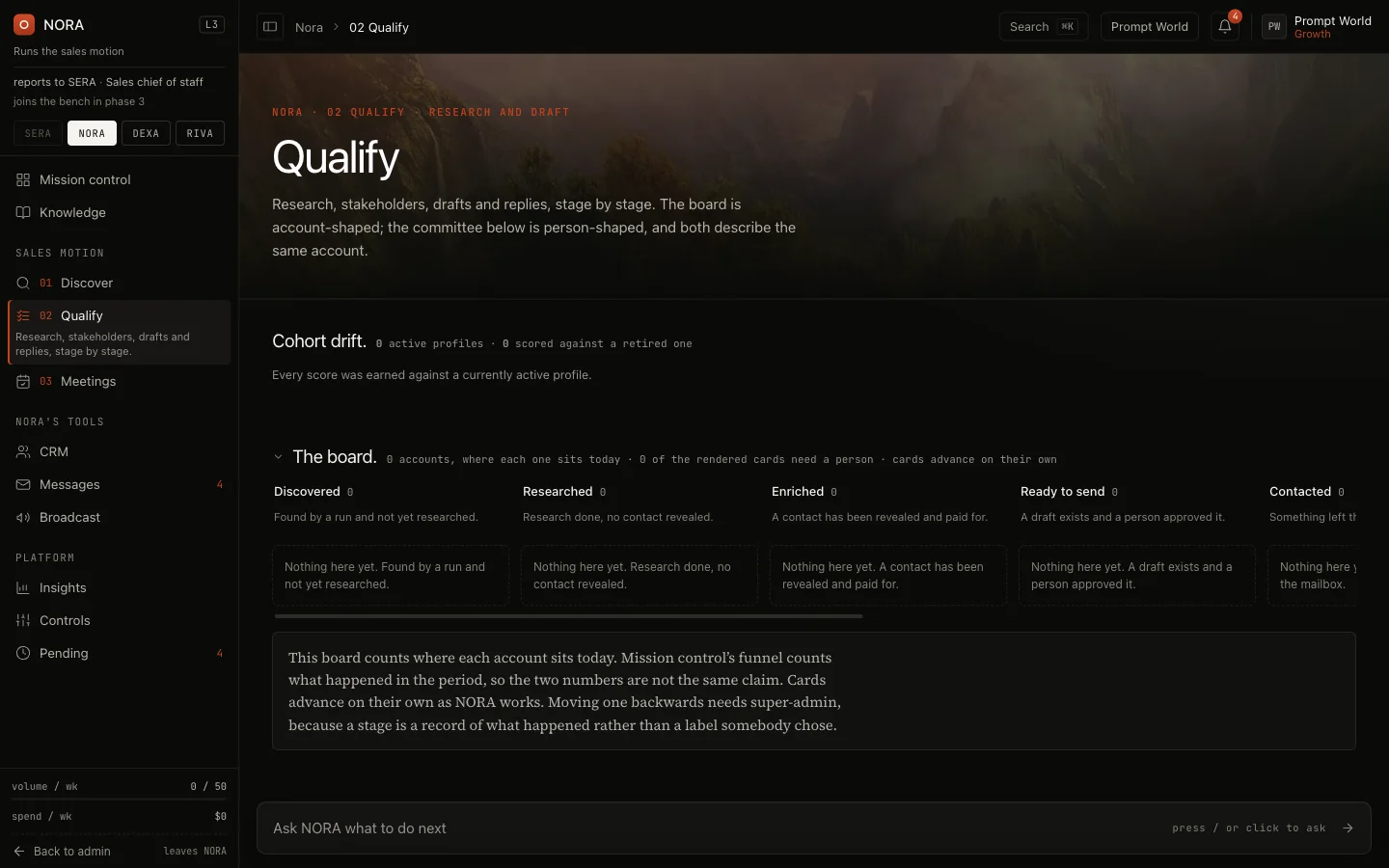
On Nagent, NORA, the AI Outbound Research Lead under SERA, finds companies that fit your active customer profile, scores each one and researches it into a sourced dossier. Her Prospects view shows what surfaced each company and why now, and a signal older than thirty days is not treated as a reason to write. Contact details are revealed only for a company that scores seventy or more out of a hundred against your profile.
VANI (Beta) writes NORA's first-touch emails from the dossier and your own knowledge. A saved campaign can run on a schedule, but every send waits for a person's approval on a new workspace, and approving a draft does not send it.
How do agents win comparison queries in answer engines?
SaaS buyers ask answer engines things like "product A vs product B" or "best tool for this job for a mid-sized team". Those questions come late in the buying process, and the answer often cites a handful of sources. Being one of them is answer engine optimization (AEO).
DRIS leads organic visibility on the Marketing team and reports to MIRA, the AI Marketing Chief of Staff. He asks ChatGPT, Claude, Gemini, Perplexity and Grok the questions your buyers ask, with each prompt tagged by intent, including comparison, integration, pricing and vendor evaluation. He records whether each answer cites your site and which sources it relies on, and proposes fixes such as titles, structured data, FAQs and direct answers. Publishing a change to a live page needs a person at every level. Content gaps go to CREA's content team as tasks.
How do agents turn product knowledge into content?
SaaS content is only useful when it is accurate about the product, and the people who know the product are rarely the ones with time to write. That is why content from product knowledge is an early use case.
CREA, the AI Content Chief of Staff, leads a team that researches, drafts, edits, reviews and illustrates a blog post from your own sources: the brand profile, your products and services, matching Knowledge Hub passages and the brand book. Nothing goes live until a person approves it, and an editorial check runs at publish. For long form, FOLIO turns the source documents you pick into an illustrated publication as PDF and DOCX, with comparison and listicle among its book types.
Can agents route product-qualified leads?
This is where to be careful. Product-qualified lead (PQL) routing means scoring accounts on how they use your product, such as activation, seats added or a feature adopted, and sending the qualified ones to the right owner with the usage that qualified them. Many product-led SaaS teams want it, because product signals often sit in an analytics tool that sales never reads.
Nagent has no prebuilt teammate that reads product usage and scores PQLs today. What exists is nearby:
Lead routing in CORA's CRM. A lead that arrives from your forms or chatbot is given an owner automatically: the member with a sales or admin role who has the fewest open leads. Hot-lead rules set the minimum intent, the ICP bands and the reply window that make a lead show as hot. See CORA's CRM.
A way to build it. A signed webhook from your product can start a workflow, and a Connector can give an agent the operations of your own API. See triggers and webhooks and creating an agent, which starts from one sentence in Agent Workbench.
If PQL routing is your first priority, plan it as a build, not a switch you turn on.
How do agents help with paid search?
Paid search for SaaS is full of repetitive work: building campaigns from a brief, adding negatives, adjusting bids and budgets, rewriting ad copy. It also spends money, so every change needs control.
NIA, the performance marketing lead on the Marketing team, drafts Google Ads Search, Shopping, Display, Video and Performance Max campaigns from a brief. Her live changes cover pausing and resuming, budgets, bids and targets, keywords and negatives, ad copy and location targeting. Campaigns arrive paused, every live change queues for a person, and for a leads or sales objective she will not build without an enabled conversion action. Meta ads and ChatGPT ads are in Beta.
How do agents keep the CRM clean?
Every other use case depends on the CRM. Outbound needs to know who is already a customer, routing needs owners, and reporting needs stages that reflect reality. CRM hygiene is unglamorous, which is why teams hand it to agents early.
On Nagent, reps and agents work the same record in CORA's CRM: the same lead, the same stage and the same email thread, and when an agent moves something the record says so. NORA counts a lead only when the four qualification questions are answered with evidence, so unqualified people stay out of the book. SERA, the AI Sales Chief of Staff, answers pipeline questions from the CRM and says what is missing rather than inventing a number. RIVA, the revenue operations seat that flags deals whose stage has not moved, is Coming soon.
How should a SaaS team choose where to start?
Pick the use case closest to the number you are measured on this quarter, and where a person can review every output before it reaches a buyer.
Pipeline short? Start with account research and outbound.
Losing deals at the comparison stage? Start with AEO.
Content backlog growing? Start with content from product knowledge.
Product-led motion with unread usage data? Scope PQL routing as a build.
Run one use case for a few weeks, read what the agent produced, and widen its remit only when the drafts are coming out right.
Frequently Asked Questions
What are the most common agentic marketing use cases in B2B SaaS?
The ones SaaS teams usually start with are account research and signal-based outbound, AEO for comparison and category queries, content from product knowledge, PQL routing, paid search and CRM hygiene. No sourced survey ranks them, so choose by the number you own.
Do agentic marketing platforms send emails on their own?
They can, but they should not start that way. On Nagent, every send NORA makes waits for a person's approval on a new workspace, and approving a draft does not send it.
Can AI agents do PQL routing?
Agents can route leads if they can read product usage. Nagent has no prebuilt PQL teammate today; a team can build it with a webhook-started workflow and a Connector to its own API.
Which agentic use case shows results fastest?
The one with the shortest feedback loop for your team. Outbound research produces reviewable dossiers quickly, while AEO and content need weeks of measurement before a trend is clear.
Start with the use case closest to your number
The agentic marketing use cases B2B SaaS teams start with are the repetitive, measurable ones a person can review: research, outbound, AEO, content, paid search and the CRM underneath them. Start with one, keep approval on anything that reaches a buyer, and widen from there. Nagent for SaaS shows how the teams fit together.
Book a demo to see which use case fits your team first.