
Can AI Agents Be a Growth Channel for SaaS? Yes, Two Ways
Can AI agents be a growth channel for SaaS? Yes, in two senses. First, answer engines and the AI agents buyers use to research software now sit between a buyer and your website, so being cited and legible to agents is a discovery channel in its own right. Second, AI agents can run growth work for you. The first is the bigger shift, and most of this guide is about it, with DRIS as an example of measuring it.
What does it mean for AI agents to be a growth channel?
A growth channel is any route by which buyers find you, try you and buy. For most SaaS companies that has meant search, paid ads, outbound, partners and word of mouth. AI agents add a route on two fronts:
Agents as the place buyers look. A buyer asks ChatGPT, Claude, Gemini, Perplexity or Grok which tools fit their problem, or asks an agent to compare three vendors and shortlist one. The answer names some products and leaves others out. If yours is left out, that buyer may never reach your site.
Agents as the people doing the work. Agents research accounts, draft content, audit pages and prepare campaigns, with a person approving what goes out.
The first is a channel you earn, like organic search. The second is a way of running every channel.
How do buyers use answer engines and agents to find SaaS products?
The questions that used to go into a search box now often go into a chat. They are longer and more specific: "which CRM works for a ten person sales team that sells to hospitals", "what is the difference between product A and product B", "does this tool integrate with our data warehouse". The answer engine reads sources, writes an answer and cites some of them.
Three things follow for a SaaS company:
The shortlist forms before the visit. A buyer can arrive having already read a summary of your category and your competitors.
Comparison and integration questions matter most. They come late in the buying process, when a buyer is choosing, and answer engines lean on pages that answer them plainly.
Agents read more than people do. An agent asked to evaluate vendors may fetch your pricing page, your docs and your security page, and judge you on what it can parse.
No reliable industry figure tells you how large this channel is for your category. The honest way to size it is to measure it for your own prompts, which we cover below.
What makes a SaaS company visible to answer engines?
Answer engine optimization (AEO) is the work of getting answer engines to cite your brand for the questions your buyers ask. For SaaS, the pages that tend to earn citations are the ones that answer a buying question directly:
Comparison and alternative pages. Honest, specific pages on how you differ from named alternatives, with the trade-offs stated.
Integration pages. One page per integration, saying what connects, what data moves and what the setup takes.
Use case pages. Pages written for a job to be done, not just a feature list.
Docs and help content. Public, crawlable documentation is often the most precise description of what your product does.
Pricing that can be read. A plan table in plain HTML, not only inside an image or a calculator.
A direct answer near the top. The first paragraph of a page should answer the question its title asks, because that is often the passage an answer quotes.
Structured data and FAQs. Schema markup and question and answer sections make a page easier to parse and quote.
None of this is new to good SEO. What changes is the bar for clarity: an answer engine quotes the page that says the thing plainly.
What does it mean to be legible to an agent?
Legible means an agent can fetch your page, read it and understand it without a person's help. A page that loads its text only through scripts, hides answers behind a form or describes the product only in marketing language is hard for an agent to use, however good it looks.
Practical checks:
Can crawlers reach the page? Your robots rules and your hosting should let answer engine crawlers fetch the pages you want cited.
Is the text in the page? The key facts should be in the HTML, not only in images, videos or client-side widgets.
Is there a map for agents? The llms.txt proposal suggests a small markdown file at your site root that gives agents a concise guide to the site, with links to more detail.
Are the facts consistent? If your pricing page, docs and comparison pages disagree, an agent may quote the wrong one.
DRIS measures this directly: one of the six dimensions he scores per target is "whether the page is legible to an agent at all", beside coverage, share of voice, entity strength, recommendation position and sentiment.
Should a SaaS product offer an API or MCP server for agents?
Being read is the first step. Being callable is the next. As buyers and their teams work through agents, some will want those agents to use your product directly: to pull a report, create a record or start a job. The Model Context Protocol (MCP) is an open-source standard for connecting AI applications to external systems, and offering an MCP server alongside a documented API is one way to make a product usable from inside the agents people already work in.
Nagent does this for its own product. Its developer docs describe a REST API, an MCP server that works with clients such as Claude Code and Cursor, and signed webhooks for events like a run finishing or an approval being requested. Runs started from outside are governed as they are inside Nagent, with the same knowledge, tools, autonomy level and approvals. API keys are in Beta and start on the Team plan.
To be clear about scope: those tools let you run your Nagent agents from your own code. Nagent does not build an API or an MCP server for your product. That is your engineering team's work, and it is worth doing once the read side is in order.
How do you measure AI agents as a channel?
Treat it like any other channel: fix what you measure, take a baseline and track change against it.
A fixed prompt set. Write the questions your buyers ask, grouped by intent, and ask them the same way every time. A trend means nothing if the questions keep changing.
Citation share against named competitors. Count how often answers cite you versus the alternatives you lose deals to.
Recommendation position. Being mentioned last in a list of eight is different from being recommended first.
Visits from answer engines. Your analytics can split out sessions referred by answer engine domains.
Agent fetches. Your hosting or CDN logs show when an engine fetches a page while someone is asking, which is a different signal from an indexing crawl.
Can AI agents also run the growth work?
Yes, and this is the second sense of the question. On Nagent, AI teammates do the work under people who approve it. DRIS finds visibility gaps and proposes fixes. NORA finds accounts that fit your customer profile, researches each into a sourced dossier and drafts the first email, and every send waits for a person's approval on a new workspace. CREA, the AI Content Chief of Staff, leads a content team that drafts posts from your own knowledge and publishes only when a person approves.
The approval matters: an agent that writes to buyers speaks for your company.
How does DRIS measure the agent channel?
DRIS leads organic visibility on Nagent's Marketing team and reports to MIRA, the AI Marketing Chief of Staff. He asks ChatGPT, Claude, Gemini, Perplexity and Grok the questions your buyers ask, records whether each answer cites your site and which other sources it relies on, and keeps the prompt set fixed per account so a trend means something.
Prompts by intent. Each prompt carries its intent, including comparison, integration, pricing and vendor evaluation.
Search and traffic. DRIS reads Google Search Console and Google Analytics 4, and Traffic splits out the visits answer engines send.
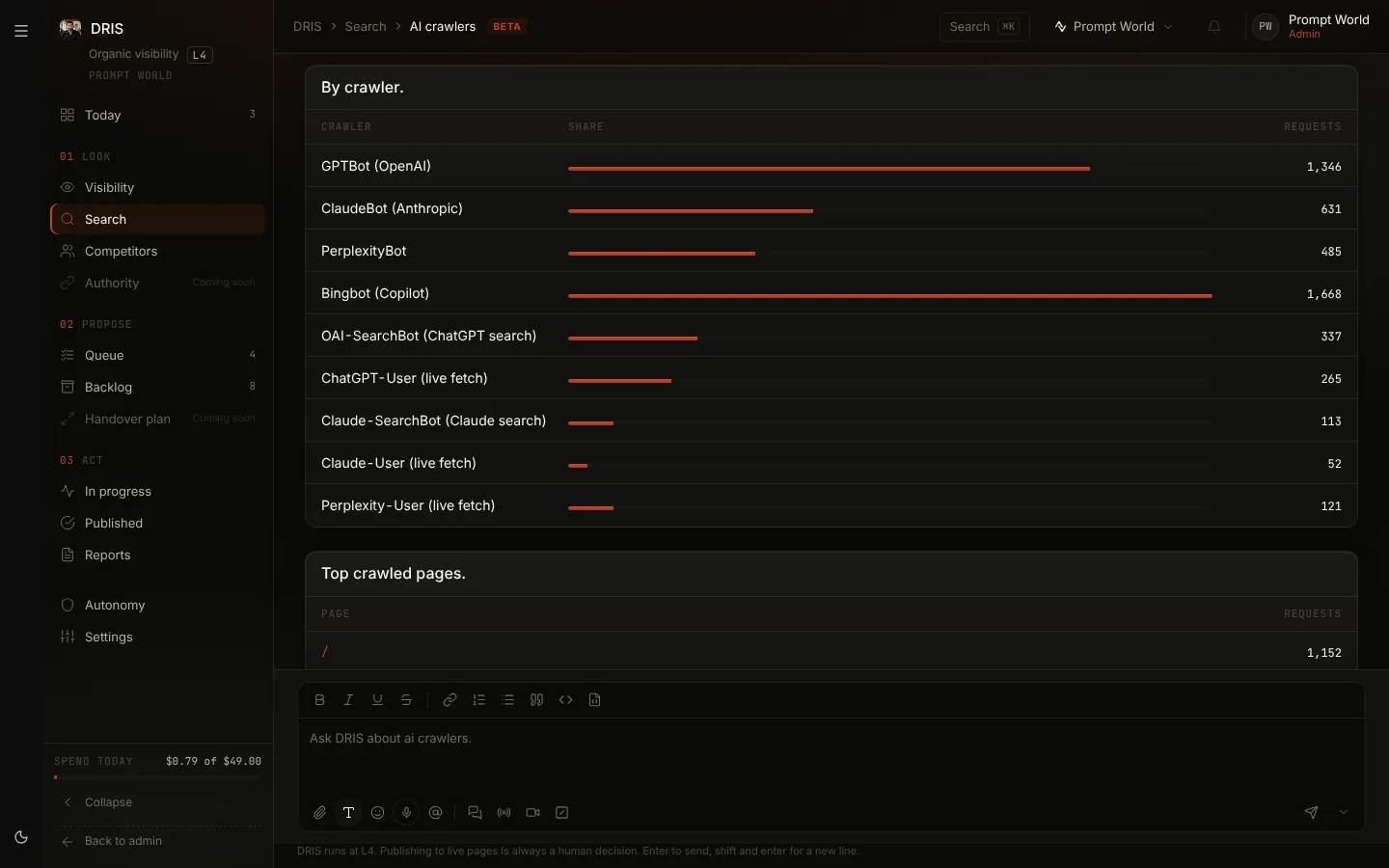
AI crawlers. With your hosting or CDN analytics connected (Nagent's team switches this on), DRIS separates the fetches an engine makes while someone is asking from its indexing and training crawls.
Fixes you approve. Titles, descriptions, headings and structured data, plus FAQ, direct answer, schema and llms.txt fixes, arrive as proposals with their reason. Publishing a change to a live page needs a person at every level.
The DRIS guide walks through the setup.
Frequently Asked Questions
Are AI agents a real growth channel for SaaS?
Yes. Buyers ask answer engines and AI agents which software to consider, and the answers cite some vendors and not others. Whether it is a large channel for your category is something to measure with a fixed prompt set, not assume.
What is the difference between SEO and AEO for SaaS?
SEO aims to rank pages in search results. AEO aims to be cited and recommended inside AI answers. They share most of the groundwork, but AEO puts more weight on direct answers, comparison pages and text an agent can parse.
Do SaaS companies need an MCP server?
Not to be cited. To be cited, you need clear, crawlable pages. An MCP server or API helps when buyers want their agents to use your product directly, so it is the next step after your pages are legible.
Can AI agents run SaaS growth work on their own?
They can do much of it, such as research, drafting and audits, but the steps that reach buyers or change a live page should wait for a person. On Nagent, sends and live page changes wait for approval.
Start with the channel you can measure
AI agents are a growth channel for SaaS in both senses: they are where buyers increasingly look, and they can do the work. Start with the first. Make your comparison, integration and docs pages clear, make them legible to agents, and measure your citation share from a fixed baseline. DRIS asks the answer engines your buyers' questions from a fixed prompt set and shows where you are missing.
Book a demo to see DRIS measure your visibility in AI answers.