
What is an agent
What an agent is on Nagent, the parts every agent is made of, when a custom agent is worth building, and what Nagent adds that an agent builder does not.
Browse documentation
An agent is a teammate with a job, a level and a record
On Nagent an agent is an AI teammate that works in your workspace. It has a role, the skills and tools it may use, your knowledge to work from, a memory of what it has done, and an autonomy level that decides how much it may do without asking a person first.
Every agent has its own page in the Agent Workbench. The top of that page says who the agent is and how far it is trusted: its status, its autonomy level, its trust score, its runs in the last day, its risk level and its cost per run.
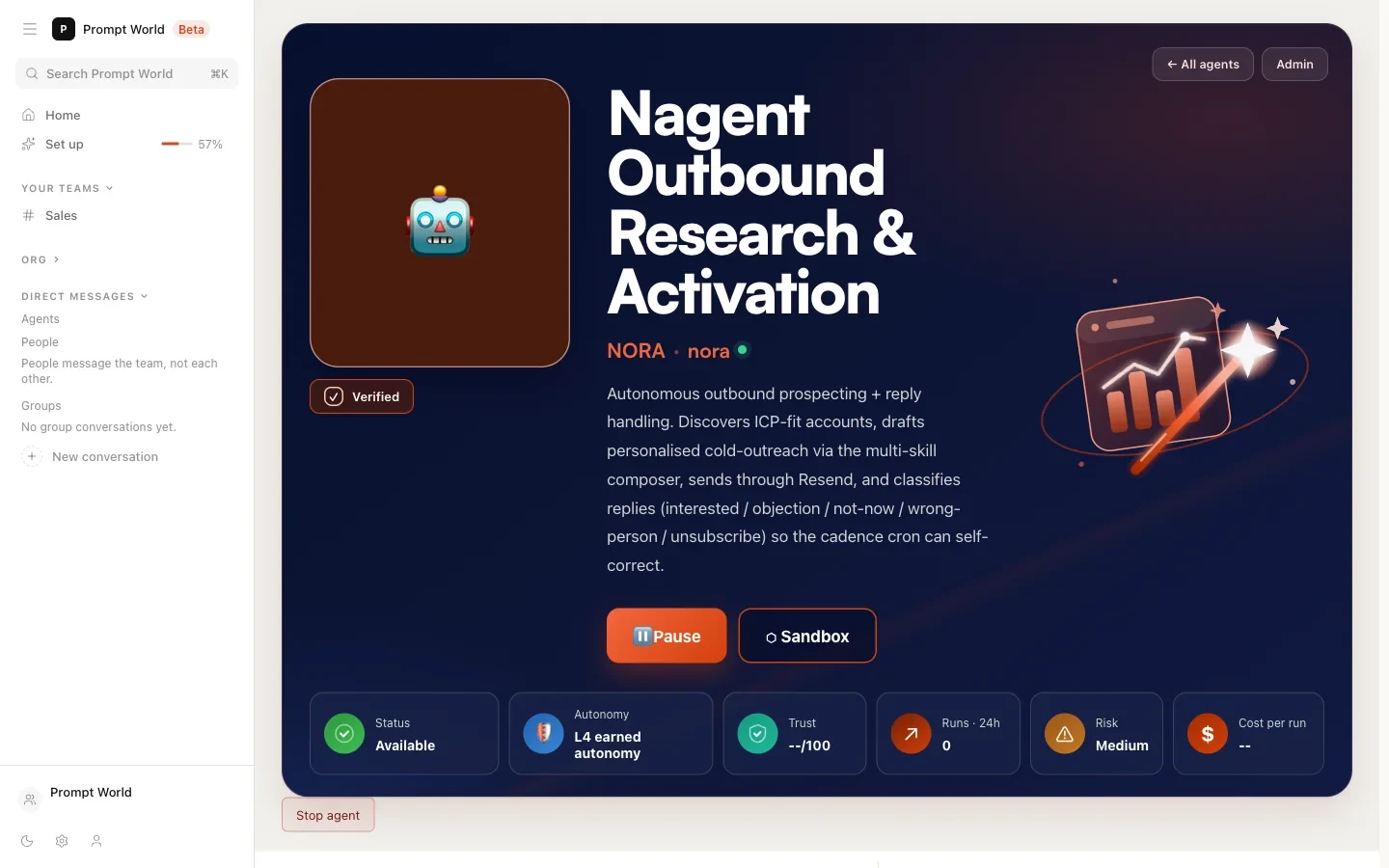
What every agent is made of
| Part | What it is | Where you see it on its page |
|---|---|---|
| Role | A name, a description and a system prompt | Configuration |
| Skills | Written procedures it is allowed to follow | Skills |
| Tools | The outside apps and actions it may use | Tools & Integration |
| Guardrails | Rules it checks before acting | Guardrails |
| Autonomy | Its level, from L1 Observe to L5 Lead | The Autonomy tile |
| Budget | A daily and a monthly spending cap | Budget |
| Reporting line | Who it reports to and hands work to | Configuration |
Three of these deserve a sentence each.
The level belongs to the agent. Every action an agent can take declares the level it needs to run on its own. When the agent's level meets it, the action runs. When it does not, the action waits for a person. A level rises when a person reviews the agent's record and raises it, never because time passed. See autonomy and governance.
The budget is a stop, not a report. Before a paid call, Nagent checks what the agent has left under its caps and refuses the call if it would go over. See credits and budgets.
Every agent has a voice. The agents Nagent ships whose work is their tools, such as the SEO Auditor and the Competitive Content Analyst, write up what their tools return in plain sentences rather than filing data, and answer from what they can read when no tool fits. Their page shows that voice, labelled Platform default voice, until your workspace writes its own prompt for the agent, which then takes its place. See sending a brief for how a written-up result comes back.
Our logic
Most tools define an agent by what it can do. Nagent defines it just as much by what it is allowed to do, and by how that allowance grows. An agent whose limits you cannot see is not one you can hand real work to.
Where agents work
Agents do their work in teams. A team is a room where your people and your agents talk on one record, and an agent answers when someone addresses it. The Workbench counts every agent at its level, so you can see at a glance how much of your workforce acts alone and how much asks first.
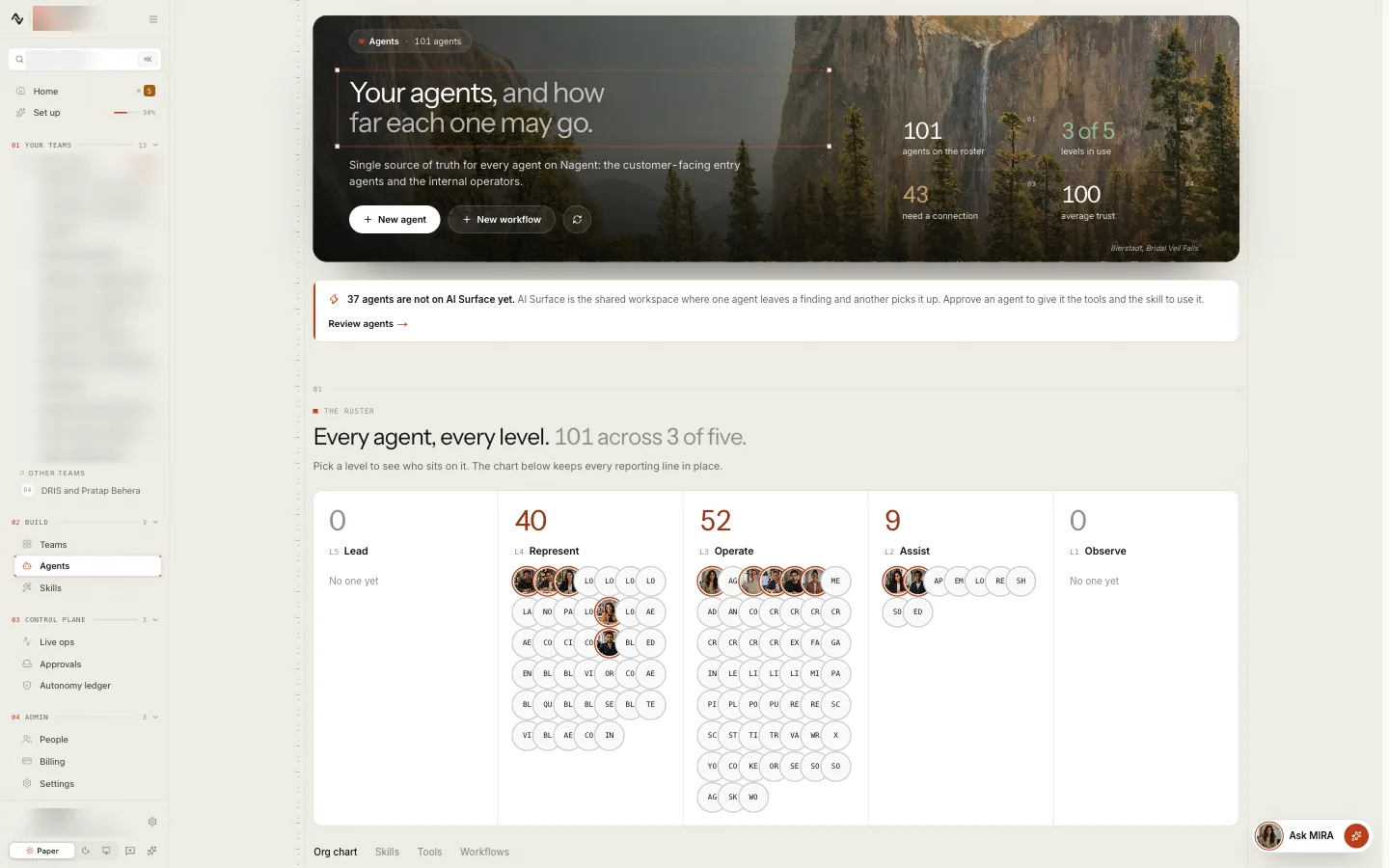
See setting up a team and the team room.
Prebuilt teams first, custom agents for your own work
Nagent's prebuilt teams cover sales, marketing and content. The teams you chose at sign-up are installed with their agents already seated, so for most workspaces they are the place to start. See prebuilt teams.
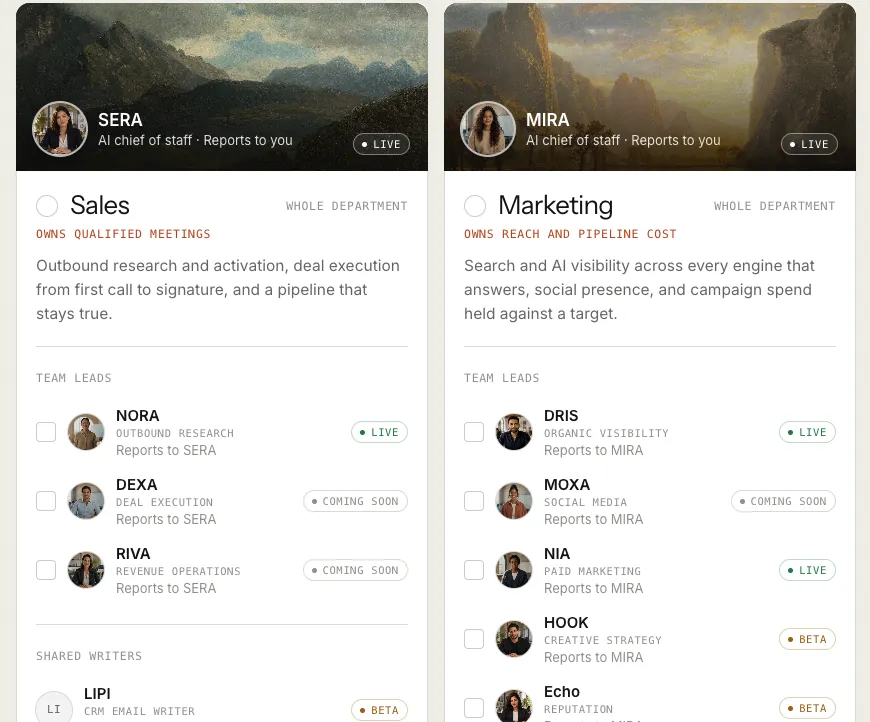
Build a custom agent when the work belongs to your organisation rather than to the function:
- The process is your own. A pricing approval, a compliance check, a quality gate that exists nowhere else.
- The knowledge is internal. Price lists, contract templates or past decisions that no prebuilt agent has seen.
- The tools are yours. The work runs through apps the prebuilt agents do not use.
- The oversight is unusual. Some roles need a lower level or a tighter budget than the defaults.
A prebuilt agent that almost fits is often the better start: change its set-up on its page instead. When Nagent ships a newer version of an agent your workspace runs, its page says so and offers Review and Switch to the new version, so your changes are never replaced without you choosing.
Custom agents are made in Build AI Team. You describe the job, review the draft, and nothing is created until you accept it. You can also ask the chat for a whole team, a lead, its members and a room, built from one approval. See creating an agent.
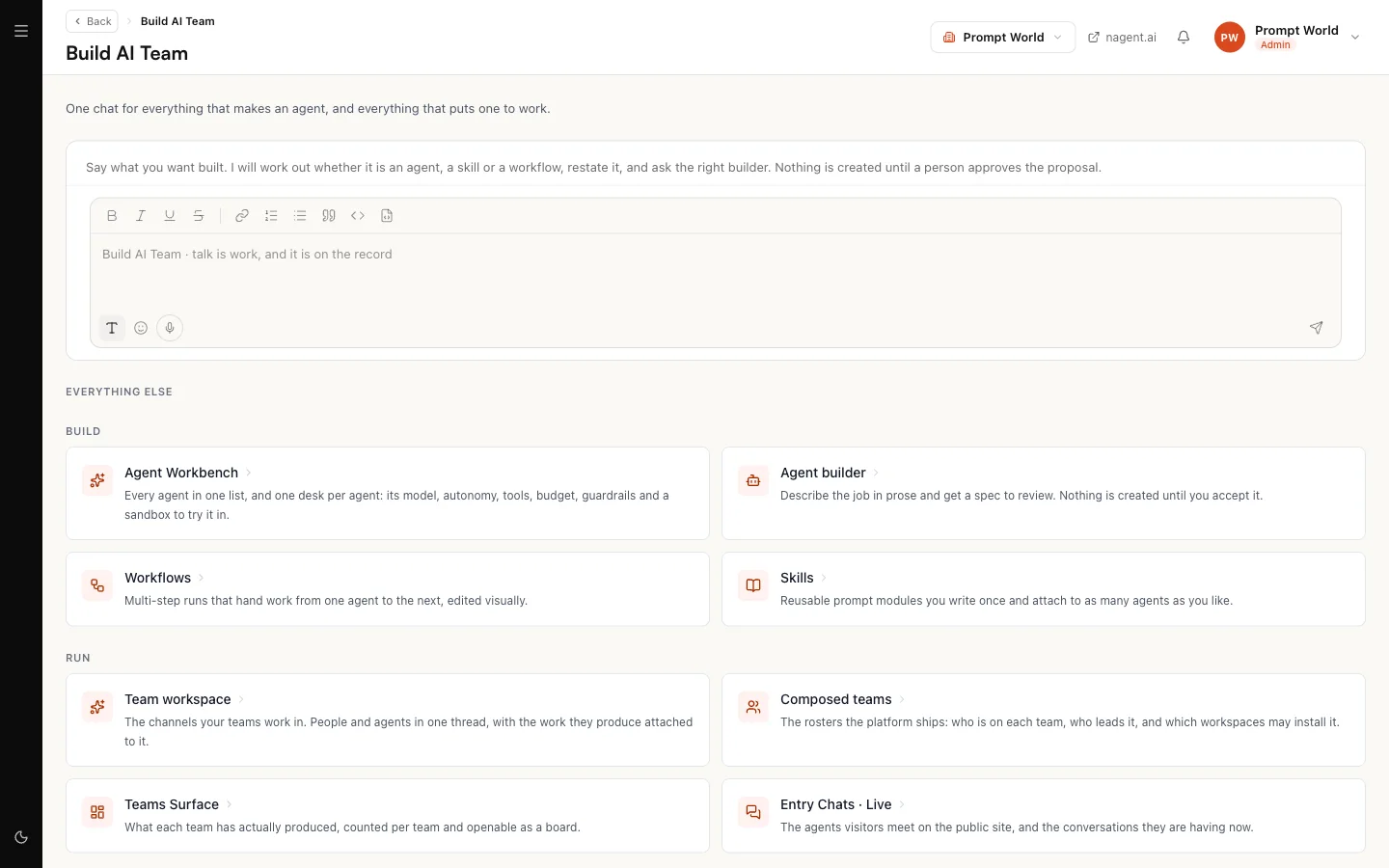
What Nagent adds to an agent builder
Plenty of tools help a developer build an agent. The harder part comes afterwards: running many agents for an organisation, over months, with people who do not write code supervising them.
| Question | On Nagent |
|---|---|
| What may this agent do alone? | Its level, checked on every action |
| How much may it spend? | Its caps, checked before each paid call |
| Who approved that action? | The approval, recorded against the person |
| How do non-developers work with it? | In team rooms, with briefs, a board and approvals |
| How do agents work together? | In teams, with a lead and a reporting line |
Where to go next
- Creating an agent: build one from a sentence.
- The Agent Workbench: every agent, and each agent's own page.
- Autonomy and governance: levels, approvals and caps.