
Signing in
The ways back into your workspace, passkeys, the second step some roles need and how to set it up, remembering a device and removing one, how a self-serve account gets a password, and what an invited teammate does the first time.
Browse documentation
Several ways in, and you only need one
The sign-in page is at nagent.ai/admin/login. It offers these ways in, in this order:
- Sign in with a passkey, on a browser that supports passkeys.
- Continue with Google.
- Email me a sign-in link.
- Your password, under "or use your password".
All of them open the same account. Use whichever suits you; you can switch between them freely.
The sign-in pages show no cookie banner, so nothing covers Sign in. Analytics load here only if you already allowed them on the public site.
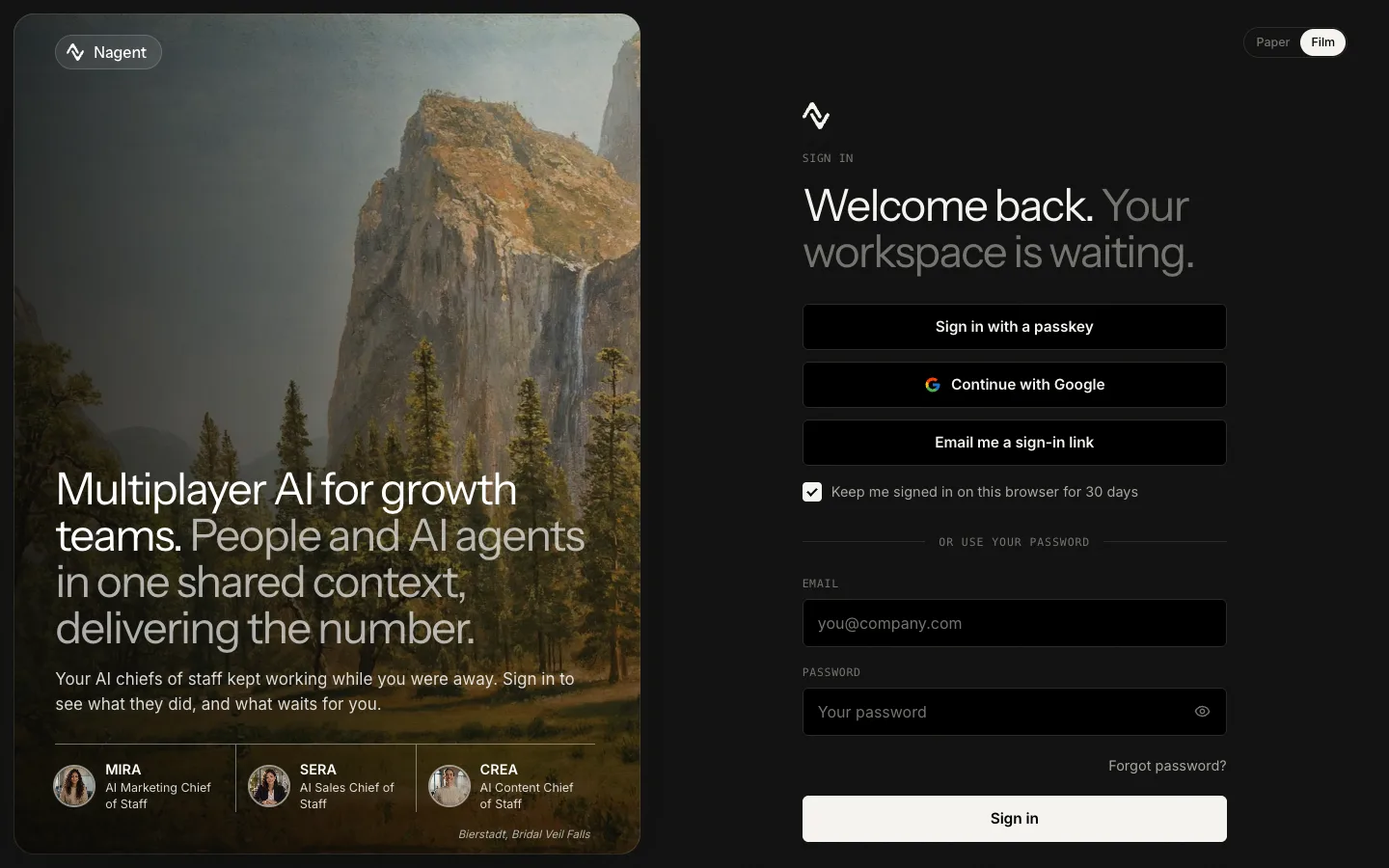
E-mail me a sign-in link
This is the way in that always works, whether or not you have ever set a password.
- Press Email me a sign-in link.
- Type your work e-mail and press Send link.
- The page says "If that email has an account, a sign-in link is on its way. It works once, for 30 minutes."
- Open the e-mail, "Your Nagent sign-in link", and press Sign in to Nagent.
- On the page that opens, press Open my workspace.
The same three rules apply as at sign-up: the link lasts 30 minutes, it works once, and asking for a new one cancels the old one. The extra button press in step 5 is there because e-mail scanners open links on their own, and a link that signed you in on opening would be spent before you reached it.
The page gives the same answer whether or not the address has an account. That is on purpose: the sign-in page must not tell a stranger who has an account with us.
You can ask for a few links an hour. If you ask too often, the page tells you how long to wait.
Sign in with a passkey
A passkey lets your device sign you in: you confirm with your fingerprint, your face or the device PIN, and there is nothing to type. Add one at Two-factor auth with Add a passkey, or when the sign-in page asks you to set up a second step.
Then press Sign in with a passkey and confirm on your device. A passkey counts as both steps of two-factor authentication on its own, so a role that needs a second step asks for nothing more.
A passkey made on a phone or a computer that syncs its passkeys works on your other devices signed in to the same account. You can add several, and remove any of them from the same page.
Continue with Google
Press Continue with Google and pick the Google account whose address matches your Nagent account. You come straight back signed in.
Google is accepted only for an address Google says it has verified. Three things can happen.
| Your Google address | What happens |
|---|---|
| Matches an active Nagent account | You are signed in |
| Has no Nagent account | You are taken to sign-up, with the address filled in |
| Is not verified with Google | You are asked to verify it with Google, or use an e-mailed link |
The Google button appears only where Google sign-in is switched on for the site.
When your role needs a second step
Some roles need two-factor authentication. Google, an e-mailed link and a password prove one thing, so for those roles they lead on to one more step. A passkey proves both and needs nothing more.
- You have a passkey, an authenticator app or text codes. After Google, Slack or the link, the page says Confirm it is you. Press Use a passkey, or type the 6-digit code from your authenticator app and press Sign in, or press Text me a code and type the code we text to your phone, or press Use a recovery code instead. After your password, the same choices appear under the password, with Text me a code instead. Do it within five minutes; after that the page says "That sign-in waited too long for its authenticator code. Start again." and offers Start again.
- You have neither yet. Whichever way you signed in, the page says Add a second step to your sign-in and sets one up there and then. Press Add a passkey, or Use an authenticator app instead and scan the code it shows, or Text codes to my phone and confirm your number with the code we text you. After Google, Slack or a link your workspace stays closed until you finish, and Sign out is the only other way out of the page. After your password you may press Not now for the moment.
The first second step you add comes with ten recovery codes. Save them: each one signs you in once if you lose your device, and they are shown only once. You manage passkeys, the authenticator app and text codes at Two-factor auth.
Text codes
Text codes are the easiest second step if you would rather not install an app, and the weakest: anyone who gets your number moved to their own SIM can receive them. Add a passkey as well if you can.
- Turn them on at Two-factor auth under Text codes, or from the set-up step. Give your mobile number with its country code and type the code we text you. If you verified the same number for Agent N in the last few minutes, one press turns codes on.
- A phone you verified for Agent N is not a sign-in step until you turn text codes on here.
- You have one verified phone across Nagent. Changing it, or turning text codes off, needs a sign-in that passed your second step.
- If another Nagent account verifies your number, it moves to them and your text codes switch off. We e-mail you when that happens.
- Codes go to a limited list of countries for now. When a text cannot be sent, or text codes are paused for the day, use a passkey, your authenticator app or a recovery code.
Your password
Type your e-mail and password and press Sign in. If you have a second step set up, the form then asks for your authenticator code, or offers Use a passkey instead.
A self-serve account has no password yet
If you created your workspace yourself, you signed up with an e-mailed link or with Google, and no password was set. The password form will not work for you until you set one. There are two ways to do it.
- Signed out: on the sign-in page press Forgot password?, enter your e-mail and press Send reset link. Open the e-mail within 30 minutes and choose a password of at least 8 characters.
- Signed in: open Change password and press Email me a link to set a password. The same 30-minute link arrives.
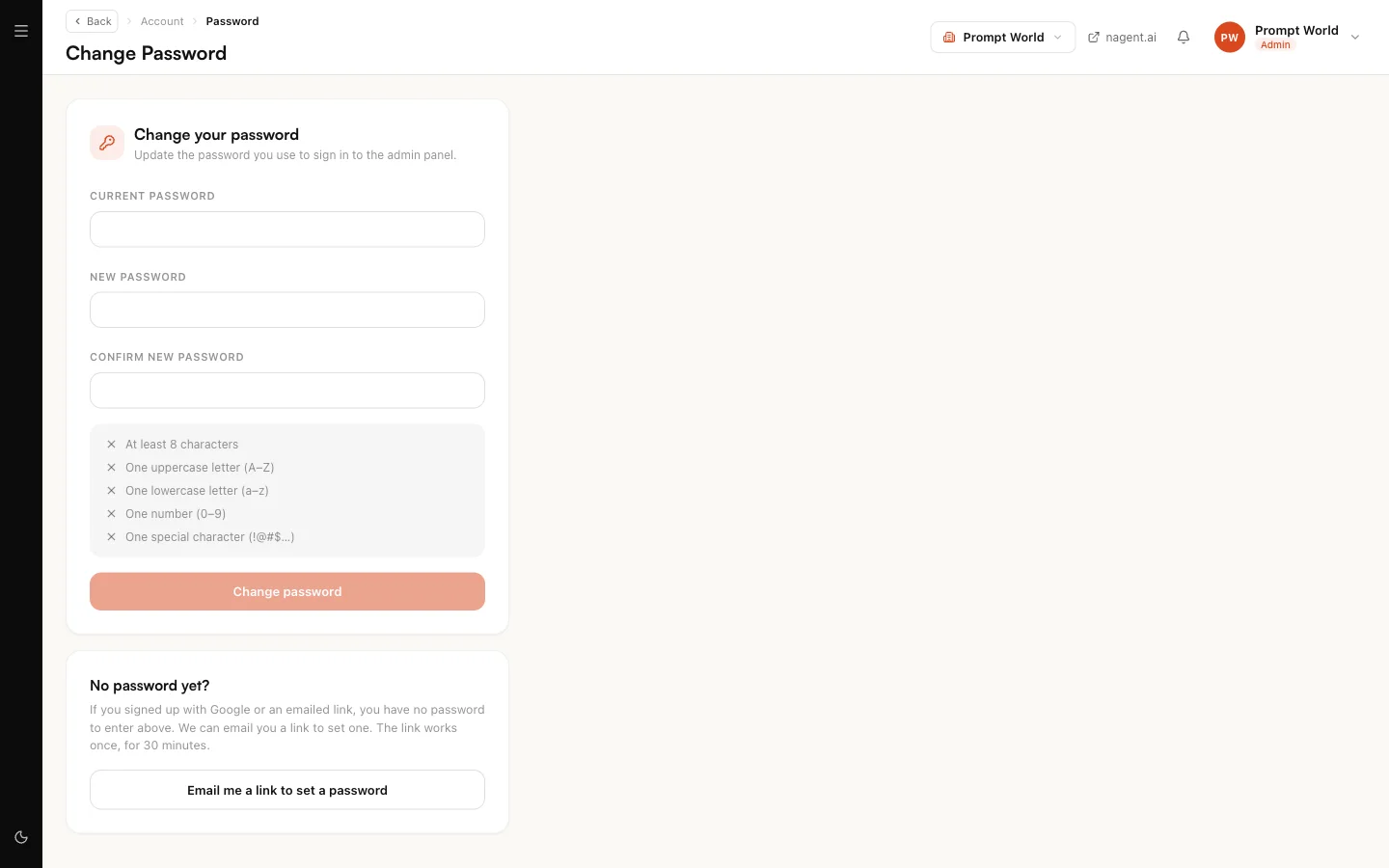
Our logic: a password is only ever set from your inbox. Being signed in is not enough, so someone using a laptop you left open cannot plant a password on your account.
Changing a password you know
Open Change password, give your current password and a new one. The new password needs at least 8 characters, an uppercase letter, a lowercase letter, a number and a special character.
Changing your password signs you out everywhere else. The browser you changed it in keeps its session; every other session you had open ends, and every remembered device is forgotten. The same happens when you reset a password from an e-mailed link, or when an Organisation admin resets it for you. If you think someone else is using your account, this is the quickest way to shut every door at once.
Too many wrong attempts
After five wrong passwords in a row the account is locked for 15 minutes. The e-mailed link still works during the lock, so you are never stuck.
Invited by a teammate
When an Organisation admin invites you, you receive an e-mail headed "You're invited to the (workspace) admin panel". It contains your e-mail address, a temporary password, and a Sign in to Admin button.
- Press Sign in to Admin, or open the sign-in page.
- Enter your e-mail and the temporary password, and press Sign in.
- Change the password straight away at Change password.
You can also ignore the temporary password and use Email me a sign-in link or Continue with Google with the invited address. All three work from your first visit.
If your admin presses Resend invite, a new temporary password is issued and the old one stops working.
What you can see and do once inside depends on the role you were given. See people and roles.
How long you stay signed in
While you are using Nagent your session renews itself, so an active working day needs no repeated sign-in. If you are away for more than about an hour, you will be asked to sign in again, unless you asked this device to remember you. Signing out on a shared computer is still a good habit.
Keep me signed in
The sign-in page has a box, Keep me signed in on this browser for 30 days, and it is ticked to start with. It applies to every way in: a passkey, Google, Slack and your password. When your session lapses, that browser signs itself back in, for 30 days from the last time it did so. Untick it on a shared computer.
A few rules keep this safe.
- A remembered device carries only what it proved. If your role needs a second step, the device is let back in without one only because it passed one, a passkey or a code, when it was remembered.
- Anything that stops a password sign-in stops this one. A deactivated account or a lock after too many wrong attempts sends you back to the form.
- Sign out forgets the device. Sign out in your account menu forgets the device before it ends the session; otherwise the browser would sign itself straight back in.
- A password reset ends every remembered device, and so does changing your password on Change password.
Trusted devices
Open your account menu and choose Trusted devices, or go to Trusted devices. It lists the devices you have signed in from. Each shows its name, whether it is trusted or unverified, remembered until a date for one that remembers you, when it was first and last seen, and its recent IP addresses.
To end a device's access, press the bin icon beside it and confirm. A removed device stops signing itself back in: the next time it is used, you sign in again in full, with an authenticator code where your role asks for one. Remove any device you do not recognise, and any you no longer use.
Removing a device also ends the session open on it, so a laptop left signed in somewhere is signed out the moment you remove it here. Remove the device you are on and you are signed out there too.
If you have never signed in from this account before, the page says "No devices on file. Sign in once and the current device will register here."
The Change password page carries a Signed-in devices card with a See and remove devices link to this page.
Messages you may see
| Message | What it means | What to do |
|---|---|---|
| Invalid email or password | The password does not match, or none is set | Use an e-mailed link, or set a password |
| This link has expired or was already used | Older than 30 minutes, used, or replaced by a newer link | Ask for a fresh link |
| Your workspace is not open | You signed up but never opened the first link, or the workspace was suspended | Open the sign-up link, or contact your administrator |
| Google has not verified that email address | Google does not vouch for it | Verify it with Google, or use an e-mailed link |
| Your role needs two-factor authentication | An older sign-in page that refused a role with no second step | Sign in again; the page sets one up |
| That passkey did not sign you in | The passkey is not one on this account, or the prompt was answered twice | Try again, or use another way in |
| That sign-in waited too long for its authenticator code | More than five minutes passed after Google or the link | Start again |
Where to go next
- Your first hour: what Home shows you.
- People and roles: inviting others.